
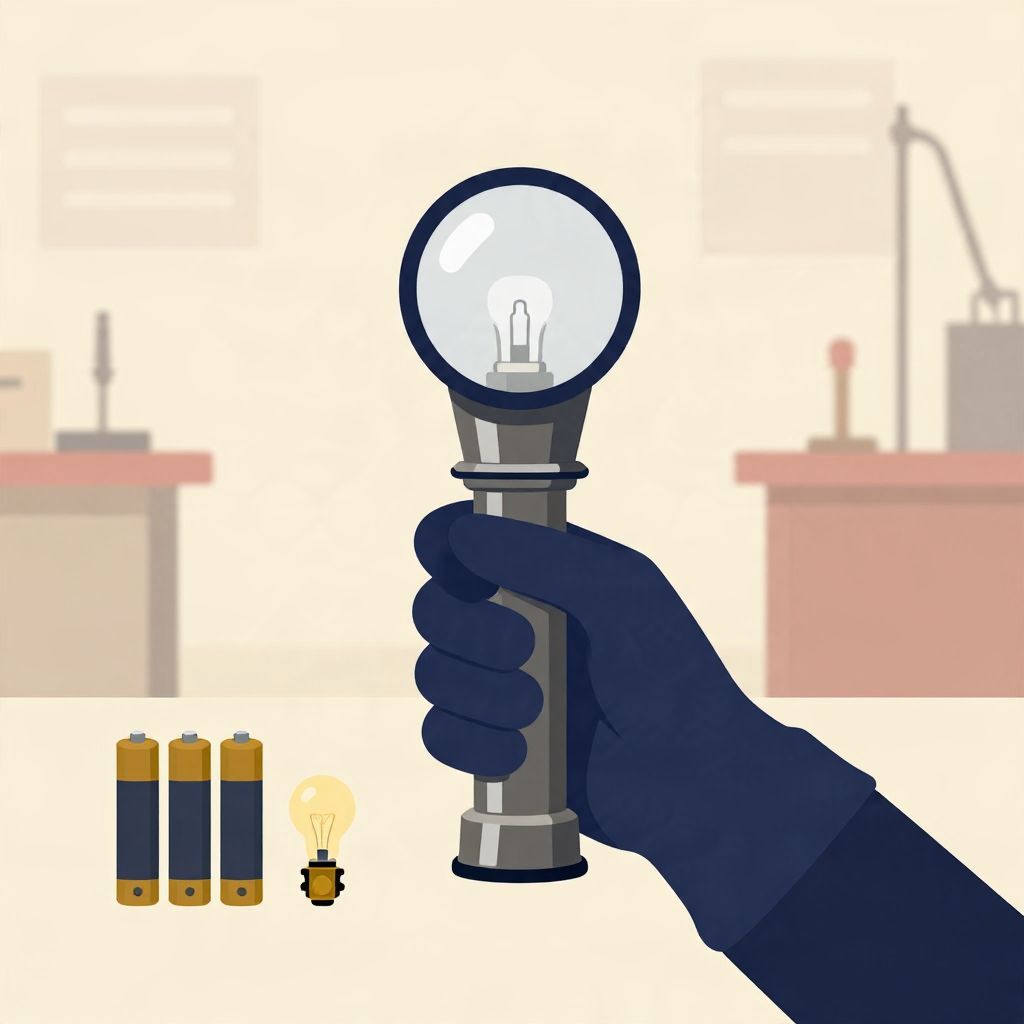
The flashlight is one of those everyday objects that feels timeless, but it has a surprisingly recent history. The question “When was the flashlight invented?” has a clear answer only if we distinguish between the first electric portable light and the modern battery-powered flashlight people recognize today.
In short, the flashlight emerged in the late 1890s, with the first practical versions appearing around 1899–1900. It became widely useful only after small dry-cell batteries, incandescent bulbs, and safer switches made portable electric light reliable enough for everyday use.
When Was the Flashlight Invented?
The flashlight was invented in the late 1890s, with the first commercially practical models appearing around 1899. The modern flashlight did not arrive all at once; it developed from earlier portable electric lamps, and its usefulness depended on improvements in batteries, bulbs, and electrical design at the turn of the 20th century.
The Historical Background: Why the Flashlight Appeared When It Did
The flashlight was not an isolated invention. It depended on several earlier breakthroughs in electricity. By the 1880s and 1890s, inventors had already developed practical incandescent light bulbs and portable dry-cell batteries. Once these technologies became small, cheap, and durable enough, inventors could combine them into a handheld lamp.
Before that, portable lighting usually meant candles, oil lamps, or gas lamps. Those sources worked, but they were smoky, fragile, and dangerous indoors. Electric light offered a cleaner alternative, yet early electrical systems were often too bulky for portable use. The flashlight emerged when technology finally made true portability possible.
Key Predecessors to the Flashlight
- Incandescent bulbs made electric light practical for small enclosed lamps.
- Dry-cell batteries allowed electricity to be carried without liquid acid spilling easily.
- Compact switches and housings made handheld operation possible.
- Mass production lowered the cost enough for ordinary consumers to buy them.
A Brief Timeline of the Flashlight’s Development
The invention of the flashlight is best understood as a sequence rather than a single moment. Several inventors and companies helped shape the device, and the modern flashlight gradually replaced earlier forms of portable light.
- 1870s–1880s: Practical electric lighting develops, especially incandescent bulbs and better batteries.
- 1890s: Portable electric lamps become feasible as dry cells improve.
- 1899: The first commercially practical flashlight is generally associated with this period.
- 1900: Flashlights begin appearing more widely in consumer markets.
- Early 1900s: Designs improve, making flashlights more reliable and affordable.
Who Invented the Flashlight?
There is no single universally agreed “inventor” of the flashlight in the way people sometimes imagine. The device evolved through contributions from multiple inventors and manufacturers. One of the most important early names is David Misell, who is often credited with an early practical flashlight design that was later associated with the American Electrical Novelty and Manufacturing Company.
Misell’s role matters because his design helped turn the idea of a portable electric light into a marketable consumer product. Still, the flashlight was not the work of one isolated genius. It was the result of a broader technological ecosystem in which battery makers, bulb manufacturers, and electrical engineers all played a part.
Why the Inventor Question Is Complicated
Historical inventions often have messy origins. A device may be patented by one person, improved by another, and commercialized by a company that did not invent the underlying technology. The flashlight fits that pattern. Depending on how one defines “invented,” the answer may refer to the first portable electric lamp, the first patented design, or the first mass-produced consumer flashlight.
How the First Flashlights Worked
Early flashlights were simple by modern standards. They used a battery, a small incandescent bulb, and a switch inside a handheld case. The light output was limited, and early batteries could be inconsistent, so the beam was often weak and short-lived. Even so, the device was revolutionary because it offered portable light without flame.
Early models were sometimes called “electric torches” in some English-speaking regions, while “flashlight” became the common term in the United States. The name itself reflects the early device’s limitations: the beam often flashed rather than shone steadily for long periods because batteries were not yet very strong.
What Made It Different from Earlier Portable Lights?
- No flame: safer than candles or kerosene lamps in many settings.
- Handheld design: easy to carry for short tasks.
- Instant light: no need to strike a match or trim a wick.
- Indoor usefulness: practical for homes, workshops, and public spaces.
Why the Late 1890s Were the Turning Point
The late 19th century was the right moment for the flashlight because electricity was moving from novelty to everyday utility. Urban electrification was expanding, and consumers were becoming familiar with electric appliances. At the same time, manufacturers were learning how to make small electrical devices in large numbers.
This broader industrial setting mattered as much as the invention itself. A flashlight could only become popular if batteries were affordable and replaceable, bulbs were durable, and the casing could survive regular use. The late 1890s brought those conditions together.
The Flashlight in the Early 20th Century
Once introduced, flashlights quickly found many uses. They were useful for household tasks, night travel, repair work, and emergency situations. Police officers, railroad workers, and soldiers also adopted them because portable light had obvious practical value in the dark.
As the 20th century progressed, flashlights became smaller, brighter, and more dependable. Battery chemistry improved, bulb life increased, and later plastic housings made the devices lighter and cheaper. What began as a novelty became a standard household tool.
Common Early Uses
- Checking dark corners in homes and basements
- Outdoor walking and travel at night
- Work in railroads, factories, and mines
- Emergency use during power outages
How the Flashlight Changed Daily Life
The flashlight changed ordinary life in a quiet but important way. It gave people portable control over darkness. That may sound simple, but it affected safety, work, and mobility. A person no longer needed a flame to move through a dark space, inspect a machine, or find something at night.
The device also helped normalize the idea that electricity could be portable. That concept later shaped many other inventions, from radios to portable medical devices. In that sense, the flashlight was part of a larger shift toward mobile modern technology.
Flashlight vs. Torch: A Note on Terminology
Readers sometimes encounter different terms for the same device. In the United States, flashlight is the standard word. In Britain and some other English-speaking regions, the same object is often called a torch. This can create confusion when reading older sources, but the device itself is the same: a handheld electric light powered by batteries.
The terminology also reflects historical language patterns. “Flashlight” became established in American usage early in the 20th century, while “torch” remained common elsewhere. The naming difference does not change the invention date, but it does matter when tracing the device’s spread across cultures.
Historical Facts About the Flashlight
Several facts help place the flashlight in context without overstating certainty. First, it was not invented in ancient times or during the early Industrial Revolution; it belongs to the age of practical electricity. Second, its development was gradual, not instantaneous. Third, the flashlight’s success depended on manufacturing as much as on invention.
It is also worth noting that early flashlights were often less impressive than modern ones. They were dim, sometimes unreliable, and limited by short battery life. Yet they were still a major step forward because they solved a real everyday problem in a new way.
What the Flashlight Was Not
- It was not a medieval or pre-electric invention.
- It was not created fully in one single year by one person alone.
- It was not immediately powerful or long-lasting by modern standards.
So, What Is the Best Answer to the Question?
If you want the shortest historically responsible answer, the flashlight was invented in the late 1890s, with the first practical commercial versions appearing around 1899. If you want the broader answer, it was the product of decades of electrical innovation that finally made portable battery-powered light possible.
That is why the flashlight belongs to the modern age: it reflects the moment when electricity moved from fixed buildings into the hand. For readers interested in other invention histories, you may also enjoy when flashlights were invented and, in a very different cultural context, when the violin was invented.