
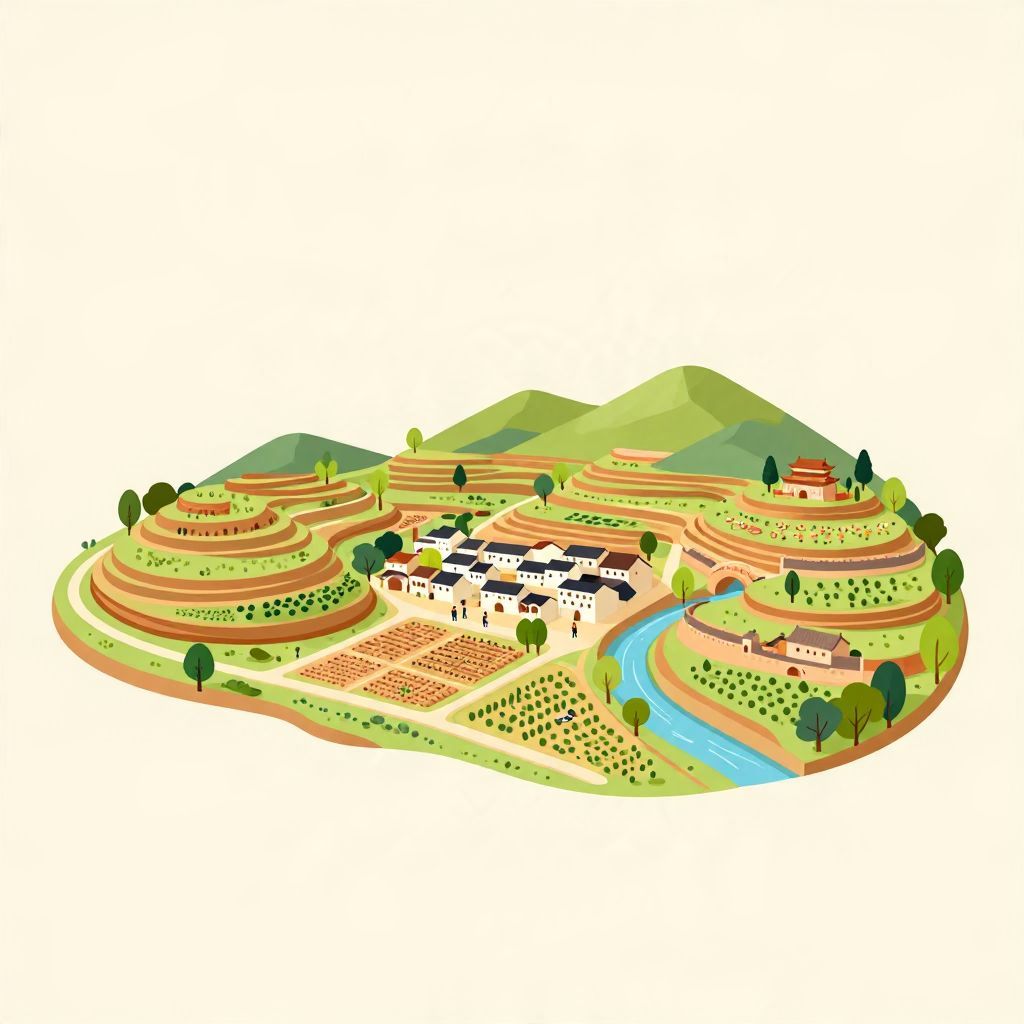
What is cultural landscape? In history and geography, it is the visible result of people shaping land over time. Fields, roads, temples, towns, terraces, irrigation systems, and sacred sites all become part of a landscape that reflects human values, labor, belief, and power.
The idea matters because cultural landscapes show that places are not “natural” in any simple sense. They are historical records, revealing how communities adapted to environments, organized society, and left meanings on the land that can still be read today.
What Is Cultural Landscape?
A cultural landscape is a geographic area shaped by the interaction of people and environment. It may include farms, cities, gardens, religious sites, transport routes, or managed forests. Historians use the term to understand how human activity transforms space into a record of social, political, economic, and spiritual life.
Origins of the Idea
The term “cultural landscape” became important in modern scholarship in the late 19th and early 20th centuries, especially in geography. Scholars such as Otto Schlüter in Germany helped distinguish between “natural landscape” and landscapes altered by human settlement and use. Later, the concept developed further in cultural geography and heritage studies.
From geography to history
Early geographers were interested in how climate, terrain, and resources shaped human life. Over time, scholars also asked the reverse question: how did people reshape land through agriculture, architecture, and infrastructure? This shift made the landscape itself a historical source, not just a backdrop for events.
Why the concept grew in the modern era
The rise of industrialization, nation-states, archaeology, and heritage conservation encouraged people to think about land as something with cultural memory. Ancient ruins, historic gardens, terraced farms, and old city centers began to be seen not only as useful places, but as evidence of long human histories.
How Historians Define Cultural Landscape
Historians and heritage experts usually define cultural landscape as a place where natural features and human activity are closely intertwined. The key idea is not simply that people live somewhere, but that their work, beliefs, and institutions leave lasting marks on the land itself.
Main types of cultural landscapes
- Designed landscapes — gardens, parks, royal estates, and planned ceremonial spaces.
- Organically evolved landscapes — places that changed gradually through long use, such as farming regions or historic towns.
- Associative landscapes — places valued for religious, artistic, or symbolic meaning, even when physical alteration is limited.
These categories are especially useful in heritage preservation, but they also help historians think about how different societies used land in different ways.
Examples Across History
Cultural landscapes appear in every major period of history. They are not limited to famous monuments. Ordinary fields, canals, villages, and roads can be just as historically important as palaces or temples.
Ancient and classical worlds
In ancient Mesopotamia, irrigation canals turned dry land into productive agriculture and supported cities. In ancient Egypt, the Nile valley became a highly organized cultural landscape shaped by farming cycles, temples, burial grounds, and state control. In Greece and Rome, roads, terraces, harbors, and urban planning altered terrain and connected regions politically and economically.
Medieval landscapes
In medieval Europe, open-field farming, monasteries, castles, and market towns transformed the countryside. In Islamic societies, water management, gardens, mosques, and caravan routes shaped both urban and rural spaces. In many parts of Asia, rice terraces, sacred mountains, and pilgrimage routes became enduring cultural landscapes tied to religion and labor.
Early modern and colonial landscapes
From the 15th century onward, empire and trade changed landscapes on a global scale. Plantation systems, colonial cities, mission settlements, and mining districts altered land use and often displaced Indigenous communities. These landscapes were not neutral: they reflected conquest, commerce, forced labor, and new political orders.
Modern industrial landscapes
The Industrial Revolution created factories, railways, canals, company towns, and dense urban districts. These places show how technology and capitalism changed the relationship between people and land. Even when later abandoned, industrial sites remain historical evidence of labor, migration, and environmental change.
Why Cultural Landscapes Matter in History
Cultural landscapes help historians study everyday life, not just rulers and battles. They show how ordinary people farmed, traveled, worshipped, traded, and built communities. They also reveal unequal power, because land use often reflects who controlled resources and who was forced to work them.
Evidence of social organization
The arrangement of fields, streets, walls, and buildings can show how a society was organized. A planned capital city suggests centralized authority. A patchwork of small farms may suggest different patterns of ownership or inheritance. Sacred spaces can reveal religious hierarchy, pilgrimage, or ritual practice.
Evidence of environmental adaptation
Cultural landscapes also show how people adapted to climate and geography. Terraces in mountainous regions, raised fields in wetlands, and irrigation in dry zones all demonstrate practical knowledge. Such landscapes are historical proof that human societies did not merely occupy environments; they learned to modify them.
Evidence of memory and identity
Many landscapes carry symbolic meaning. A battlefield, burial ground, ancestral village, or pilgrimage route can become part of collective memory. In this sense, cultural landscape is not only about physical change. It is also about how communities attach meaning to place across generations.
Cultural Landscape and Heritage Preservation
In the 20th century, cultural landscape became important in preservation policy. Heritage organizations recognized that historic value is not limited to isolated buildings. Entire settings—fields, streets, water systems, and sacred views—may need protection because their meaning depends on the larger landscape around them.
From monuments to living places
Earlier preservation efforts often focused on single monuments such as castles, temples, or cathedrals. Later approaches argued that the surrounding land is part of the historical record. A temple without its processional route, or a historic town without its street pattern, may lose much of its meaning.
Living landscapes
Some cultural landscapes are still actively used. Agricultural terraces may continue to produce crops. Historic neighborhoods may still house residents. Sacred groves or pilgrimage routes may remain part of living religious practice. This makes preservation more complicated, because protecting history must be balanced with the needs of present-day communities.
How Cultural Landscapes Change Over Time
Cultural landscapes are never fixed. They evolve through war, migration, trade, climate shifts, urban growth, and changing beliefs. A landscape may begin as farmland, become a town, later industrialize, and eventually be preserved as heritage. Each phase adds another layer of history.
Forces that reshape landscapes
- Conquest and colonization — new rulers often rename, reorganize, or repurpose land.
- Economic change — trade, industry, and tourism can transform local space.
- Population movement — migration brings new building styles, farming methods, and religious practices.
- Environmental change — floods, droughts, deforestation, and climate shifts can alter how land is used.
- Political decisions — zoning, conservation, and redevelopment shape what survives.
Because of these forces, cultural landscapes are often layered and contested. Different groups may assign different meanings to the same place.
Contested Meanings and Historical Interpretation
Not every cultural landscape is celebrated equally. Some landscapes are admired for beauty or heritage, while others remind people of oppression, displacement, or exploitation. Plantation landscapes, colonial boulevards, and former battle sites can be interpreted in very different ways depending on whose history is being told.
Whose landscape is it?
This question is central to modern historical interpretation. A landscape may be sacred to one community, profitable to another, and painful to a third. Historians try to account for these overlapping meanings rather than treating place as if it had only one story.
Archaeology and written history together
Cultural landscapes are often studied through both archaeology and documents. Maps, land records, travelers’ accounts, and local traditions can help explain how a place changed. Physical remains—walls, paths, terraces, irrigation channels, or ruins—confirm that landscapes are historical evidence, not just scenery.
The Lasting Importance of Cultural Landscape
The concept of cultural landscape teaches that history is written on the land. It connects environment, economy, religion, politics, and memory in one framework. By studying landscapes, historians can see how people made places and how places, in turn, shaped human life.
In short, a cultural landscape is a historically formed place where nature and human action meet. It is both a product of the past and a living record of how societies have organized, remembered, and transformed the world around them. For related topics, see What Is Cultural Preservation Architecture and What Is Cultural Diffusion.