
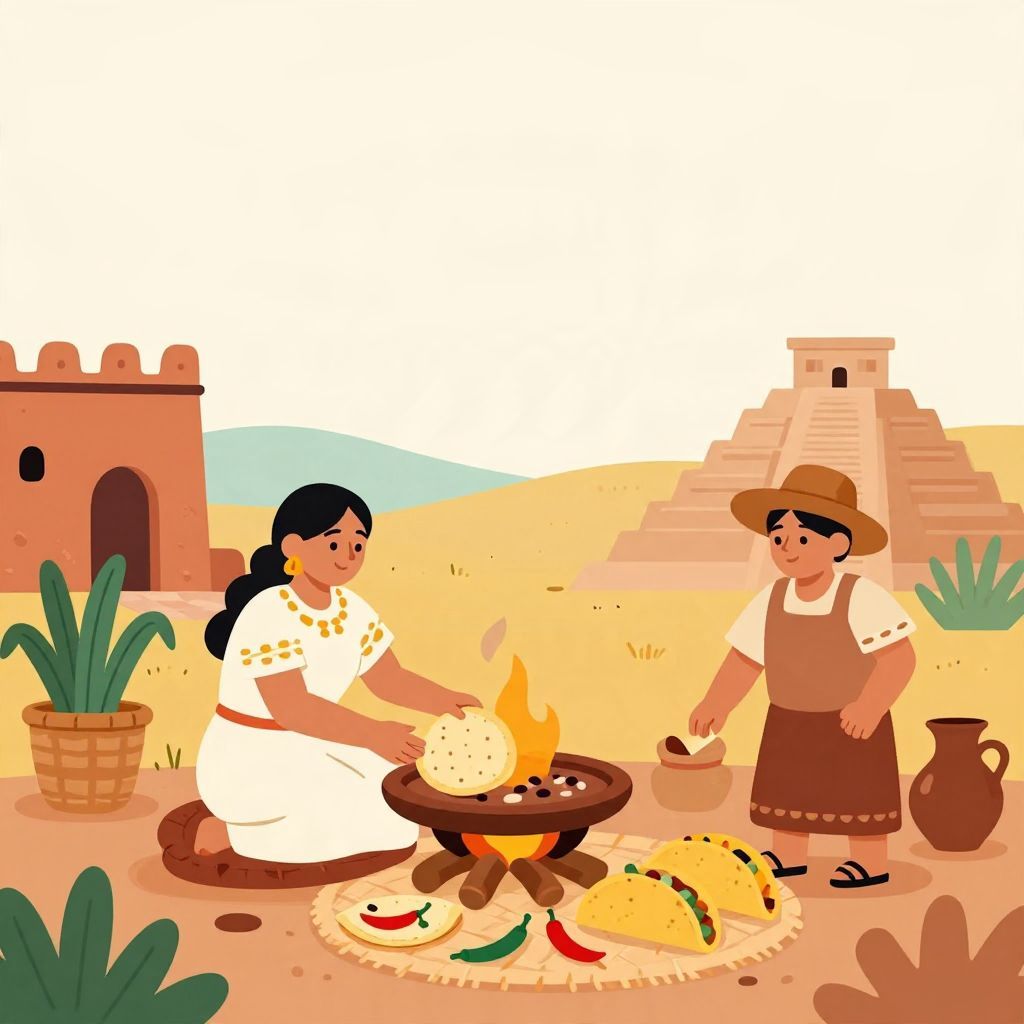
When were tacos invented? The short answer is that tacos were not invented in one exact moment by one person. They emerged gradually in central Mexico, likely from Indigenous tortilla-based eating traditions long before the Spanish arrived, and the modern taco took shape over centuries.
Because tacos developed from everyday food culture rather than a single documented invention, historians can only give an approximate timeline. What we do know is that the taco is deeply rooted in Mexico’s pre-Columbian past and became a recognizable street food in the colonial and modern eras.
When Were Tacos Invented?
Tacos were invented gradually, not at a single date. Their deepest origins go back to pre-Hispanic Mexico, where Indigenous peoples ate tortillas filled or topped with fish, beans, insects, and other foods. The taco as we know it likely became common during the colonial period, especially from the 16th to 19th centuries.
The Indigenous Roots of the Taco
The taco’s history begins with maize, the foundation of Mesoamerican food culture. Long before Europeans arrived, people in central Mexico made tortillas from corn and used them as an edible base for wrapping food. This practice was practical, portable, and suited to daily life in farming communities, markets, and on the move.
Why tortillas mattered
Tortillas were more than a side dish. They functioned much like a utensil, a plate, and a wrapper all at once. In many Indigenous traditions, food was eaten by hand, and a tortilla could hold ingredients inside or scoop them up. That basic method is the clearest ancestor of the taco.
What people ate before modern tacos
Pre-Columbian diets varied by region, but historical and archaeological evidence shows that people in Mesoamerica consumed a wide range of fillings: beans, squash, chili peppers, turkey, fish, edible insects, and wild greens. These were not “tacos” in the modern commercial sense, but they show the same core idea: a tortilla used to carry other foods.
How the Taco Took Shape in Colonial Mexico
After the Spanish conquest in the 16th century, Mexico’s food culture changed through new ingredients, animals, and social systems. Pork, beef, cheese, and wheat flour entered local diets, while Indigenous corn traditions remained central. The taco evolved in this mixed environment, blending old tortilla customs with new fillings and cooking methods.
From Indigenous practice to named food
The word “taco” appears in historical usage later than the tortilla itself. Scholars generally associate the term with Mexican Spanish usage that developed over time, rather than with a single founding event. In other words, the food existed first in practice, and the label came later as regional street foods and everyday meals became more distinct.
Colonial cities and street food culture
As towns and cities grew, so did the market economy. Workers, travelers, and urban residents needed inexpensive, quick meals. Tortillas filled with simple ingredients fit that need perfectly. By the colonial period, the taco had become part of ordinary foodways, especially among working people and in marketplaces.
When Did the Modern Taco Appear?
The “modern taco” is best understood as a 19th- and early 20th-century development. By then, tacos were widely recognized in Mexico as a familiar, flexible food, and regional styles became more visible. The taco did not suddenly appear in this era, but it became more standardized, more commercial, and more closely associated with urban street vending.
Regional variation mattered
Mexico is geographically and culturally diverse, so tacos never had one single recipe. Different regions developed their own styles based on local ingredients and traditions. Some tacos were made with corn tortillas, others with flour tortillas in northern areas. Fillings ranged from grilled meat and stews to seafood and vegetables.
Street vendors helped define the taco
Street vending played a major role in making tacos a national staple. Vendors could prepare food quickly and cheaply, which made tacos ideal for laborers and city dwellers. This practical advantage helped the taco spread across social classes and regions, turning it from a local habit into a widely recognized Mexican food.
What Is the Earliest Evidence for Tacos?
There is no single archaeological object labeled “the first taco.” That is why the question of when tacos were invented is partly a matter of definition. If a taco means a tortilla used to hold food, then its origins are ancient. If it means the modern dish with a specific name and style, then the answer is much later.
Why historians avoid one exact invention date
Everyday foods rarely leave behind a neat invention record. Unlike a machine or a patent, a dish develops through repeated use in homes, markets, and communities. Historians therefore rely on broader evidence: food traditions, linguistic history, colonial records, and the continuity of tortilla-based eating in Mexico.
Popular origin stories are not the same as history
Some popular stories try to assign tacos to a single inventor or a dramatic moment. Those tales are appealing, but they are usually folklore rather than documented history. The stronger historical explanation is simpler: tacos emerged from long-standing Indigenous food practices and changed gradually as Mexico’s society changed.
A Brief Taco Timeline
The history of tacos can be summarized as a long evolution rather than a single event. This timeline shows the broad stages historians use to explain their development:
- Pre-Columbian era — Indigenous peoples in Mesoamerica use corn tortillas as a base for carrying and eating food.
- 16th century — Spanish conquest transforms Mexican society, but corn tortilla traditions continue and adapt.
- Colonial period — Tortilla-based filled foods become common in towns, markets, and among working people.
- 19th century — Tacos become more clearly identifiable as a named, everyday Mexican food.
- 20th century — Urbanization, migration, and restaurants help spread tacos nationally and internationally.
Why the Taco Became So Important
The taco’s historical significance comes from its flexibility. It is inexpensive, portable, and adaptable to local ingredients. That made it useful in Indigenous communities, colonial cities, and modern urban life alike. Few foods reflect continuity and change in Mexican history as clearly as the taco.
A food of continuity
The taco preserved an ancient relationship with maize and tortillas. Even as new ingredients arrived from Europe and beyond, the basic structure remained recognizable. That continuity links modern Mexican cuisine to deep Indigenous roots and reminds us that cultural change often builds on older traditions rather than replacing them entirely.
A food of adaptation
At the same time, tacos show how Mexican cuisine adapted to conquest, migration, commerce, and regional diversity. Beef tacos, pork tacos, fish tacos, and countless other variations all reflect local histories. The taco’s success lies in its ability to absorb change without losing its essential form.
The Taco Beyond Mexico
In the 20th century, tacos spread far beyond Mexico through migration, tourism, restaurants, and mass culture. In the United States especially, tacos became a major part of Mexican-American and broader American food culture. As they traveled, they changed again, sometimes in ways that differed from older Mexican regional traditions.
Global popularity and transformation
International versions of tacos can be delicious and meaningful, but they are also part of a separate history of adaptation. The global taco is not identical to every traditional Mexican taco. Understanding that difference helps preserve the food’s historical depth while recognizing its modern reach.
So, When Were Tacos Invented?
Tacos were invented gradually, with roots in pre-Hispanic Mexico and a recognizable form that developed over centuries. If you are asking about the oldest origins, the answer is ancient Indigenous tortilla culture. If you mean the taco as a named, everyday dish, the best estimate is the colonial to 19th-century period.
That long history is what makes the taco so significant: it is not just a popular food, but a living record of Mexican continuity, adaptation, and identity. If you want to explore related topics, you can also read about where tacos originated and what Cinco de Mayo is celebrating.