
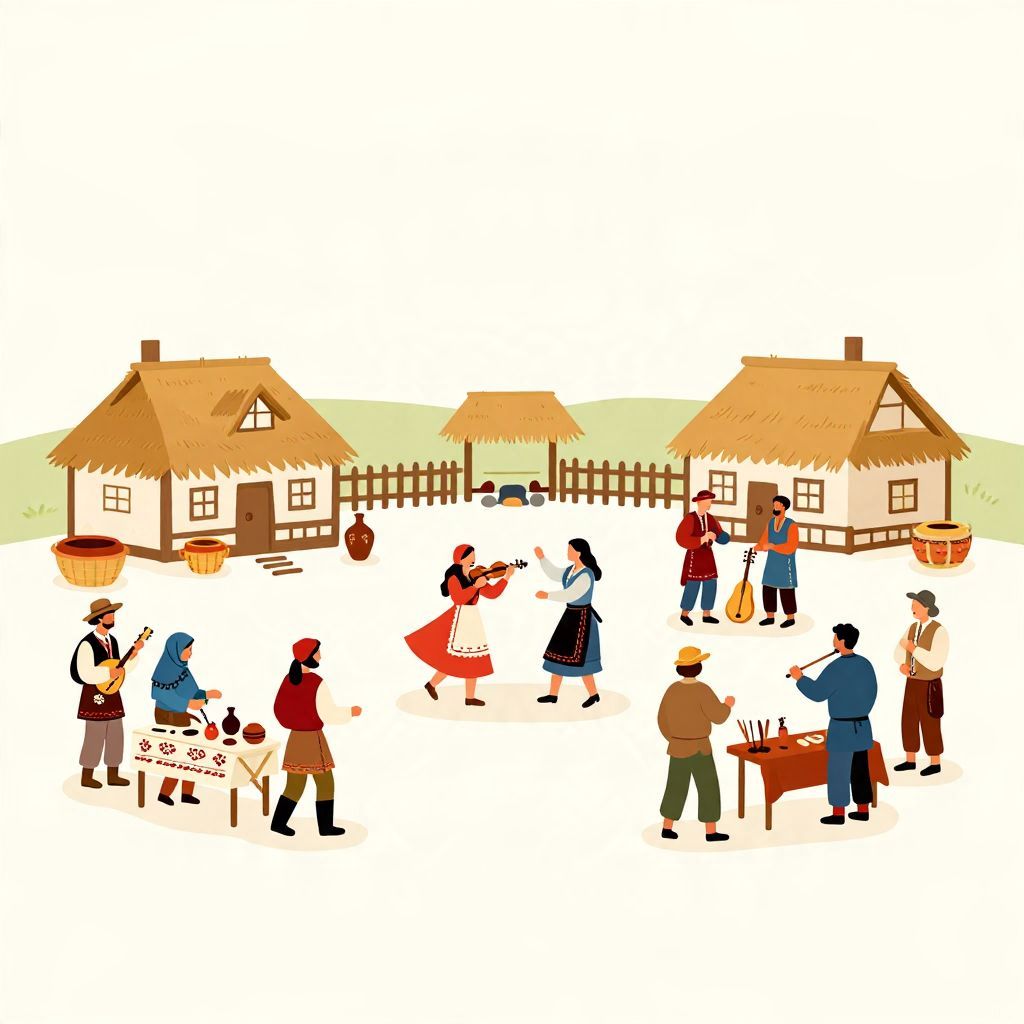
What is folk culture? At its simplest, folk culture is the shared way of life of ordinary people in a community, shaped by tradition, local experience, and everyday needs. It includes customs, stories, music, food, dress, crafts, beliefs, and celebrations passed from one generation to the next.
Unlike elite or mass culture, folk culture usually develops within smaller communities and changes slowly. It is not frozen in time, but it often preserves older practices that reveal how people lived, worked, worshiped, and made meaning in the past.
What Is Folk Culture?
Folk culture is the traditional culture of a community, especially practices created and maintained by ordinary people rather than by political elites, commercial industries, or formal institutions. It is usually local, practical, and rooted in shared memory. Historians study it to understand everyday life, identity, and continuity across generations.
Origins and Historical Meaning of Folk Culture
The idea of folk culture emerged as scholars in the 18th and 19th centuries became interested in the customs of rural people, peasants, and local communities. In Europe, this interest grew alongside romantic nationalism, when writers and collectors began recording songs, tales, and traditions they believed reflected a nation’s “authentic” spirit. That approach shaped modern folklore studies, though it sometimes idealized rural life.
From “the folk” to folklore
The word folk refers to people, especially common people in a shared community. Folklore became a term for the stories, sayings, songs, and customs of those people. Over time, historians and anthropologists used “folk culture” to describe the broader pattern of life behind folklore: how people ate, dressed, celebrated, worshiped, and organized daily life.
Why historians care about it
Folk culture matters because it often preserves older habits that do not appear in official records. Kings, governments, and churches left many written documents, but ordinary people left fewer. To recover their lives, historians use oral traditions, material objects, architecture, songs, recipes, tools, and local festivals. These sources help reconstruct how communities adapted to environment, religion, and social change.
Key Features of Folk Culture
Folk culture is not one single tradition. It varies by region, language, religion, occupation, and environment. Still, several features appear again and again in historical study.
- Local and community-based: It grows within a particular place or group.
- Tradition-oriented: Customs are passed down through family and community memory.
- Practical: Many practices arise from daily needs such as farming, shelter, or ritual life.
- Shared and participatory: People often learn by imitation, habit, and participation rather than formal instruction.
- Slow to change: It can adapt, but usually more gradually than commercial culture.
Examples across daily life
Folk culture can be seen in regional clothing, seasonal festivals, wedding rituals, healing practices, house forms, dances, lullabies, and craft traditions. A village harvest festival, a local style of embroidery, or a family recipe handed down for generations may all be part of folk culture. The point is not that these practices are ancient or unchanging, but that they are rooted in community continuity.
How Folk Culture Developed in History
Folk culture is older than the term used to describe it. For most of human history, nearly all culture was local and traditional because communication was slow and most people lived in small communities. Before modern transportation, mass media, and industrial production, daily life was shaped by local conditions, seasonal work, and inherited custom.
Pre-industrial societies
In agrarian societies, folk culture was often closely tied to the agricultural calendar. Planting, harvest, religious feasts, and life-cycle rituals marked the year. Songs, dances, and stories helped communities remember moral lessons, explain the world, and strengthen social bonds. In many places, folk traditions blended with official religion rather than existing apart from it.
Industrialization and change
The Industrial Revolution transformed folk culture by drawing people into cities, expanding literacy, and spreading standardized goods and entertainment. As factories, railways, newspapers, and later radio and film widened cultural exchange, local traditions faced new pressures. Some customs declined, while others survived by adapting to new settings. Folk culture did not disappear; it became one tradition among many in a more connected world.
Nationalism and collection of traditions
In the 19th century, many intellectuals and governments treated folk culture as a source of national identity. Collectors gathered ballads, legends, costumes, and tales to prove that a nation had deep historical roots. This helped preserve many traditions, but it also created problems: collectors sometimes edited or reshaped material to fit nationalist ideas. Historians now read such collections carefully, recognizing both their value and their bias.
Folk Culture, Popular Culture, and High Culture
People often compare folk culture with popular culture and high culture, but the boundaries are not always sharp. These categories help explain differences in how culture is made and shared, yet real societies often mix them.
Folk culture
Usually local, traditional, and community-based. It is passed along informally and often connected to everyday life.
Popular culture
Produced for large audiences through mass media, markets, and entertainment industries. It spreads quickly and changes rapidly.
High culture
Associated with elite institutions such as courts, academies, opera houses, or literary traditions. It is often supported by education, patronage, and formal training.
These categories are useful, but they should not be treated as rigid. A folk song may become popular music. A court dance may be adapted by villagers. A religious ritual may move between elite and local settings. Culture has always moved across social boundaries.
Examples of Folk Culture Around the World
Folk culture appears in every region, though its forms differ widely. A few examples show how broad the concept can be.
- Oral storytelling: Myths, legends, and folktales shared by word of mouth.
- Traditional music and dance: Regional songs, instruments, and communal dances.
- Craft traditions: Pottery, weaving, woodwork, basketry, metalwork, and embroidery.
- Foodways: Local ingredients, cooking methods, and festive dishes.
- Ritual and belief: Seasonal ceremonies, healing customs, and rites of passage.
- Architecture and settlement patterns: Vernacular houses, barns, courtyards, and village layouts shaped by climate and labor.
Folk culture and religion
Religious life often overlaps with folk culture. In many societies, official doctrines coexist with local saints’ festivals, pilgrimage customs, charms, blessings, and household rituals. Historians call this overlap “popular religion” or “folk religion” when local practice differs from formal teaching. This does not mean people were less religious; rather, they expressed faith through local traditions.
How Historians Study Folk Culture
Because folk culture is often transmitted orally or through practice, historians and anthropologists use a wide range of evidence. They compare written records with songs, objects, images, and memory. This helps them avoid assuming that the absence of documents means the absence of culture.
Common sources
- Oral histories and recorded interviews
- Folktales, songs, and proverbs
- Material culture such as tools, clothing, and household objects
- Architecture and settlement patterns
- Festival and ritual records
- Ethnographic observation of living traditions
These sources require careful interpretation. A tradition may look ancient but may actually be relatively recent. Another may seem “pure” but in fact may have absorbed influences from trade, migration, conquest, or religion. Folk culture is best understood as historical and changing, not timeless.
Why Folk Culture Still Matters
Folk culture helps explain how communities preserve identity under changing conditions. It can survive migration, colonization, urbanization, and modernization by adapting to new circumstances. A festival may move from a village square to a city neighborhood. A recipe may change ingredients but keep its symbolic meaning. A song may be rewritten for a new generation while retaining its structure.
It also matters because it reminds us that history is not only made by rulers and institutions. Ordinary people shaped the past through habits, memory, labor, and creativity. Folk culture preserves that human scale. It shows how people made meaning in daily life, how they responded to hardship, and how they passed knowledge forward.
Conclusion: The Historical Importance of Folk Culture
Folk culture is the traditional, everyday culture of ordinary people, built through shared memory, local practice, and long use. Its history stretches back to pre-industrial life, but the concept itself was shaped by modern scholars who sought to record traditions before they changed or disappeared. To understand folk culture is to understand how people lived, not just how states ruled. For related topics, see what cultural preservation in architecture means and what a cultural landscape is.