
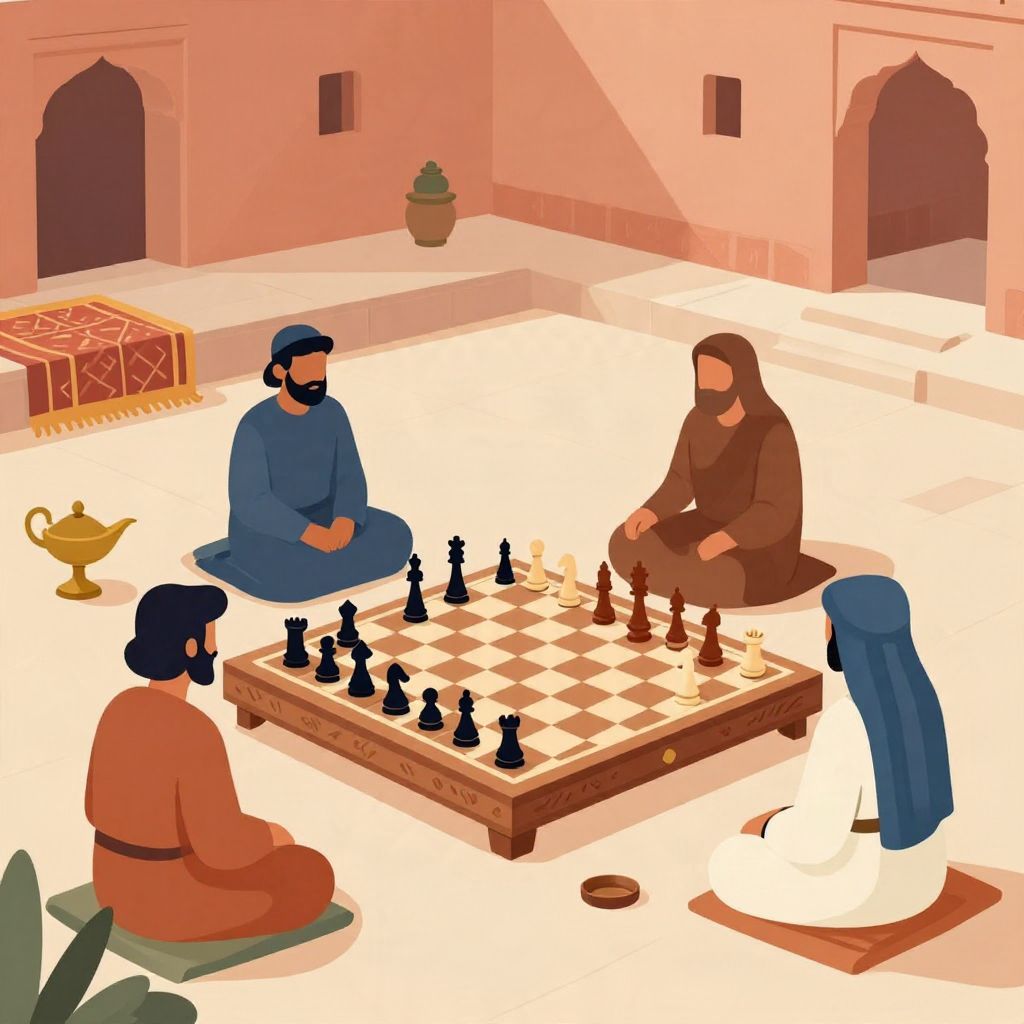
How old is chess? The short answer is that chess is about 1,500 years old, if we trace it back to its earliest known ancestor in India. The game did not appear fully formed overnight; it developed gradually from earlier strategy games and changed as it moved across Asia, the Islamic world, and Europe.
Because its early history is partly reconstructed from literary references, surviving pieces, and later rule changes, the exact “birth date” of chess is not known. But historians generally agree that the game’s roots lie in the 6th century CE, making chess one of the world’s oldest still-played board games.
How old is chess?
Chess is usually dated to around 1,500 years ago, with its earliest ancestor emerging in India during the 6th century CE. The game then spread through Persia, the Islamic world, and medieval Europe, where its rules evolved into the modern form played today.
Where chess began
The most widely accepted origin story places chess in northern India, where an early form of the game called chaturanga appeared sometime in the 6th century. Scholars do not know the exact year, and some details remain debated, but this is the strongest historical starting point for chess.
Chaturanga and its meaning
Chaturanga is a Sanskrit word often translated as “four divisions,” referring to the traditional parts of an Indian army: infantry, cavalry, elephants, and chariots. This military structure likely influenced the game’s pieces and strategy. In that sense, chess began as a simulation of battlefield command, not as a purely abstract puzzle.
What historians know and what they do not
There is no surviving original “first chess set” or single founding document. Instead, historians piece together the game’s early history from later texts, linguistic clues, and the way related games spread across cultures. That means the broad origin is well supported, while precise details are less certain.
The early timeline of chess
The history of chess is best understood as a gradual evolution rather than a single invention. Here is the basic timeline most historians accept:
- 6th century CE: Early chess-like game, probably chaturanga, develops in India.
- 7th century: The game spreads into Persia, where it becomes known as shatranj.
- 7th–8th centuries: After the Islamic conquest of Persia, chess spreads widely through the Islamic world.
- 9th–12th centuries: Chess enters Europe through Spain, Sicily, and other contact zones.
- 15th century: Major rule changes in Europe create the faster, more powerful modern game.
- 19th century onward: Standardized rules, tournaments, and clocks turn chess into a modern competitive sport.
From India to Persia
Chess did not remain confined to its place of origin. It traveled westward into Sasanian Persia, where it became shatranj. Persian literature and later Arabic writings preserve some of the clearest early references to the game, which is one reason historians take the Persian stage of chess history very seriously.
The Persian influence
In Persia, chess became associated with elite culture, intellectual skill, and courtly life. The terminology of the game changed, but the basic structure remained recognizable. This Persian phase is important because it helped preserve and transmit chess after the fall of the Sasanian Empire.
Why the Islamic world mattered
As the Islamic world expanded, chess spread across a vast network of cities from the Middle East to North Africa and beyond. Scholars, merchants, and courtiers all helped carry the game. Arabic writers discussed chess problems, strategy, and etiquette, showing that it had become both a pastime and a subject of serious thought.
How chess reached Europe
Chess arrived in Europe by the early Middle Ages, likely through al-Andalus in Islamic Spain, through Sicily, and through wider trade and cultural contact. By the 10th and 11th centuries, it was known among European elites, and by the later Middle Ages it had spread more broadly.
Medieval chess was not yet modern chess
The medieval European version of chess was slower than the game played today. Pieces moved more cautiously, and some of the most powerful modern moves did not yet exist. The game was still recognizable, but its pace and tactics were very different.
Chess as a symbol of society
In medieval Europe, chess often appeared in moral writings, courtly literature, and educational contexts. It was used to teach discipline, hierarchy, and strategic thinking. At the same time, it became a social marker of refinement, especially among nobles and educated elites.
When chess became the modern game
The biggest transformation in chess happened in 15th-century Europe. During this period, several rules changed at once, creating a faster and more dynamic game. The queen became far more powerful, bishops gained long-range movement, and pawns received new options. These changes produced the modern version of chess.
Why the rules changed
Historians think the rule changes reflected a broader cultural shift toward speed, aggression, and more decisive play. The old game could be slow and positional; the new one rewarded sharper attacks and greater tactical complexity. This made chess more exciting and more suitable for competitive play.
The queen’s rise
The most famous rule change was the transformation of the queen from a relatively limited piece into the strongest piece on the board. This change altered the balance of the game dramatically. It also helped make chess more popular, because the new rules created more dramatic possibilities and quicker outcomes.
How old is the modern form of chess?
If you mean the game as it is played today, modern chess is about 500 years old. The core rules stabilized in the late 15th and early 16th centuries, though some details continued to vary for a long time. Standardization came much later, especially in the 19th century.
Standard rules and competition
During the 1800s, chess became increasingly organized. Tournament play expanded, chess clocks were introduced, and written opening theory developed rapidly. These changes did not create chess, but they turned it into the globally recognized competitive game we know now.
Common myths about the age of chess
Because chess feels ancient, people sometimes give it much older origins than the evidence supports. Some legends claim the game is thousands of years older than historians can prove. Those stories are interesting, but they should be treated cautiously.
Myth: chess is ancient Egyptian or biblical
There is no reliable historical evidence that chess began in ancient Egypt, biblical times, or classical Greece. Those claims usually come from later speculation or symbolic storytelling. The documented historical trail points instead to early medieval India and Persia.
Myth: one person invented chess
Chess was almost certainly not invented by a single named individual. It evolved over time, much like language or cuisine. Different regions shaped the game as it spread, which is why chess history is a story of adaptation as much as invention.
Why chess has lasted so long
Chess has survived for more than a millennium because it combines simple rules with deep complexity. It can be learned relatively quickly, but mastery takes years. That balance has helped it remain relevant across cultures, classes, and historical eras.
A game that traveled well
Chess also adapted easily to new societies. Its pieces could be renamed, its symbolism reinterpreted, and its rules adjusted without losing its identity. Few games have shown such long-term resilience across so many different historical settings.
So, how old is chess really?
Chess is about 1,500 years old in its earliest known form, and the modern version is roughly 500 years old. The game began in India, developed through Persia and the Islamic world, and was reshaped in Europe into the chess played today. Its age is part of what makes it remarkable: chess is both ancient and still alive.
If you want to explore more questions about origins and early historical development, you may also enjoy reading about the origin of Yukevalo Island and what was the first war.