
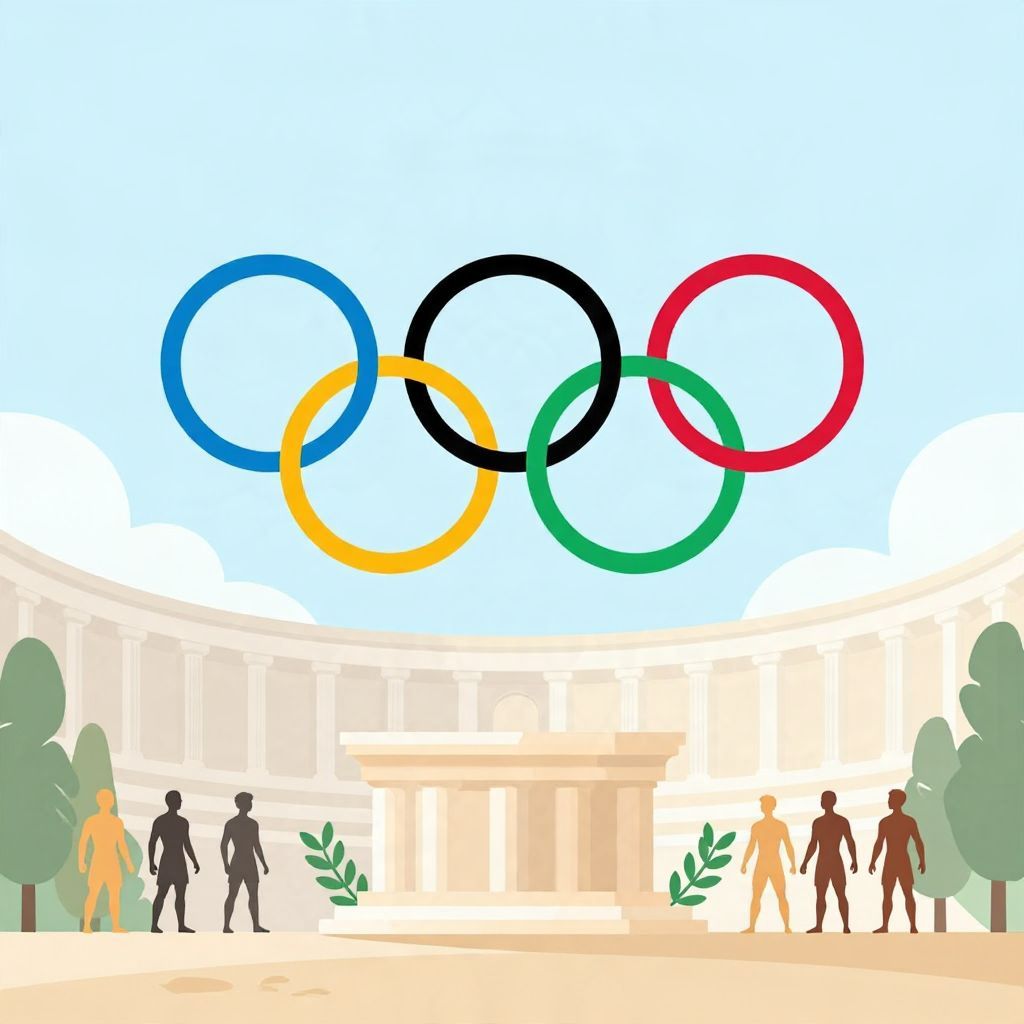
What do the 5 Olympic rings represent? In the simplest historical sense, they are the symbol of the Olympic Games and of the idea that athletes from around the world can compete together. The five interlocking rings are meant to suggest unity, not five specific continents in a strict scientific or political sense.
The emblem was created in the modern Olympic era, not in ancient Greece. Its meaning developed over time through the work of Pierre de Coubertin and the International Olympic Committee, becoming one of the most recognizable symbols in global sport.
What do the 5 Olympic rings represent?
The five Olympic rings represent the unity of the Olympic movement and the coming together of athletes from across the world. Traditionally, the five rings are associated with the inhabited continents, though this is a symbolic idea rather than a precise geographic map. Their interlocking design emphasizes connection, cooperation, and international competition under one banner.
Origins of the Olympic rings
The Olympic rings are a modern symbol, created in the early 20th century by Pierre de Coubertin, the French educator and founder of the modern Olympic Games. He introduced the emblem in 1913, and it was first publicly used in connection with the Olympic movement soon afterward. The rings were never part of the ancient Olympic Games held in Greece; they belong to the modern revival of the Olympics.
Why Coubertin created the symbol
Coubertin wanted a visual emblem that could express the international character of the revived Games. The Olympics were intended to be more than a sporting event: they were also meant to promote peace, fair competition, and mutual respect among nations. The rings gave that ideal a simple, memorable form.
The first public appearance
The emblem was introduced in the years before the First World War, but its wider recognition came gradually. The Olympic flag bearing the rings was first flown at the 1920 Antwerp Games, helping establish the design as the official face of the modern Olympics.
What each ring symbolizes
Today, the five rings are commonly explained as representing the five inhabited continents: Africa, the Americas, Asia, Europe, and Oceania. This interpretation is widely repeated in Olympic education and media, but it should be understood as symbolic rather than literal. The rings do not assign a single ring to a single continent in any official, fixed way.
The continents and the symbolic idea
- Africa — part of the global Olympic community and a longstanding source of elite athletic talent.
- The Americas — often treated as one symbolic region in Olympic usage, though geographically they include North, Central, and South America.
- Asia — the largest continent by population and a major force in modern Olympic competition.
- Europe — central to the origins of the modern Olympic revival.
- Oceania — including Australia, New Zealand, and Pacific island nations in Olympic representation.
Because the Olympics are a global event, the symbolism is deliberately broad. The goal was not to create a perfect geographic classification, but to show that the Games were open to the world.
A common misconception
A popular myth says that each ring corresponds to one specific continent by color. That is not historically accurate. The colors of the rings and the white background of the flag were chosen so that, when combined, they could appear on the flags of every nation. The symbol was designed to be inclusive, not to divide the world into fixed color-coded regions.
The meaning of the colors and design
The Olympic rings are usually shown in blue, yellow, black, green, and red on a white background. Coubertin explained that the choice of colors was meant to ensure that at least one of the ring colors appeared on every national flag in use at the time. That does not mean each color has a separate official meaning attached to a continent.
Why the rings are interlocking
The interlocking shape is one of the most important parts of the emblem. It visually communicates connection, friendship, and shared participation. In the context of the early 20th century, when nationalism and international rivalry were intense, this was a powerful statement. The design suggested that nations could meet in peaceful competition without losing their distinct identities.
Timeline: how the Olympic rings became official
The history of the rings is closely tied to the growth of the modern Olympic movement. A brief timeline helps show how the symbol moved from an idea to a global emblem.
- 1894 — Pierre de Coubertin helps found the International Olympic Committee and advances the revival of the Olympic Games.
- 1913 — Coubertin designs the Olympic rings as a symbol of the modern Games.
- 1914 — The emblem is presented in Olympic circles and begins to circulate more widely.
- 1920 — The Olympic flag with the rings is flown at the Antwerp Games, giving the symbol official visibility.
- 20th century onward — The rings become the standard emblem of the Olympic movement worldwide.
Historical significance of the Olympic rings
The Olympic rings matter because they helped give the modern Games a clear identity. Before the symbol became established, the revived Olympics were still building traditions. The rings offered a unifying image that could be used across posters, ceremonies, medals, and flags, making the Olympics instantly recognizable across languages and borders.
Symbol of internationalism
The rings also reflect a broader historical trend in the late 19th and early 20th centuries: the growth of international organizations and global competitions. The Olympic movement belonged to the same world that produced the Red Cross, international peace conferences, and other efforts to manage relations across national boundaries. The rings became one of the most enduring symbols of that era’s ideal of international cooperation.
Symbol of political tension as well as unity
Although the rings represent unity, the Olympic Games themselves have often been shaped by politics, boycotts, propaganda, and conflict. That tension is part of their history. The symbol promises harmony, but the events under it have frequently reflected the real divisions of the modern world. In that sense, the rings are both idealistic and historically revealing.
Ancient Olympics vs. modern Olympic rings
It is important not to confuse the ancient Olympic Games with the modern emblem. The ancient Games, held at Olympia in Greece from at least the 8th century BCE, had no Olympic rings, no modern national teams, and no global flag system. The rings belong entirely to the revived Olympic movement of the 19th and 20th centuries.
What connects the two eras
The modern Olympics borrowed the name, some ceremonial ideas, and the prestige of ancient Greek athletics. But the symbol of the rings was a modern invention, created to serve a new international sporting culture. It is a reminder that the Olympics are both ancient in inspiration and modern in structure.
Why the Olympic rings still matter today
The five rings remain powerful because they are simple, flexible, and widely understood. They appear on Olympic flags, stadiums, broadcasts, merchandise, and medals, but their deeper meaning has stayed consistent: the Games are meant to bring together athletes from many places in a spirit of shared competition. Even people who know little about Olympic history can usually recognize the symbol immediately.
At the same time, the rings also carry the weight of Olympic history. They represent the hopes of the modern founders, the growth of a global sporting institution, and the continuing tension between idealism and reality in international sport. That is why the emblem has lasted for more than a century without losing its force.
So, what do the 5 Olympic rings represent? They stand for the unity of the Olympic movement and the symbolic gathering of the world’s inhabited regions in peaceful competition. If you want to explore more Olympic history and related modern developments, you may also like this deeper look at the Olympic rings and a broader historical overview of 2013.