
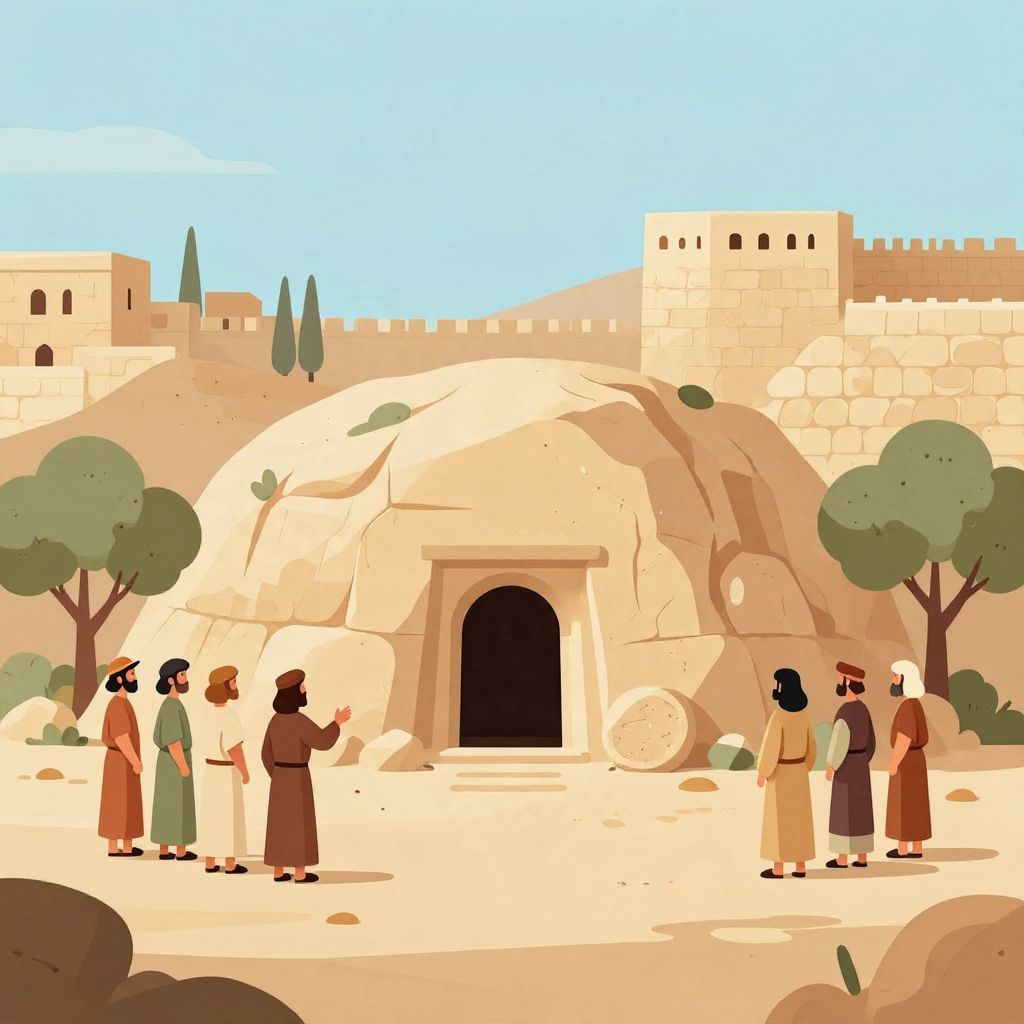
Where is Jesus’ tomb? The short answer is that Christians and historians do not agree on a single universally accepted site. The most widely venerated location is the Church of the Holy Sepulchre in Jerusalem, which has been honored since late antiquity as the place of Jesus’ crucifixion, burial, and resurrection.
That identification rests on early Christian tradition and historical geography, but the evidence is not the same as a modern archaeological certainty. Other proposals exist, especially the Garden Tomb, yet most scholars consider the Holy Sepulchre the stronger historical candidate.
Where Is Jesus’ Tomb?
The most widely accepted traditional location of Jesus’ tomb is inside the Church of the Holy Sepulchre in Jerusalem’s Old City. This site lies within the area that was outside Jerusalem’s walls in the first century CE, which fits the Gospel accounts of Jesus’ burial after crucifixion. However, the exact tomb cannot be proven with absolute certainty.
The Historical Background of Jesus’ Burial
The burial story belongs to the final phase of Jesus’ life in the early 1st century CE, during Roman rule in Judea. According to the New Testament, Jesus was crucified in Jerusalem and then placed in a tomb before the Sabbath. Historically, crucifixion victims were often left unburied, so the Gospel claim of burial has long been discussed by scholars as both a religious tradition and a historical question.
What the sources say
The four Gospels agree that Jesus was buried in a tomb associated with Joseph of Arimathea. They differ in details, but they all place the burial near the crucifixion site and before the Sabbath began. Outside the New Testament, early Christian writers also treated Jerusalem as the place of Jesus’ burial and resurrection, which helped anchor later site traditions.
Why Jerusalem matters
Jerusalem is central because Jesus’ death, burial, and the earliest resurrection traditions were all tied to the city. In the first century, the area later occupied by the Church of the Holy Sepulchre was outside the city walls, which matches the Gospel setting of a burial place near the execution site. That geographic fit is one reason the site became so important.
The Church of the Holy Sepulchre
The Church of the Holy Sepulchre is the oldest and most influential traditional site connected with Jesus’ tomb. By the 4th century, Christians in Jerusalem identified this area as the place of the crucifixion and burial. Today the church contains a small shrine, often called the Edicule, which encloses the tomb tradition.
How the site became sacred
In the early 300s, Emperor Constantine supported Christian holy places in Jerusalem. Ancient Christian writers report that a pagan temple had stood over the area, and that it was removed during Constantine’s building program. Whether every detail of that tradition can be verified is debated, but by the 4th century the site was firmly established in Christian memory.
What archaeology can and cannot tell us
Archaeology shows that the area had a first-century quarry and burial caves, which is consistent with the kind of landscape used for tombs in Jesus’ time. Later construction, destruction, and rebuilding make it impossible to isolate one tomb with complete certainty. Still, the site’s long continuity of veneration gives it exceptional historical weight.
Why Many Historians Favor the Holy Sepulchre
Many historians and archaeologists consider the Holy Sepulchre the strongest candidate because its location matches the first-century topography and because the tradition is very old. The site was already revered by Christians in late antiquity, long before medieval pilgrimage reshaped Jerusalem’s sacred landscape. Its age and continuity are major reasons it remains the leading identification.
Key reasons for its credibility
- It lies in an area that was outside Jerusalem’s walls in the early 1st century.
- It preserves a burial setting consistent with first-century Jewish tomb practices.
- Its Christian identification appears early in the historical record.
- It has remained the principal pilgrimage site for centuries.
What About the Garden Tomb?
The Garden Tomb, north of Jerusalem’s Old City, is a popular alternative site. It was identified in the 19th century and attracts many visitors because it has a peaceful setting and a tomb-like appearance. However, most scholars date the tomb earlier than the time of Jesus, which makes it less likely to be his burial place.
Why it became popular
The Garden Tomb gained support among Protestants in the 1800s, partly because it offered a simple, visually compelling place for devotion outside the traditional church complex. Its appeal is devotional and symbolic, but its historical case is weaker than that of the Holy Sepulchre. In scholarly terms, it is usually viewed as a meaningful alternative, not the leading candidate.
How the Tomb Tradition Developed Over Time
The history of Jesus’ tomb is not just a question of location; it is also a story about memory, pilgrimage, and sacred geography. The burial site became central because Christians believed the resurrection happened there or nearby. Over time, that belief shaped architecture, worship, and the political struggle over Jerusalem’s holy places.
From memory to monument
- 1st century: Jesus is crucified and buried in Jerusalem according to Christian tradition.
- 2nd–3rd centuries: The site is remembered by local Christians, though records are limited.
- 4th century: Constantine’s era brings monumental identification of holy places.
- Medieval period: Pilgrimage expands, and the Holy Sepulchre becomes a major Christian destination.
- Modern era: Archaeology and historical study reassess the site, but no consensus alternative surpasses it.
Why the Exact Tomb Cannot Be Proven Beyond Doubt
Even though the Holy Sepulchre is the strongest traditional site, historians cannot prove it in the way one might prove the location of a modern grave. The tomb itself has been altered by centuries of construction, damage, and restoration. In addition, the earliest evidence comes from religious tradition rather than from a first-century inscription identifying the burial place.
Historical certainty versus faith tradition
This is an important distinction. For believers, the tomb is a sacred place tied to the resurrection. For historians, it is a site with strong early tradition and plausible geography, but not a fully documented first-century burial chamber that can be verified with complete certainty. Both perspectives can be understood without confusing one for the other.
What the Tomb Means in Christian History
Jesus’ tomb became one of the most important places in Christianity because it is linked to the resurrection, the central event of Christian belief. The site helped define Jerusalem as the heart of Christian pilgrimage. It also influenced art, liturgy, and architecture across the Christian world, from replicas of the Holy Sepulchre to Easter observances.
Lasting significance
The tomb’s importance is not only theological. It also reflects how ancient cities preserve memory through sacred space. Jerusalem’s holy sites became tied to imperial patronage, pilgrimage, and later interfaith contestation. As a result, the question “Where is Jesus’ tomb?” is both a historical inquiry and a window into how traditions shape places over time.
So, Where Is Jesus Tomb?
The best historical answer is that Jesus’ tomb is traditionally located at the Church of the Holy Sepulchre in Jerusalem. That identification is the oldest and most widely accepted one, and it fits the geography of first-century Jerusalem. Still, historians stop short of absolute proof, and alternative sites such as the Garden Tomb remain part of the broader discussion.
In other words, the tomb’s exact identity cannot be settled with complete certainty, but the Holy Sepulchre remains the most historically grounded answer. If you want to explore the wider context, see also how old Jesus was when he was crucified and where Jesus lived.