
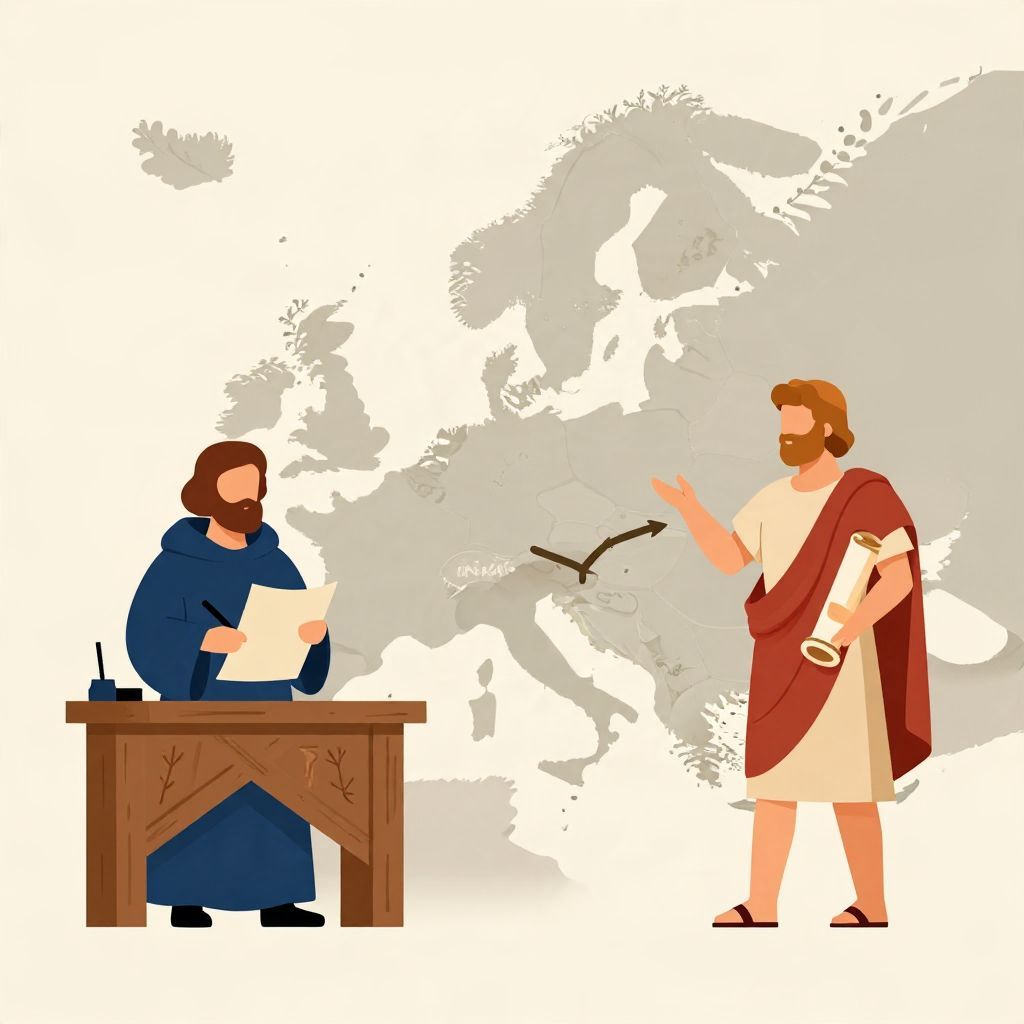
Is German a Latin language? The short answer is no. German belongs to the Germanic branch of the Indo-European language family, while Latin belongs to the Italic branch. The two languages are related only at a very distant prehistoric level, not because German descended from Latin.
That said, German has absorbed many Latin words over two millennia of contact with the Roman world, the Christian Church, scholarship, and modern science. This borrowing can make German look “Latinized” in places, but its grammar, core vocabulary, and historical development are fundamentally Germanic.
Is German a Latin language?
No. German is not a Latin language; it is a Germanic language. Latin is the ancestor of the Romance languages such as Italian, French, Spanish, Portuguese, and Romanian. German and Latin share a remote Indo-European ancestry, but German did not evolve from Latin and is classified in a different language branch.
Where German actually comes from
German developed from Proto-Germanic, the reconstructed ancestor of the Germanic languages. Proto-Germanic was spoken in northern Europe in the late prehistoric period, probably by the first centuries BCE and earlier, before written records. Over time it split into North Germanic, West Germanic, and East Germanic branches. German emerged from the West Germanic branch.
The Germanic branch
- North Germanic: the ancestors of Danish, Swedish, Norwegian, Icelandic, and related languages.
- West Germanic: the ancestors of German, English, Dutch, Frisian, and others.
- East Germanic: now extinct, including Gothic.
Old High German, the earliest stage usually identified as the direct ancestor of modern Standard German, appears in written sources from roughly the 8th to 11th centuries CE. It was not Latin-based; it was a Germanic language that developed its own sound changes, grammar, and vocabulary.
Why people confuse German with Latin
German is often mistaken for a Latin language because it contains many Latin loanwords and because educated German writing has long used vocabulary drawn from Latin and Greek. But borrowing words does not change a language’s family classification. English, for example, also contains many Latin-derived words, yet it remains a Germanic language.
Latin influence came through contact, not descent
German-speaking peoples came into contact with the Roman Empire along the Rhine and Danube frontiers. Trade, warfare, diplomacy, and later Christianity brought Latin into German-speaking regions. Latin was the language of administration, religion, learning, and law in much of medieval Europe, so German absorbed words from it in several waves.
Examples include words connected to religion, education, government, and abstract concepts. Some entered German directly from Latin; others came through French, which itself developed from Latin. This layered borrowing can make the language look more “Latin” than it really is.
How Latin influenced German historically
Latin influence on German unfolded over many centuries rather than in a single event. The main phases are historically clear, even if individual loanwords sometimes have complex routes of transmission.
- Roman frontier contact in the first centuries CE introduced some Latin terms into the speech of Germanic peoples near the empire.
- Christianization from the 6th to 9th centuries CE brought church Latin into the German-speaking world.
- Medieval learning kept Latin as the language of scholarship, law, and administration.
- Early modern science and diplomacy continued to favor Latin terminology, especially in technical and academic fields.
Church Latin and the Middle Ages
When Germanic kingdoms converted to Christianity, Latin became central to liturgy, education, and written culture. Monasteries and clerical schools preserved Latin texts and trained scribes. As a result, German gained religious and intellectual vocabulary from Latin, especially terms linked to church life, writing, timekeeping, and learning.
At the same time, German remained a living vernacular. People spoke German dialects in daily life, while Latin often served as the language of record. This bilingual environment shaped German vocabulary without changing its family classification.
Borrowing from Latin versus being a Latin language
A language can borrow heavily from another language and still remain genetically distinct. The key question is not how many borrowed words it contains, but where its core structure comes from. German grammar, verb system, noun classes, and historical sound changes are Germanic, not Latin.
How German differs from Latin in structure
German and Latin differ in ways that go far beyond vocabulary. Latin is an Italic language with a highly inflected system of noun cases and verb endings. German also has cases and inflection, but its forms and historical development are different. Similarities reflect shared Indo-European inheritance, not direct descent.
Core grammatical differences
- Word order: German has a distinctive verb-second structure in main clauses and verb-final patterns in subordinate clauses.
- Articles: German uses definite and indefinite articles in ways Latin does not.
- Sound history: German underwent the High German consonant shift, a major sound change not found in Latin.
- Vocabulary base: German’s everyday words for family, body parts, basic actions, and nature are mostly Germanic, not Latin.
For example, the German words for “mother,” “father,” “house,” “water,” and “hand” are inherited Germanic words, not Latin borrowings. That everyday core is one of the clearest signs that German is not a Romance or Latin-derived language.
German and Latin in the Roman world
The Roman Empire never made German a Latin language. Instead, it created zones of contact. Roman writers described Germanic peoples as living beyond the imperial frontier, and some Germanic groups served as allies, enemies, mercenaries, or settlers within Roman territory. In these encounters, Latin words moved into Germanic speech, but the languages remained separate.
Roman frontier influence
Archaeology and historical sources show intense interaction across the Rhine and Danube. Germanic elites traded with Romans, adopted some Roman goods and customs, and sometimes used Latin in official contexts. Yet the spread of Latin was uneven. In most Germanic areas, Latin never replaced local speech the way it later did in much of Gaul, Iberia, and Italy.
That difference matters. In regions that became Romance-speaking, Latin gradually evolved into local vernaculars after the fall of Roman authority. In German-speaking lands, Latin remained a prestige language, but the spoken vernacular continued on a separate path.
Why German is not a Romance language
People sometimes assume German must be related to Latin because modern German contains so many Latin-based scholarly terms. But the Romance languages are the direct descendants of spoken Latin. German is not. It is closer to English and Dutch than to French or Italian, even though all of these languages have borrowed from Latin to some degree.
Romance languages versus Germanic languages
The Romance languages grew out of regional forms of spoken Latin after the Roman Empire’s expansion and later fragmentation. German, by contrast, developed north of the Roman core and followed a different historical trajectory. The two language families are cousins within Indo-European, not parent and child.
This distinction is important for understanding European history. Roman political power spread Latin widely, but not uniformly. The map of modern European languages reflects where Latin became the main spoken language and where it did not.
What about Latin words in German today?
Modern German contains many words of Latin origin, especially in formal, academic, religious, and technical contexts. Some are obvious, such as Universität, Doktor, or Information. Others entered German through French or other intermediary languages. But the presence of these words does not make German a Latin language any more than the presence of Arabic loanwords makes English an Arabic language.
Common areas of Latin borrowing
- Religion: terms associated with Christianity and church organization.
- Education: words for schools, universities, and scholarly concepts.
- Law and administration: vocabulary used in official and legal writing.
- Science and medicine: many technical terms, especially from the early modern period onward.
German also has many loanwords from French, Italian, English, and other languages. Borrowing is a normal part of language history, especially in societies with long literary and political connections across Europe.
Historical evidence used by linguists
Linguists classify languages by systematic evidence, not by surface resemblance. In German’s case, the evidence points firmly to a Germanic origin. The strongest clues are regular sound correspondences, inherited basic vocabulary, and shared grammatical patterns with other Germanic languages.
Why classification is secure
Historical linguistics compares patterns across many words and structures. German matches the Germanic pattern in its oldest attested forms and in its later development. Latin does not explain those patterns. Instead, Latin contributed a large layer of borrowed vocabulary that sits on top of a Germanic foundation.
This is why scholars can say with confidence that German is not a Latin language. The classification is not based on modern spelling or prestige vocabulary, but on deep historical relationships.
Conclusion: the historical answer in one sentence
German is not a Latin language; it is a Germanic language that has borrowed extensively from Latin over many centuries of contact, especially through the Roman Empire, the medieval Church, and scholarship. If you want to compare the two language histories further, see what language the Romans spoke and what language Romans spoke.