
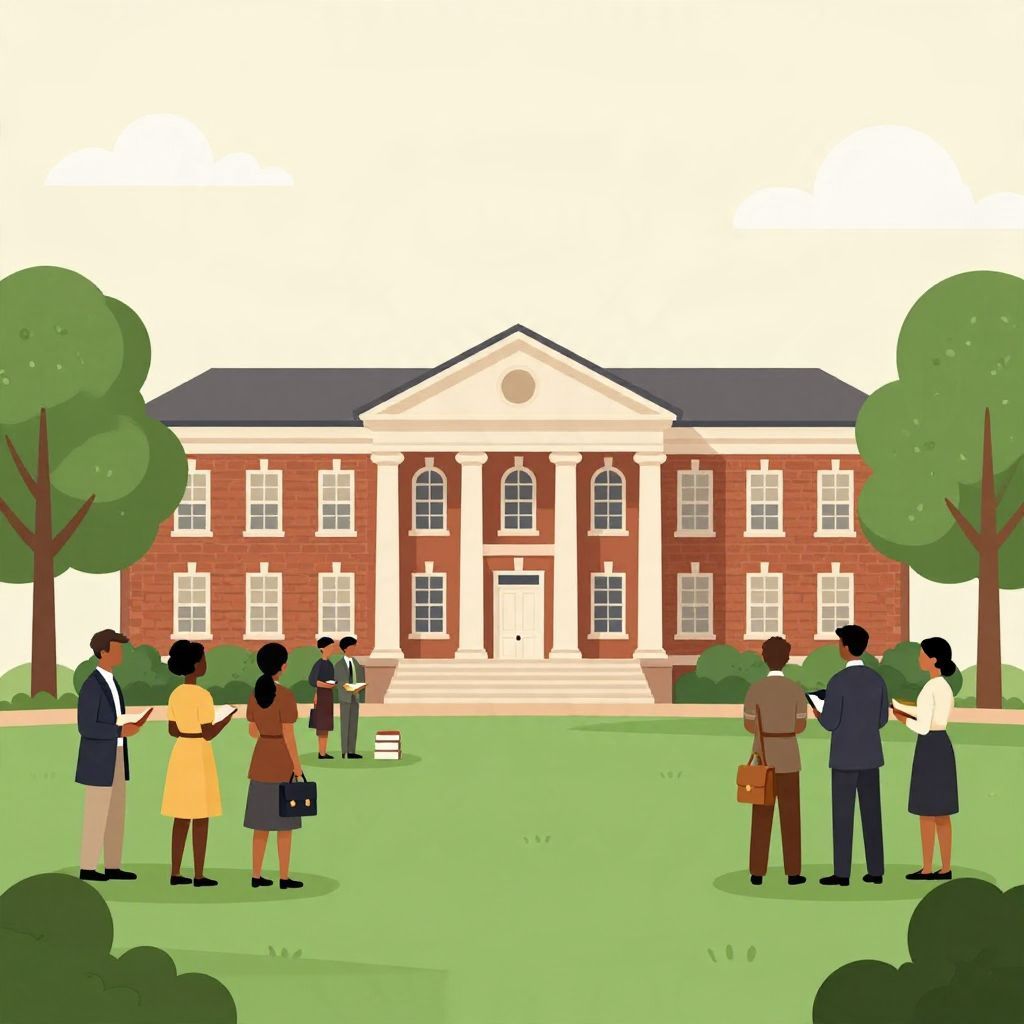
What is HBCU mean? In U.S. history, HBCU stands for Historically Black Colleges and Universities. The term refers to institutions founded before the Civil Rights era to educate Black students who were excluded from most white colleges, and to schools later established with that same mission.
HBCUs are not just a category of schools; they are part of the long history of segregation, Black self-determination, and access to higher education in the United States. Their story helps explain both the barriers Black Americans faced and the institutions they built in response.
What Is HBCU Mean?
HBCU means Historically Black College or University. The term describes American colleges and universities founded to serve Black students, especially during the 19th and early 20th centuries when segregation and discrimination limited access to most higher education. Today, HBCUs enroll students of all backgrounds, but their historical mission remains central.
Where Did HBCUs Come From?
HBCUs emerged from the realities of slavery, emancipation, and segregation. Before the Civil War, very few Black Americans had access to formal schooling, and laws in many states restricted Black education entirely. After emancipation, freedpeople, Black communities, religious groups, and northern philanthropists helped create schools that would become colleges and universities.
The post-Civil War origins
The earliest HBCUs grew out of Reconstruction-era efforts to educate newly freed people. Some began as normal schools, institutes, or seminaries before expanding into colleges. Their creation was driven by a practical need: Black students were often barred from white institutions, so separate schools became one of the few paths to advanced education.
Examples of early HBCUs
- Cheyney University in Pennsylvania, founded in 1837, is often recognized as the oldest HBCU.
- Lincoln University in Pennsylvania, founded in 1854, was among the earliest degree-granting institutions for Black students.
- Many well-known HBCUs, such as Howard University (1867), Fisk University (1866), and Morehouse College (1867), were founded during Reconstruction or shortly after.
These schools did not arise from a single plan. They developed through a mix of Black initiative, church support, state action, and private philanthropy, often under difficult financial conditions.
Why Were HBCUs Necessary?
HBCUs were necessary because racial exclusion shaped American education for generations. In the 19th and early 20th centuries, many colleges either refused to admit Black students or admitted only a very small number under unequal conditions. HBCUs offered access, but they also became centers of leadership, professional training, and community advancement.
Segregation and exclusion
In the era of Jim Crow, segregation was enforced across much of the South and influenced higher education nationwide. Even where Black students were technically admitted elsewhere, they often faced hostility, isolation, or limited opportunities. HBCUs provided a place where Black students could study in larger numbers and build institutions of their own.
Education as freedom and uplift
For many Black families, higher education was tied to freedom, citizenship, and economic mobility. HBCUs trained teachers, ministers, lawyers, doctors, engineers, and public servants at a time when other institutions often shut Black Americans out of those professions. That role made HBCUs central to Black middle-class formation and community leadership.
How HBCUs Developed Over Time
The history of HBCUs reflects changing patterns in American race relations. Their role shifted from basic literacy and teacher training in the 19th century to broader liberal arts, scientific, and professional education in the 20th century. Yet they remained important even after legal segregation ended.
Reconstruction and the late 19th century
During Reconstruction, Black education expanded rapidly, but funding was unstable and often unequal. Many HBCUs relied on missionary societies, the Freedmen’s Bureau, church networks, and state legislatures. Their early curricula often emphasized teacher training, agriculture, theology, and practical skills, reflecting the limited resources and urgent needs of the era.
The Jim Crow era
As segregation hardened after Reconstruction, HBCUs became even more important. They educated generations of Black students who had few alternatives. At the same time, they often operated with less public funding than white institutions, a disparity that historians have long noted as part of the broader inequality of segregated schooling.
Desegregation and beyond
After the mid-20th-century civil rights victories and court-ordered desegregation, Black students gained greater access to predominantly white institutions. Some observers assumed HBCUs would fade away, but they did not. Instead, they adapted by continuing to serve as centers of Black intellectual life, cultural identity, and social mobility.
What Makes an HBCU Historically Significant?
HBCUs matter because they are institutions created in response to exclusion, yet they became much more than a reaction to racism. They developed distinctive traditions, alumni networks, and educational cultures. Their history shows how marginalized communities can build durable institutions when denied equal access elsewhere.
Leadership and public service
HBCUs have produced many leaders in politics, law, education, science, religion, business, and the arts. Their graduates have played major roles in civil rights organizing, local government, and national leadership. This is not accidental: HBCUs were designed to cultivate talent that mainstream institutions often ignored or undervalued.
Cultural and intellectual life
These schools also helped shape Black scholarship, literature, music, and debate. Campuses became spaces where Black history and identity could be studied, affirmed, and expanded. In that sense, HBCUs were not only educational institutions but also cultural institutions.
Are All HBCUs the Same?
No. HBCUs vary widely in size, mission, denomination, funding, and academic focus. Some are public universities, while others are private. Some are large research institutions; others are smaller liberal arts colleges. What they share is their historical role in educating Black Americans and their continuing connection to that legacy.
Public and private HBCUs
Public HBCUs often grew from state-supported normal schools or agricultural and mechanical colleges. Private HBCUs were frequently founded by churches, missionary groups, or Black educators. Both types faced unequal funding for much of their history, though the nature and degree of that inequality differed by state and institution.
Coeducation and single-sex traditions
Most HBCUs are coeducational, but some, such as Spelman College and Morehouse College, are historically single-sex institutions. These schools became especially influential in shaping Black professional and civic leadership.
How Many HBCUs Are There?
The number can vary slightly depending on legal definitions and federal recognition, but the United States currently recognizes more than 100 HBCUs. Most are located in the South, though some are in the North and Midwest, reflecting the broader geography of Black migration and education.
Why geography matters
The concentration of HBCUs in the South reflects the region’s history of slavery, segregation, and Black population growth. But northern HBCUs also emerged because Black students in free states still faced exclusion and limited opportunities. The schools’ distribution mirrors the national scope of racial inequality in education.
How Did the Federal Government Define HBCUs?
The modern legal definition of HBCUs comes from federal policy. In U.S. law, an HBCU is generally a college or university established before 1964 whose principal mission was, and remains, the education of Black Americans. This definition helps determine eligibility for federal support and recognition.
Why 1964 matters
The year 1964 is significant because it marks the passage of the Civil Rights Act, a landmark in the legal dismantling of segregation. Schools founded before that date are considered “historically” Black because they were created in a segregated educational landscape. The label does not mean only Black students attend them today.
What Role Do HBCUs Play Today?
HBCUs remain important in contemporary higher education. They continue to enroll students from many backgrounds, but they are still especially significant for Black students seeking supportive environments, strong mentoring, and a connection to Black history and culture. Their role has evolved, but their historical meaning remains powerful.
Academic and social impact
HBCUs are often praised for close faculty-student relationships, leadership development, and community engagement. They have also remained important in fields where Black representation has historically been limited. Their influence extends beyond campus through alumni networks, civic leadership, and cultural production.
Ongoing challenges
Like many institutions, HBCUs face financial pressures, infrastructure needs, and competition for students and funding. Historians and policymakers often note that these challenges are tied to the same long history of unequal investment that made HBCUs necessary in the first place.
Why the Meaning of HBCU Still Matters
Understanding what HBCU means is about more than decoding an acronym. It opens a window onto the history of Black education in the United States, from exclusion and survival to institution-building and achievement. HBCUs represent both the injustices of segregation and the resilience of communities that created their own paths to learning.
So, when someone asks what HBCU means, the answer is simple on the surface: Historically Black College or University. But historically, the term carries a much deeper story about race, education, opportunity, and the long struggle for equality in America. For related context, see “Separate Is Never Equal” and what a Black American flag means.