
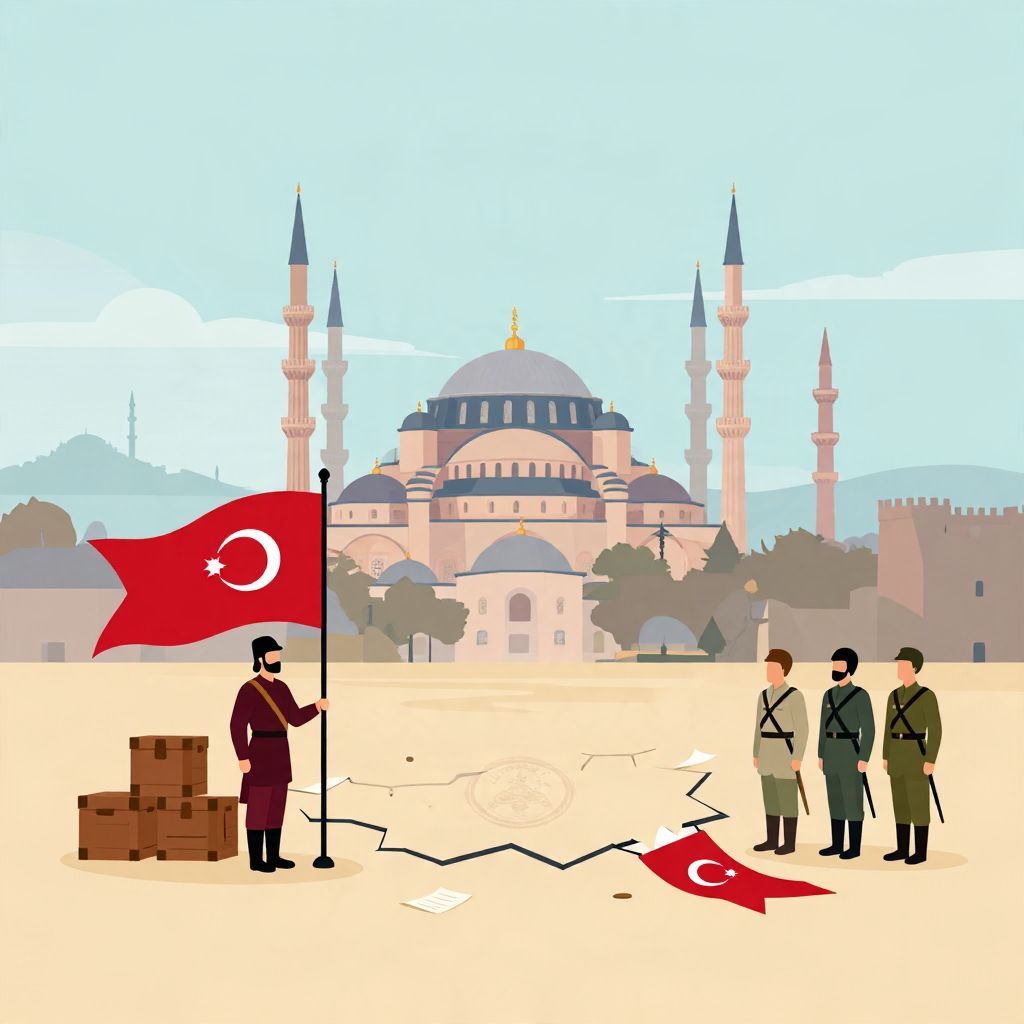
The Ottoman Empire fell through a long decline rather than a single sudden collapse. Its final defeat came during World War I, when military exhaustion, nationalist revolts, foreign intervention, and political upheaval inside the empire combined to destroy the old imperial system.
By 1922, the Ottoman sultanate had been abolished, and by 1923 the Republic of Turkey replaced the empire’s core state. The Ottoman case is a classic example of how war, reform failure, and rising nationalism can unravel a centuries-old empire.
How did the Ottoman Empire fall?
The Ottoman Empire fell because it entered the 20th century weakened by military defeats, economic dependence, territorial losses, and nationalist movements among its diverse peoples. World War I accelerated the collapse: the empire joined the Central Powers, suffered major defeats, and then faced occupation, partition plans, and a Turkish nationalist war that ended the sultanate and created modern Turkey.
The long decline before World War I
The empire did not suddenly fail in 1918. Its decline stretched across the 18th and 19th centuries as European powers grew stronger, Ottoman institutions struggled to modernize, and provinces became harder to control. Historians often describe this as a process of “relative decline,” meaning the empire remained powerful in many ways but fell behind its rivals in military and administrative capacity.
Military setbacks and lost territory
Repeated wars exposed Ottoman weakness. The empire lost ground to Russia, Austria-Hungary, and local challengers in the Balkans and the eastern Mediterranean. By the late 1800s, much of southeastern Europe had broken away or been taken from Ottoman control. These losses reduced revenue, prestige, and manpower, while also encouraging more separatist movements.
Economic pressure and foreign dependence
The Ottoman state also became increasingly dependent on European loans and trade. Unequal commercial arrangements gave foreign merchants and creditors major advantages. Debt and financial control limited Ottoman sovereignty, especially after the empire defaulted in the 1870s and foreign administrators gained influence over state revenues. This made reform more difficult and deepened domestic resentment.
Nationalism inside the empire
The empire was multiethnic and multireligious, which had long been a source of strength. But in the 19th century, modern nationalism changed political loyalties. Greeks, Serbs, Bulgarians, Armenians, Arabs, and others developed movements that demanded autonomy or independence. Some of these movements were driven by local elites, others by foreign support, and many were shaped by both religion and language.
Reform efforts that could not fully save the empire
Ottoman rulers tried to preserve the state through reform, especially during the Tanzimat era in the 19th century. These reforms aimed to centralize government, modernize the army, improve taxation, and create more equal citizenship. They achieved some successes, but they also created tensions by raising expectations the state could not always meet.
The Young Turk Revolution
In 1908, the Young Turk movement forced the restoration of the constitution and promised a stronger, more modern empire. The Young Turks wanted to preserve Ottoman rule through centralization and reform, but they inherited a state already under severe strain. Their government faced internal factionalism, military weakness, and growing ethnic conflict. In practice, the revolution did not solve the empire’s core problems.
Why reform was not enough
Reform efforts often arrived too late or were undermined by war. Centralization could improve administration, but it also alarmed local communities that feared losing autonomy. Modernization required money, trained personnel, and peace—resources the empire increasingly lacked. As a result, reforms slowed decline but could not reverse it.
World War I and the final blow
The most direct answer to how the Ottoman Empire fell is World War I. In 1914, the Ottoman leadership entered the conflict on the side of Germany and Austria-Hungary. This decision brought the empire into a global war it was not equipped to win and exposed its remaining territories to attack from multiple directions.
Why the Ottomans entered the war
Ottoman leaders hoped alliance with Germany would protect the empire from Russia and other enemies. They also believed war might restore lost prestige and territory. Instead, the conflict widened the empire’s vulnerabilities. The war brought shortages, military overstretch, and devastating battles across the Caucasus, Mesopotamia, Palestine, and the Dardanelles.
Major wartime defeats
Several campaigns weakened the empire decisively:
- Gallipoli (1915–1916): the Ottomans successfully defended the Dardanelles against Allied invasion, but the victory did not change the empire’s overall strategic position.
- Arab Revolt (from 1916): Arab forces, aided by Britain, challenged Ottoman rule in the Hejaz and beyond.
- Russian advances in the east: the war on the eastern front strained Ottoman resources and destabilized border regions.
- British offensives in the Middle East: Ottoman forces lost Baghdad, Jerusalem, and Damascus by the end of the war.
These defeats were not isolated events. They showed that the empire could no longer defend its far-flung provinces against coordinated modern warfare.
The Armenian Genocide and wartime radicalization
World War I also brought one of the darkest episodes in Ottoman history: the mass deportation and killing of Armenians in 1915. This was driven by wartime paranoia, ethnic nationalism, and state violence. It did not cause the empire’s fall on its own, but it is inseparable from the collapse because it reveals how radicalized and desperate the wartime government had become.
The armistice and occupation
The Ottoman Empire effectively lost the war with the Armistice of Mudros in October 1918. The armistice allowed Allied forces to occupy strategic points and gave the victors leverage over Ottoman territory. The empire survived in name for a short time, but its sovereignty had been shattered.
What the Allies wanted
Britain, France, Italy, and Greece all pursued interests in former Ottoman lands. Allied diplomacy increasingly treated the empire as a defeated territory to be divided rather than a state to be preserved. This culminated in plans that would carve up Anatolia and the Arab provinces, especially under the terms later associated with the Treaty of Sèvres in 1920.
Why occupation mattered
Occupation made the empire’s collapse visible and immediate. Foreign troops controlled key cities and transport routes. Ottoman authority was reduced to a shadow of its former self. For many Ottoman subjects, especially in Anatolia, this was the moment when the empire ceased to seem recoverable.
The Turkish War of Independence and the end of the sultanate
The empire’s final political end came not simply through Allied victory but through Turkish nationalist resistance. Led by Mustafa Kemal, later known as Atatürk, nationalist forces rejected the partition of Anatolia and fought to create a new sovereign state. This struggle transformed the end of the empire into the birth of a republic.
Mustafa Kemal’s movement
Mustafa Kemal organized resistance after the war, arguing that the Ottoman government in Istanbul could not defend Turkish interests under occupation. Nationalist assemblies formed in Anatolia, and a rival political center emerged in Ankara. This movement did not seek to restore the old empire; it sought to replace it with a new nation-state.
Abolition of the sultanate
In 1922, the Turkish Grand National Assembly abolished the sultanate. This was the decisive legal end of the Ottoman Empire as a ruling dynasty and political system. The last sultan, Mehmed VI, left Istanbul. The caliphate remained briefly, but it too was abolished in 1924 as the new republic consolidated power.
Why the empire fell: the main causes in summary
The Ottoman Empire fell because several long-term and short-term pressures reinforced one another. No single cause explains the collapse fully. The best historical explanation combines structural weakness with the shock of world war.
- Military decline made it harder to defend territory and deter rivals.
- Economic dependence reduced state autonomy and limited reform.
- Nationalist movements weakened imperial unity from within.
- Reform efforts modernized parts of the state but could not solve deeper problems.
- World War I delivered the decisive blow through defeat, occupation, and partition.
- Turkish nationalism replaced the empire with a new political order centered on Anatolia.
What happened after the Ottoman Empire fell?
The empire’s fall reshaped the modern Middle East, southeastern Europe, and the eastern Mediterranean. Former Ottoman Arab lands came under British and French mandates, while new borders and states emerged from the postwar settlement. In Anatolia, the Republic of Turkey was proclaimed in 1923, marking the end of the Ottoman imperial era and the beginning of a new national state.
Lasting consequences
The collapse left a complicated legacy. It ended centuries of dynastic rule but also opened the door to new conflicts over borders, minority rights, and national identity. Many modern political disputes in the region can be traced partly to the way Ottoman territories were divided after the war. At the same time, the Turkish Republic became one of the most important successor states to an empire that had once connected Europe, Asia, and the Middle East.
In short, the Ottoman Empire fell because it was weakened for generations and then broken by World War I, occupation, and nationalist revolution. If you want more background on the empire’s origins or the wider wartime context, see when the Ottoman Empire started and why Russia left World War I.