
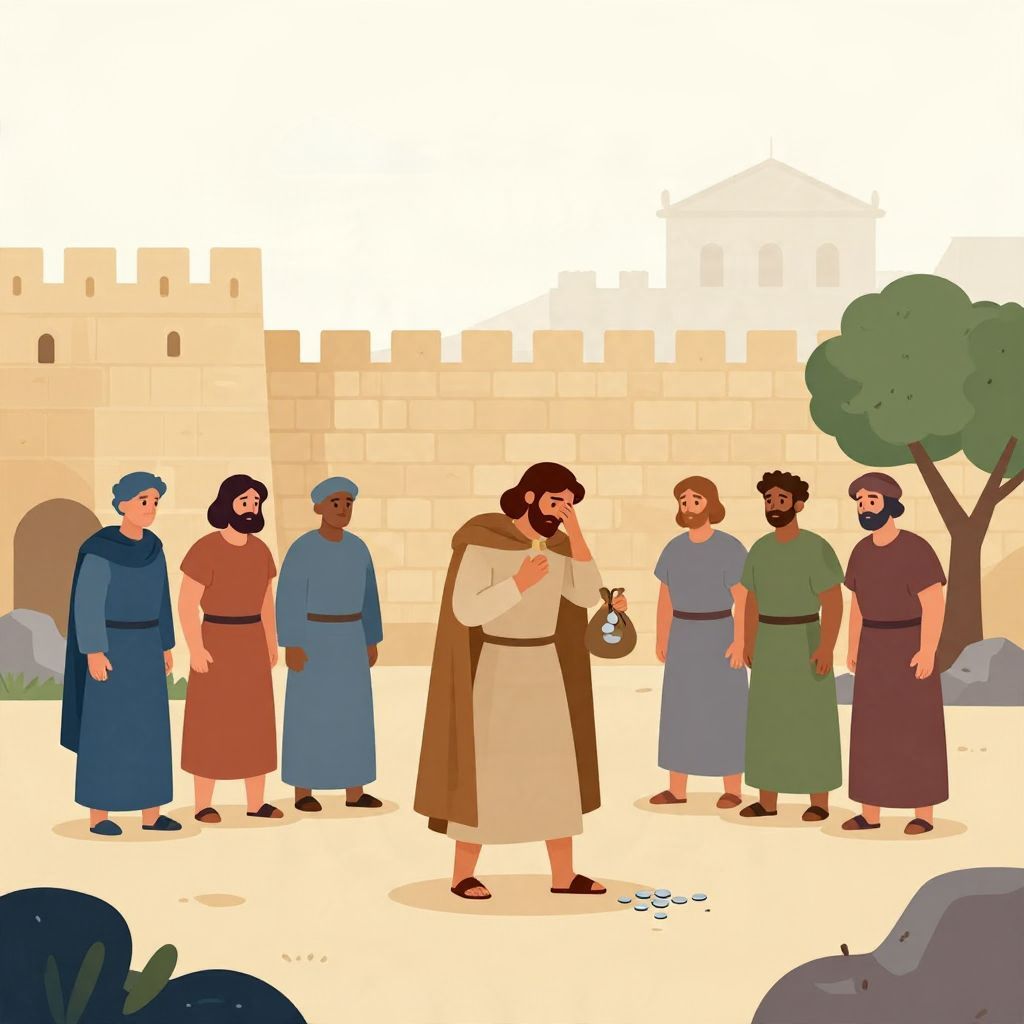
What happened to Judas after betraying Jesus is one of the most searched questions in biblical history because the answer is brief in the New Testament but surrounded by centuries of interpretation. The core story is clear: Judas Iscariot betrayed Jesus, then died soon afterward. What is less certain is exactly how, when, and how later Christians understood his fate.
The historical record comes mainly from the New Testament, especially the Gospels of Matthew and Luke-Acts. These texts agree that Judas’s betrayal led to Jesus’s arrest and death, but they differ on the details of Judas’s end. That difference matters, because it shows how early Christian writers shaped the story for theological and moral purposes.
What happened to Judas after betraying Jesus?
According to the New Testament, Judas did not live long after the betrayal. Matthew says he regretted his actions, returned the silver, and died by hanging himself. Acts gives a different account, saying he acquired a field and died in a gruesome fall there. Historians generally treat these as two theological traditions, not one fully harmonized biography.
The timeline of Judas’s betrayal and death
1. The betrayal during Jesus’s final days
Judas Iscariot appears in the Passion narratives as one of Jesus’s twelve disciples. The Gospels place his betrayal in the final days before the crucifixion, when he agreed to identify Jesus to the authorities in exchange for money. The exact motive is not stated with certainty in the sources, and later readers have proposed greed, disappointment, political frustration, or spiritual corruption.
2. Jesus’s arrest and trial
Judas’s role was to help the arresting party locate Jesus away from the crowds. In the Gospel accounts, this leads to Jesus’s arrest in Gethsemane and the chain of events that ends in crucifixion. Judas’s betrayal is therefore presented as the immediate trigger for the arrest, though the broader conflict between Jesus and the religious and political authorities also shaped the outcome.
3. Judas’s remorse
Matthew 27:3–5 says Judas felt remorse after Jesus was condemned. He returned the thirty pieces of silver to the chief priests and elders, declaring that he had betrayed innocent blood. The priests refused to take the money back into the temple treasury, and Judas then left. This scene is one of the main reasons many Christians have viewed Judas not only as a betrayer but also as a tragic figure who recognized his wrongdoing too late.
4. Judas’s death
Matthew says Judas went away and hanged himself. Acts 1:18–19, however, describes Judas as acquiring a field with the reward of his wickedness and then falling headlong so that his body burst open. These accounts are not identical, and scholars have long debated how to understand them. Some suggest Acts preserves a separate tradition about his death, while others think it reflects a later explanation of the same end. Either way, both texts present Judas as dying soon after the betrayal.
Why do Matthew and Acts tell different stories?
The difference between Matthew and Acts is one of the most important historical questions about Judas. Ancient writers often preserved multiple traditions rather than merging them into a single standardized account. Matthew emphasizes remorse, guilt, and the refusal of the temple authorities to accept responsibility. Acts emphasizes the public consequences of betrayal and the need to replace Judas among the Twelve.
Matthew’s theological emphasis
Matthew’s account highlights repentance without restoration. Judas recognizes the innocence of Jesus, but his remorse does not lead to reconciliation. The narrative reinforces a moral lesson: guilt alone is not enough to undo betrayal. In Matthew’s version, Judas’s death closes the story with tragedy and judgment.
Acts’ theological emphasis
Acts, written as a continuation of Luke’s Gospel, focuses on the early church after Jesus’s ascension. Judas’s death is described as part of the story of the apostles’ transition from twelve to eleven, followed by the selection of Matthias to restore the symbolic number. The emphasis is less on private remorse and more on the public consequences of betrayal for the community.
Historical interpretation
From a historian’s perspective, the safest conclusion is that Judas died shortly after Jesus’s arrest and crucifixion, but the exact circumstances cannot be reconstructed with certainty. The two biblical accounts are our earliest sources, and they are not fully compatible. Later traditions expanded the story further, but those later legends are not as historically reliable as the New Testament texts themselves.
Was Judas punished, forgiven, or condemned?
That question belongs more to theology than to recoverable history. The New Testament does not give a clear, unified answer about Judas’s eternal fate. Matthew presents him as deeply guilty and ends with his death. Other Christian traditions have debated whether his remorse might have opened the door to mercy, but no early canonical text explicitly says he was forgiven.
Why Judas became a symbol of betrayal
Because he was one of Jesus’s own disciples, Judas became the most powerful symbol of treachery in Western culture. His name entered common speech as shorthand for betrayal. That reputation was reinforced over centuries by sermons, art, drama, and later literature, often turning Judas into a one-dimensional villain. Historically, though, the sources show a more complex figure: a disciple, a betrayer, a remorseful man, and a literary symbol all at once.
What do we know about the “thirty pieces of silver”?
The Gospels say Judas received money for betraying Jesus, often described as thirty pieces of silver. The exact coinage is uncertain, and the phrase likely reflects a biblical allusion as much as a precise accounting record. In the ancient world, silver payment symbolized the cheapness of the betrayal and linked Judas to older scriptural themes about rejected or betrayed shepherds and leaders.
The field of blood
Matthew and Acts both connect Judas to a field afterward, though in different ways. Matthew says the priests used the returned silver to buy a potter’s field, called the Field of Blood. Acts says Judas himself acquired a field and died there. These traditions helped explain a place-name and gave the story a lasting geographic memory in Jerusalem’s Christian imagination.
How early Christians understood Judas’s death
Early Christians used Judas’s story to make sense of betrayal, repentance, divine judgment, and the suffering of Jesus. The account also helped define the identity of the early church: the community had been wounded from within, yet it continued after Judas’s absence. Replacing him with Matthias in Acts symbolized restoration after betrayal.
Judas in later Christian tradition
Over time, many Christian writers treated Judas as the archetype of the traitor. Some medieval and modern interpretations made him a near-demonic figure, while others tried to read him as a tragic participant in a larger divine plan. A few later texts, including non-canonical writings, offer alternative portrayals, but these are not the same as the earliest historical traditions.
What historians can say with confidence
- Judas Iscariot was one of Jesus’s disciples in the earliest Christian tradition.
- He betrayed Jesus before the arrest and crucifixion.
- The New Testament says he died soon afterward.
- Matthew and Acts give different descriptions of how he died.
- Later Christian tradition turned Judas into a lasting symbol of betrayal.
Why Judas’s story still matters
Judas’s fate matters because it sits at the intersection of history, memory, and theology. Historically, it reveals how the earliest Christians preserved more than one version of a painful event. Religiously, it raises questions about guilt, remorse, and judgment. Culturally, it shaped one of the most enduring images in Western history: the betrayer from within.
So, what happened to Judas after betraying Jesus? The earliest Christian sources say he soon died, but they disagree on the details. That uncertainty is part of the historical record itself. If you want more context, you may also find this deeper look at Judas’s fate and this article on Jesus’s age at crucifixion useful for understanding the wider Passion narrative.