
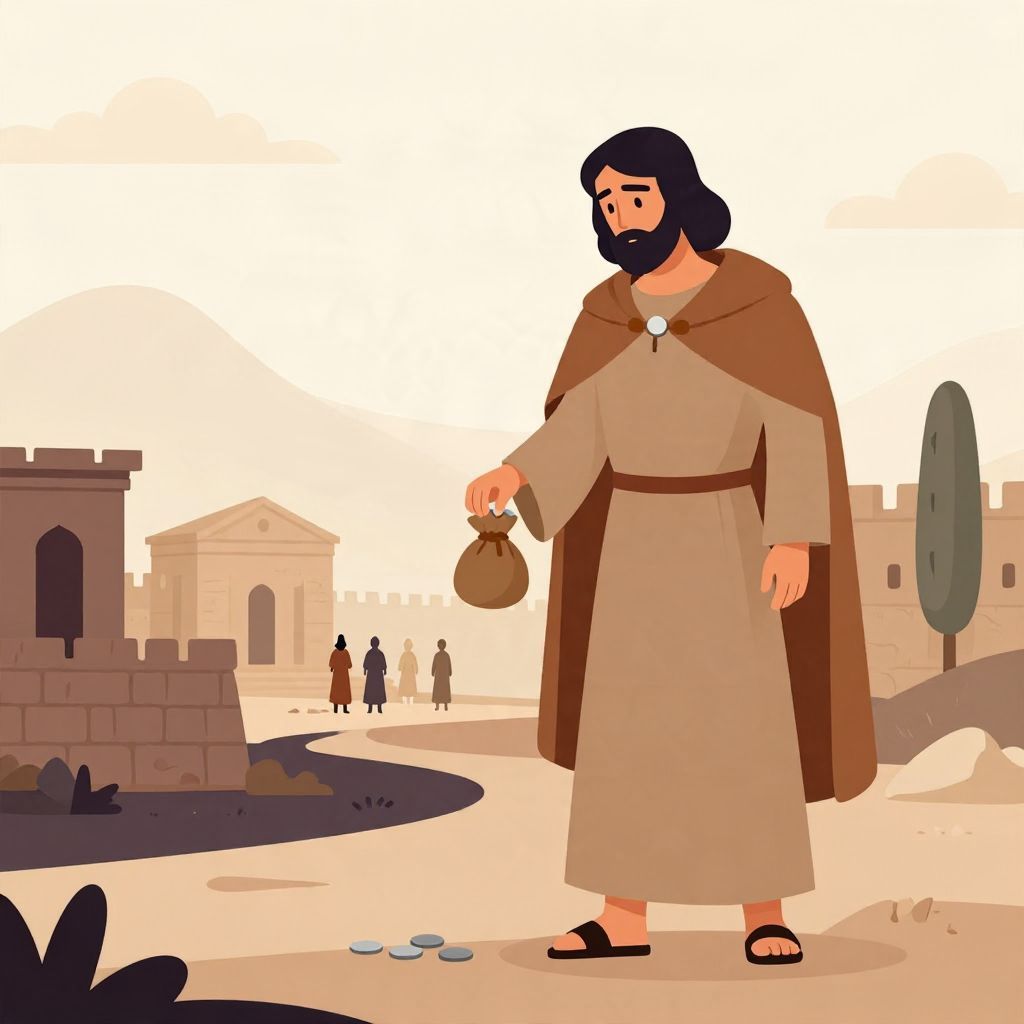
What happened to Judas after he betrayed Jesus is one of the most discussed questions in Christian history. The short answer is that the New Testament gives two main accounts of his end: in one, he returns the betrayal money and dies by suicide; in another, he falls in a field associated with that money and dies violently.
Because these accounts come from different biblical texts, historians and theologians have long debated how to reconcile them. What is clear is that Judas’s betrayal became a defining part of the Passion story and shaped Christian memory, theology, and art for centuries.
What happened to Judas after he betrayed Jesus?
According to the New Testament, Judas Iscariot regretted betraying Jesus, returned the silver he had received, and then died soon afterward. Matthew 27:3–10 says he hanged himself, while Acts 1:18 says he acquired a field with the reward of his wrongdoing and died there in a gruesome fall. These are the main ancient sources, and they do not match perfectly.
The biblical timeline of Judas after the betrayal
1. Judas agrees to betray Jesus
The betrayal begins before Jesus’s arrest. The Gospels describe Judas, one of the Twelve disciples, agreeing to identify Jesus for the authorities in exchange for money. The exact motive is not stated in a single, settled way. Some passages emphasize greed, while others present a more complex picture of disappointment, spiritual failure, or Satanic influence.
2. Jesus is arrested and condemned
Judas’s role comes to a head during the arrest of Jesus in Jerusalem, usually dated to the early 30s CE under Roman rule. After Jesus is taken, Judas appears to have realized the consequences of what he had done. The betrayal did not simply end with an arrest; it triggered a crisis of conscience in the Gospel narrative.
3. Judas returns the silver
In Matthew’s account, Judas feels remorse and brings the thirty pieces of silver back to the chief priests and elders. He declares that he has sinned by betraying innocent blood. The religious leaders refuse to accept the money back into the temple treasury, so it is used to buy a potter’s field, a place associated with burial for foreigners or the poor.
4. Judas dies
Matthew says Judas then went away and hanged himself. Acts gives a different version: Judas is said to have bought a field with the reward of his betrayal, and there he falls, his body bursting open. Both passages agree that Judas’s end was tragic and that his death became linked to the field. The difference is one reason the story has been interpreted in multiple ways over time.
Why do Matthew and Acts tell the story differently?
The two accounts are not identical, and scholars have offered several explanations. Some readers see them as describing the same death from different angles: Judas may have hanged himself, and later his body fell and decayed in a way that produced the vivid description in Acts. Others think the traditions developed separately and were preserved for different theological purposes.
Matthew’s emphasis: remorse and judgment
Matthew focuses on Judas’s remorse, the return of the silver, and the fulfillment of scripture. The account highlights guilt, rejection, and the tragic consequences of betrayal. It also connects Judas’s death to a scriptural pattern, reflecting the Gospel writer’s interest in showing events as part of a larger divine plan.
Acts’ emphasis: disgrace and replacement
Acts uses Judas’s death as part of the opening of the apostolic story after the resurrection. The account stresses the shame attached to his end and the need to replace him among the Twelve. This version helps prepare for the selection of Matthias as Judas’s replacement, signaling continuity in the early Christian community.
What caused Judas’s fate?
The sources do not give a single, simple cause. Instead, they present a combination of moral, spiritual, and narrative causes. Judas is portrayed as acting under temptation or evil influence, then collapsing under remorse once Jesus is condemned. In historical terms, his fate reflects the intense pressure and danger surrounding Jesus’s arrest and trial in Roman-occupied Judea.
Remorse and despair
Matthew’s version suggests Judas was overwhelmed by guilt. His return of the money indicates that he could not live with the consequences. Suicide, in this telling, is the final act of despair after a failed attempt to undo what he had done.
Theological meaning in the Gospels
For early Christians, Judas was more than a historical figure. He became a symbol of betrayal, broken discipleship, and the mystery of evil within the circle of Jesus’s followers. The Gospels do not treat his death as a minor detail; they use it to show the seriousness of betraying the Messiah.
What do historians think really happened?
Historians working with ancient sources usually say that Judas probably died soon after the arrest of Jesus, but the exact manner cannot be established with certainty. The New Testament is the earliest evidence, and it preserves two different traditions. Outside the Christian texts, there is no independent contemporary record that confirms the details of his death.
What can be said with confidence
- Judas was remembered by early Christians as the disciple who betrayed Jesus.
- His betrayal was linked to payment, commonly described as thirty pieces of silver.
- After the arrest of Jesus, Judas’s story ended in death.
- Early Christian tradition treated his death as tragic and shameful.
What remains uncertain
- Whether Judas died by hanging, by a fall, or through a combination of events.
- Whether the “field” tradition is literal history, symbolic storytelling, or both.
- What Judas’s personal motive was beyond the Gospel explanations.
How Judas’s death shaped Christian history
Judas’s end mattered far beyond the immediate events of the Passion. It helped define Christian language about betrayal, repentance, and judgment. Over time, Judas became one of the most infamous figures in Western religious memory, often used as a warning about greed, disloyalty, and the loss of faith.
Replacement among the Twelve
Acts says the apostles chose Matthias to take Judas’s place. This was important because the Twelve symbolized the restored people of God. Judas’s absence had to be repaired before the community could move forward. His death therefore had institutional consequences, not just moral ones.
Influence on art, literature, and popular culture
Artists and writers repeatedly portrayed Judas’s final hours as a scene of horror or sorrow. Medieval and Renaissance art often emphasized his isolation, while later literature explored his guilt and possible motives. In modern culture, Judas has become shorthand for betrayal itself, though that simplification often ignores the complexity of the ancient texts.
Did Judas repent?
This is another debated question. Matthew says Judas felt remorse, but remorse is not the same as full repentance in Christian theology. He returned the money, acknowledged wrongdoing, and expressed anguish. Yet the narrative ends in death rather than restoration, which has led many Christian interpreters to see his story as a warning about despair without reconciliation.
Why the story still matters
Judas’s fate is not just a dramatic ending to a familiar biblical story. It is part of how Christians have understood betrayal, guilt, and the possibility of forgiveness for nearly two millennia. It also shows how ancient sources can preserve overlapping traditions rather than a single neat account. The result is a story that is historically important precisely because it is both influential and contested.
In the end, the most careful answer to what happened to Judas after he betrayed Jesus is this: the earliest Christian sources say he was overcome by remorse and died soon after, but they preserve two different descriptions of how that death occurred. For more context on the Passion narrative, see how old Jesus was when he was crucified and where Jesus’s tomb is believed to be.