
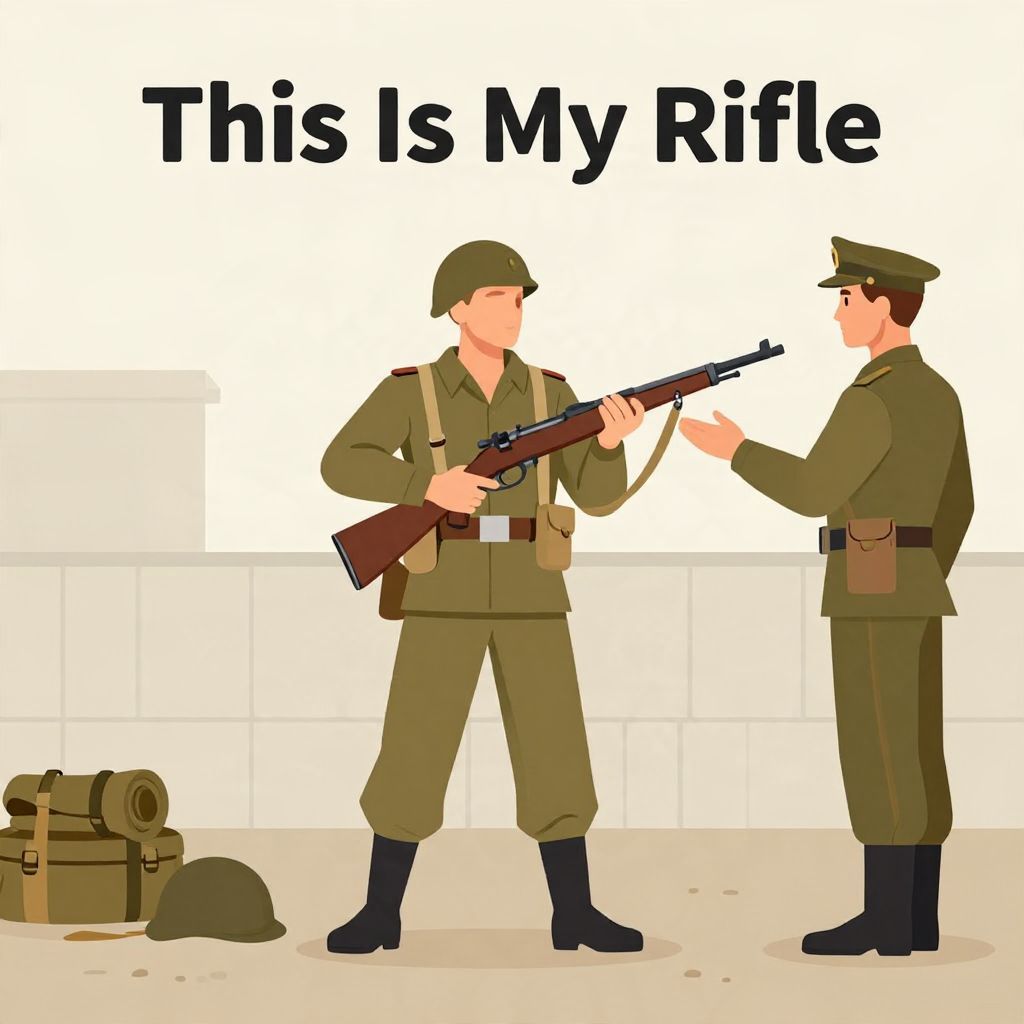
“This Is My Rifle” is best known as the line from the U.S. Marine Corps rifleman’s creed: “This is my rifle. There are many like it, but this one is mine.” The phrase is not ancient military lore. It is a modern expression of training, discipline, and the personal bond between a soldier and a weapon in industrial-age warfare.
Its history is tied to the Marine Corps in the mid-20th century, especially the post–World War II era, when marksmanship, standardization, and identity were central to military culture. The phrase became famous because it captured both the practical and symbolic meaning of a rifle in combat service.
What does “This Is My Rifle” mean in military history?
“This Is My Rifle” refers to the opening line of the U.S. Marine Corps rifleman’s creed, a short statement that emphasizes ownership, responsibility, and readiness. Historically, it reflects modern military training rather than a battlefield tradition from earlier centuries. The phrase became iconic because it links personal discipline with the standardized rifle of the 20th-century armed forces.
Origins of the phrase
The exact origin of the rifleman’s creed is not perfectly documented, but it is generally associated with the U.S. Marine Corps in the years after World War II. The creed is often credited to Major John A. Bishop, though the precise authorship has been debated. What is clear is that the creed emerged from Marine training culture, where marksmanship was treated as both a technical skill and a moral duty.
The line “There are many like it, but this one is mine” made sense in an age of mass-produced weapons. Unlike earlier centuries, when soldiers might carry personally owned muskets or sidearms, modern infantrymen were issued standardized rifles built to nearly identical specifications. The phrase therefore expressed a paradox of modern war: the weapon was one of many, yet the soldier was expected to know it intimately.
Why the wording mattered
The creed’s language is simple, repetitive, and memorable. That helped it function as a training tool. It taught recruits to think of the rifle not as a disposable object, but as an extension of the Marine’s skill, discipline, and survival. In military culture, this kind of language can shape behavior as much as formal rules do.
Timeline of “This Is My Rifle”
The phrase does not belong to a single dramatic moment. Instead, it developed within a broader history of Marine Corps training and American military culture. A brief timeline helps explain how it became famous.
- Late 19th to early 20th century: Modern armies increasingly rely on standardized rifles, drill, and mass training.
- World War I: The U.S. Marine Corps expands its reputation for marksmanship and infantry professionalism.
- World War II: Marine training becomes even more systematized, with great emphasis on rifle proficiency in the Pacific War.
- Post-1945: The rifleman’s creed is associated with Marine Corps training culture and begins to circulate more widely.
- 1960s–1980s: The phrase becomes familiar to the public through military publications, veteran memory, and popular culture.
- 1987: The line gains major cultural visibility through the film Full Metal Jacket, though the movie is a dramatization, not the origin of the phrase.
The Marine Corps and the culture of marksmanship
The phrase makes the most sense in the context of the U.S. Marine Corps, which has long emphasized rifle proficiency as a core part of its identity. Marine training traditionally treated the rifle as more than equipment. It was a symbol of the Marine’s readiness, self-control, and combat effectiveness.
This emphasis developed for practical reasons. Marines often served as expeditionary infantry, landing in difficult environments and fighting at close to medium range. Accurate rifle fire mattered. But the culture around the rifle also served a disciplinary purpose. If a recruit learned to respect, maintain, and master the weapon, that habit could reinforce broader military reliability.
From personal weapon to institutional identity
In earlier eras, soldiers might identify more closely with a regiment, a banner, or a commander. In the 20th century, the rifle became a central object of identity for the infantryman. “This is my rifle” expresses that shift. The weapon is standardized by the state, but it is also personalized through training and responsibility.
Historical background: why rifles became so important
The phrase belongs to the era of industrial warfare, when rifles replaced older smoothbore muskets as the principal infantry weapon. By the late 19th century, repeating rifles, smokeless powder, and improved sights had transformed battlefield tactics. Accuracy, range, and maintenance mattered more than ever.
That change altered military culture. A rifle was no longer just a tool for firing in mass volleys. It was a precision instrument that demanded care. Soldiers had to clean it, zero it, carry it properly, and use it under stress. The creed’s focus on possession and responsibility reflects that historical reality.
How the modern rifle changed soldiering
- It increased the importance of individual marksmanship.
- It made weapon maintenance a daily discipline.
- It encouraged armies to train soldiers as skilled operators, not just as members of a firing line.
- It gave the infantryman a more personal relationship with a standardized weapon.
“This Is My Rifle” in popular culture
The phrase became widely recognized beyond the military because it is so memorable and because it was later used in popular culture. The most famous example is Stanley Kubrick’s Full Metal Jacket, where the rifleman’s creed is recited in a stark and memorable scene. The film did not create the creed, but it helped fix the line in public memory.
Popular culture often simplifies military history, and that is true here as well. Some viewers assume the phrase is ancient or universal, when in fact it is a relatively modern Marine Corps expression. Still, its endurance shows how effectively it captures a real historical experience: the intimate link between soldier, training, and weapon in 20th-century warfare.
Why the phrase resonated with civilians
Civilians may have found the line striking because it combines individuality and conformity. The rifle is “mine,” yet it is one of many identical weapons. That tension mirrors modern military life itself: personal responsibility within a highly organized institution.
Historical significance of the phrase
The significance of “This Is My Rifle” lies less in the words alone than in what they reveal about military life. The phrase shows how armed forces use ritual language to build identity, discipline, and cohesion. It also reveals the central place of the rifle in modern infantry warfare.
Historically, the creed represents three important developments. First, it reflects the professionalization of the military, especially the idea that a soldier should be trained to a high standard. Second, it reflects the industrial standardization of weapons. Third, it shows how military institutions use language to turn equipment into a symbol of duty.
What historians can say with confidence
It is safe to say that the phrase belongs to the U.S. Marine Corps tradition and gained prominence in the mid-20th century. It is also safe to say that it expresses a broader military truth about modern infantry service. What is less certain is the exact moment and individual author of the creed’s first composition. As with many military sayings, the tradition matters more than a perfectly documented origin story.
Common misconceptions about the phrase
Because the line is so famous, it is often misunderstood. One common misconception is that it is a battlefield quote from a specific war. In reality, it is a training creed, not a combat report. Another misconception is that it refers to private ownership of a rifle in the civilian sense. In the military context, “mine” means assigned responsibility, not personal property in the ordinary sense.
It is also mistaken to treat the phrase as timeless. Earlier soldiers certainly cared for their weapons, but the exact wording and the institutional meaning behind it belong to a modern military setting. The phrase is rooted in the age of mass armies, standardized arms, and formal recruit training.
Why “This Is My Rifle” still matters
The phrase continues to matter because it captures a durable historical idea: military effectiveness depends not only on weapons, but on the relationship between people and the tools they use. A rifle in the hands of an untrained soldier is just metal and wood or polymer and steel. In the hands of a trained Marine, it becomes part of a practiced system of discipline and survival.
It also remains important as a cultural artifact. The line is a small but revealing window into how the U.S. Marine Corps has understood itself in the modern era—tough, exacting, and deeply committed to marksmanship. For historians, that makes the phrase more than a slogan. It is evidence of how institutions create identity through language.
Conclusion
“This Is My Rifle” is a modern Marine Corps phrase that grew out of 20th-century training culture, not an ancient military tradition. Its power comes from its simplicity: it links personal responsibility, standardized weapons, and the discipline of modern infantry service. For readers interested in the broader military and civic world that shaped such traditions, related topics include war bonds and political rights.