
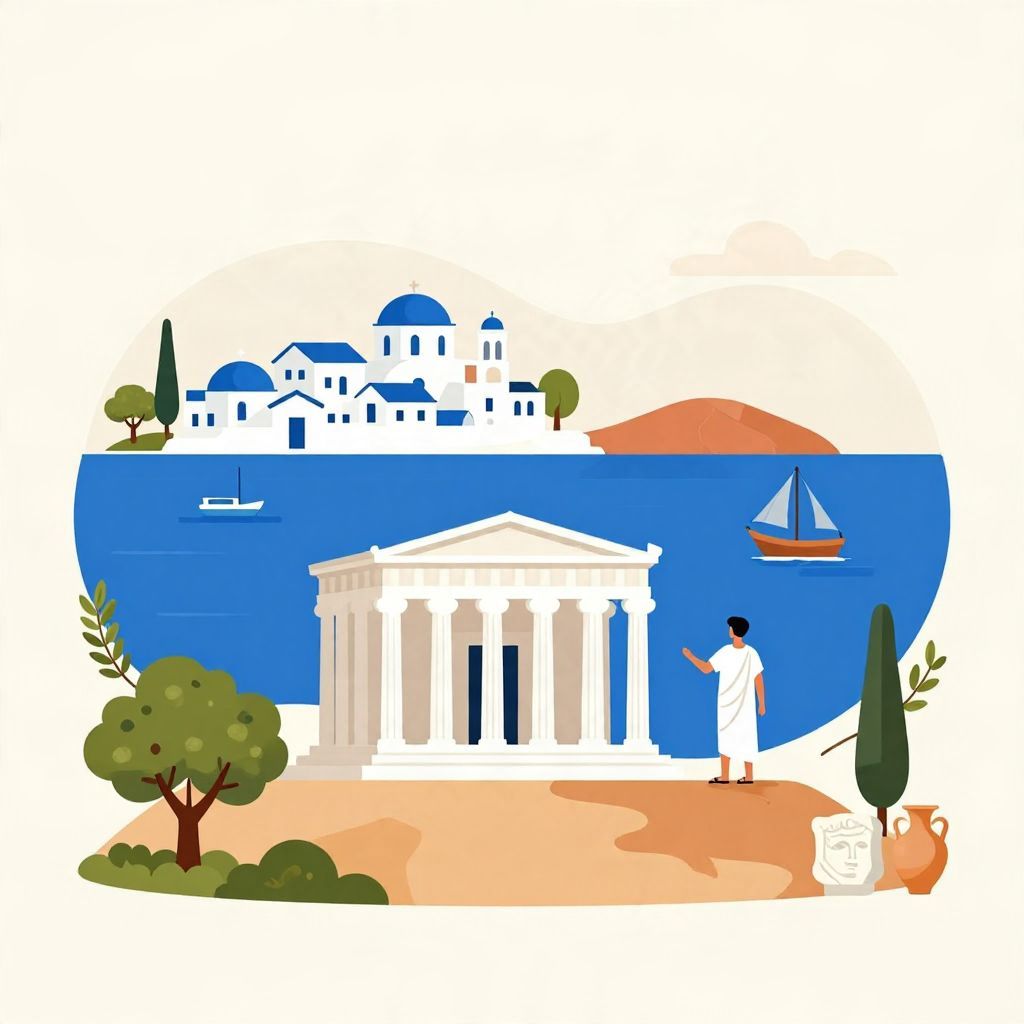
What is Greece known for? In historical terms, Greece is known as the birthplace of democracy, philosophy, and the Olympic Games, as well as for the ancient Greek world that shaped later European culture, politics, literature, and art. It is also known for its islands, Orthodox Christian heritage, and a modern national identity rooted in both classical antiquity and Byzantine history.
That reputation did not appear overnight. It was built over centuries, from the city-states of ancient Greece to the Byzantine Empire, Ottoman rule, and the modern Greek state formed in the 19th century. Understanding what Greece is known for means tracing how a small region of the eastern Mediterranean became one of the most influential civilizations in history.
What Is Greece Known For?
Greece is best known for its ancient civilization, especially the development of democracy in Athens, the philosophy of Socrates, Plato, and Aristotle, and the Olympic Games, which began in antiquity. It is also known for its mythology, architecture, literature, and a cultural legacy that deeply influenced Rome and later Western civilization.
Ancient Greece and Its Lasting Legacy
When people think of Greece, they often mean ancient Greece, a collection of independent city-states that flourished roughly from the 8th century BCE to the Roman conquest in the 2nd century BCE. These city-states were never a single unified empire in the modern sense, but they shared language, religion, and cultural traditions.
City-states, not one kingdom
Ancient Greece was organized around poleis, or city-states, such as Athens, Sparta, Corinth, and Thebes. Each had its own laws, political system, and military priorities. This diversity helped produce experimentation in government, warfare, and public life, while also creating rivalry and conflict.
The rise of democracy in Athens
Athens is especially famous for developing an early form of democracy in the late 6th and 5th centuries BCE. It was not democracy in the modern sense, since women, enslaved people, and foreigners were excluded from political participation. Still, the idea that ordinary male citizens could debate and vote on public matters became one of Greece’s most enduring contributions to political history.
Philosophy and reason
Greece is also known for its philosophers, who asked systematic questions about ethics, politics, nature, and knowledge. Socrates emphasized questioning and moral inquiry; Plato explored justice and ideal government; Aristotle studied logic, biology, politics, and more. Their work helped shape later education and intellectual traditions in Europe and the Islamic world.
Why Greece Is Famous in World History
Greece matters in world history because many ideas associated with the “West” were first developed or refined there: citizenship, civic debate, tragedy, historical writing, and rational argument. Greek culture spread widely after the conquests of Alexander the Great in the 4th century BCE, and Greek language and learning remained influential for centuries afterward.
Alexander the Great and Hellenistic culture
Alexander of Macedon conquered a vast empire from Greece to Egypt and as far east as India in the late 4th century BCE. His campaigns did not create a lasting unified state, but they spread Greek language and culture across the eastern Mediterranean and the Near East. This era is often called the Hellenistic period.
In Hellenistic kingdoms, Greek ideas mixed with local traditions, producing new centers of learning and art in places such as Alexandria. So when people say Greece influenced the ancient world, they are also referring to this broader cultural diffusion beyond the Greek mainland.
Greek literature and drama
Greek writers produced works that remain foundational. Epic poetry such as the Iliad and Odyssey, traditionally associated with Homer, shaped later storytelling and ideas of heroism. Greek tragedy and comedy, performed in public festivals, explored fate, power, family, and the limits of human control. Playwrights such as Aeschylus, Sophocles, Euripides, and Aristophanes are still studied today.
What Greece Is Known For in Mythology and Religion
Greece is widely known for its mythology: stories about Zeus, Hera, Athena, Apollo, Poseidon, and many other gods and heroes. These myths were not just entertainment. They helped explain the world, reinforce social values, and connect communities to sacred places, rituals, and festivals.
Myth versus history
It is important to distinguish myth from historical evidence. Greek myths reflect ancient beliefs and cultural imagination, but they are not reliable historical records in the modern sense. Stories such as the Trojan War may preserve distant memories of real conflicts, yet their details come from literature and legend rather than verifiable documentation.
From pagan Greece to Orthodox Christianity
Over time, Greece’s religious identity changed. Under the Roman Empire and later the Byzantine Empire, Christianity became dominant. Today, Greece is strongly associated with Eastern Orthodox Christianity, which shaped its art, festivals, monasteries, and national identity, especially during centuries of foreign rule.
Architecture, Art, and the Greek Aesthetic
Another reason Greece is famous is its architecture. Ancient Greek builders developed styles such as the Doric, Ionic, and Corinthian orders, which later influenced Roman architecture and, through Rome, much of Europe and North America. Temples, theaters, and public buildings became symbols of balance, proportion, and civic pride.
The Parthenon and classical design
The Parthenon in Athens is one of the most recognizable monuments from the ancient world. Built in the 5th century BCE, it was dedicated to Athena and reflected the wealth and confidence of Athens during its classical age. Its design has been copied and admired for centuries, especially in government buildings and museums.
Sculpture and ideal form
Greek sculpture is known for its attention to anatomy, movement, and idealized beauty. Over time, Greek artists moved from more rigid early figures to increasingly naturalistic forms. These artistic developments influenced Roman sculpture and later European artistic theory.
The Olympic Games and Greek Athletic Tradition
Greece is also known for the ancient Olympic Games, which began at Olympia, traditionally dated to 776 BCE. These games were held in honor of Zeus and drew athletes from different Greek regions. They were religious, cultural, and political events, not just sports competitions.
Ancient and modern Olympics
The ancient games were discontinued in late antiquity, but the modern Olympic Games were revived in 1896 in Athens. That revival linked modern international sport to ancient Greek heritage, which is one reason Greece remains strongly associated with the Olympics today.
Greece Through the Byzantine and Ottoman Periods
Greece is not known only for antiquity. Its medieval and early modern history also matters. After the Roman Empire divided, Greek-speaking eastern provinces became the core of the Byzantine Empire, which lasted from the 4th century CE until 1453. Byzantine culture preserved Greek language, Orthodox Christianity, and classical learning in new forms.
Byzantium as a Greek-speaking empire
Although the Byzantine Empire called itself Roman, Greek became its main language over time. Constantinople, the imperial capital, was one of the great cities of the medieval world. Greek scholars, theologians, and artists helped transmit ancient knowledge and Christian thought across centuries.
Ottoman rule and national memory
Most Greek lands later fell under Ottoman rule, beginning in the 15th century and lasting in many areas until the 19th century. This period shaped Greek identity in complex ways. It brought hardship, but it also helped preserve community traditions, local leadership, and religious institutions through the Orthodox Church.
Modern Greece and National Identity
The modern Greek state emerged after the Greek War of Independence, which began in 1821 and led to international recognition in the 1830s. The struggle against Ottoman rule became central to modern Greek national memory, and classical antiquity was often used to define the new nation’s identity.
Linking ancient and modern Greece
Modern Greeks are not simply “the same” as the ancient Greeks, because populations, languages, religions, and political systems changed over time. Still, there is a strong historical and cultural continuity in the Greek language, Orthodox tradition, and regional identity. That continuity helps explain why ancient Greece remains so important in modern Greek self-understanding.
Greece today
Today, Greece is known internationally for its islands, Mediterranean cuisine, archaeological sites, and tourism, but these modern associations sit on top of a much deeper historical reputation. Visitors often come for the Aegean landscape, yet they also encounter a country whose monuments and museums preserve one of the world’s most influential pasts.
So, What Is Greece Known For in History?
In historical terms, Greece is known for founding major ideas and institutions that still matter: democracy, philosophy, drama, the Olympic Games, and enduring artistic and architectural traditions. It is also known for the Greek world’s long evolution through Byzantine, Ottoman, and modern national history.
That combination is what makes Greece unusual. It is both a place of ancient origins and a living modern nation whose identity has been shaped by centuries of change. If you want to explore more comparative history topics, you may also find what Guatemala is known for and what happened in 2010 useful for broader historical context.