
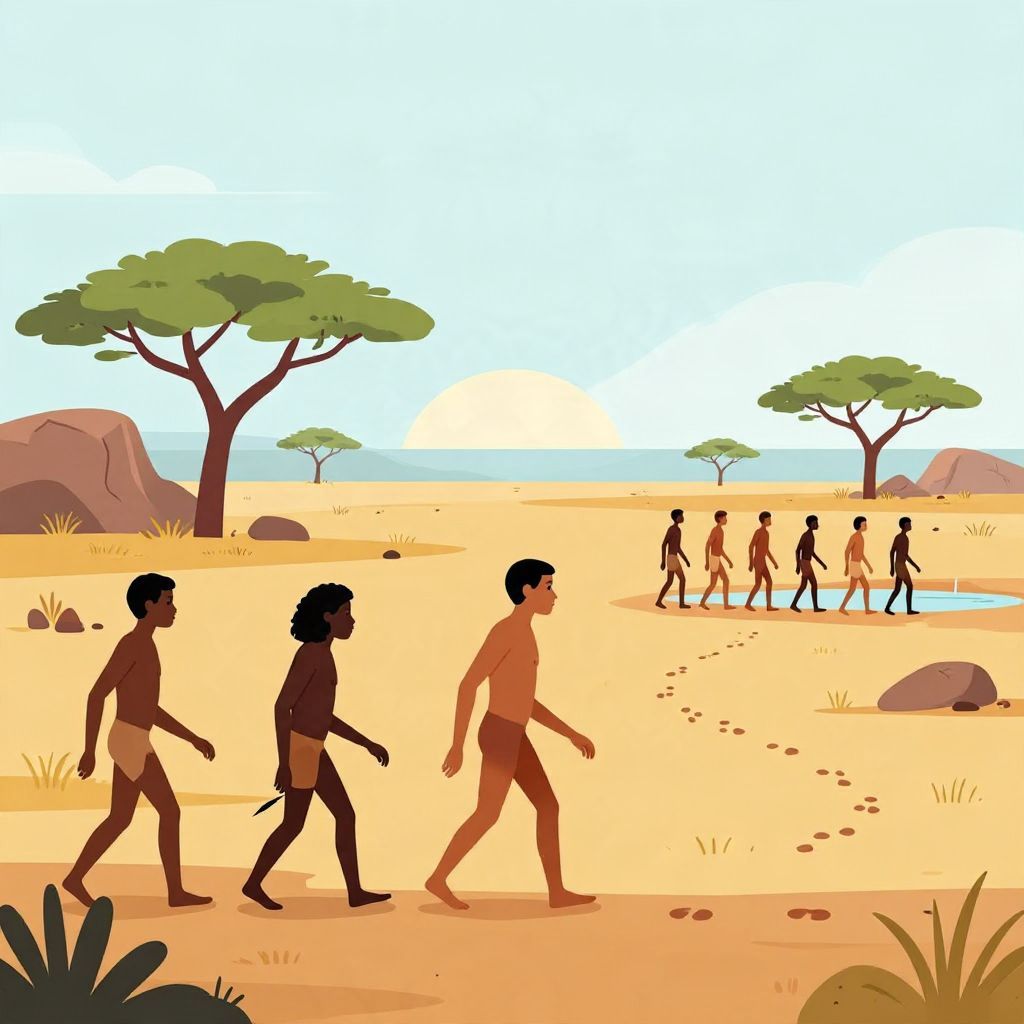
When was walking invented? Strictly speaking, walking was not invented at all. Human walking is a biological trait that evolved gradually over millions of years, long before written history. The ability to walk upright on two legs developed in early human ancestors in Africa, and it became one of the defining features of the human lineage.
So the best historical answer is that walking, as humans know it, emerged through evolution rather than invention. Fossil evidence shows that bipedal locomotion appeared at least 6 million years ago, with fully efficient human-style walking developing much later.
When Was Walking Invented?
Walking was not invented on a single date. It evolved over millions of years, beginning with early hominins in Africa. The earliest evidence for habitual bipedalism dates to roughly 6 to 7 million years ago, while the more advanced walking pattern associated with Homo appeared much later, around 2 million years ago.
Walking Is an Evolutionary Adaptation, Not a Human Invention
People often ask when walking was invented because many human abilities are tied to culture, tools, or technology. But walking is different. It is a natural mode of movement shaped by evolution, not a deliberate discovery by a person or society. No one “created” walking; instead, natural selection favored ancestors who could move efficiently on two legs.
Why bipedal walking mattered
Walking upright offered several advantages. It freed the hands for carrying food, infants, or tools. It may also have helped early humans travel across changing landscapes, see over tall grasses, and regulate body heat more effectively in open environments. These benefits likely contributed to the long evolutionary path toward habitual bipedalism.
The Earliest Evidence of Human Walking
The oldest evidence for bipedal walking comes from early hominins in Africa, especially fossils and footprints. Scientists cannot identify an exact “first step,” but they can trace the gradual shift from tree-climbing ancestors to creatures that walked on two legs part of the time, and eventually most of the time.
Key early hominins and approximate dates
- Sahelanthropus tchadensis — about 7 million years ago; possibly had some traits linked to upright posture.
- Orrorin tugenensis — about 6 million years ago; femur evidence suggests early bipedal ability.
- Ardipithecus — about 5.8 to 4.4 million years ago; likely capable of both climbing and walking upright.
- Australopithecus — about 4 to 2 million years ago; clearly bipedal, though still adapted in part to climbing.
These dates are approximate because the fossil record is incomplete and interpretations can change as new discoveries are made. Still, the broad picture is clear: walking on two legs emerged deep in human prehistory.
When Did Human-Style Walking Develop?
Early bipedalism was not identical to modern human walking. Some ancient hominins could walk upright, but they probably did so less efficiently than later humans. The long, energy-saving stride associated with modern people developed gradually, especially in the genus Homo, beginning around 2.5 to 2 million years ago.
From occasional bipedalism to habitual walking
At first, upright walking may have been one behavior among several. Over time, natural selection favored bodies better suited to life on the ground: shorter arms, longer legs, a reshaped pelvis, and feet designed for balance and propulsion. By the time of early Homo erectus, around 1.9 million years ago, walking and long-distance travel had become central to human adaptation.
Important Fossil and Trackway Evidence
Because walking leaves traces in bones and footprints, archaeologists and paleoanthropologists use both to reconstruct the past. Fossil skeletons show anatomy, while ancient trackways preserve movement itself. These discoveries help answer not just when walking appeared, but how it changed over time.
Notable evidence
- Laetoli footprints in Tanzania, about 3.6 million years old, show two-legged walking by early hominins.
- Fossils of Australopithecus afarensis, including “Lucy,” show a body adapted for bipedal movement.
- Later Homo fossils reveal longer legs and feet better suited for efficient walking and endurance travel.
The Laetoli footprints are especially famous because they provide direct evidence of upright walking in a small group moving across volcanic ash. They are among the clearest signs that bipedal locomotion was established long before modern humans appeared.
A Brief Timeline of Walking in Human Evolution
A simple timeline helps show how gradual this process was. There was no single invention moment, only a long evolutionary sequence.
- About 7 to 6 million years ago: earliest possible signs of upright posture in very early hominins.
- About 5.8 to 4.4 million years ago: Ardipithecus shows a mix of climbing and walking traits.
- About 4 to 2 million years ago: Australopithecus walks habitually on two legs.
- About 3.6 million years ago: Laetoli footprints confirm bipedal walking.
- About 2.5 to 1.9 million years ago: early Homo becomes increasingly adapted for efficient ground travel.
- About 1.9 million years ago and after: Homo erectus and later humans develop long-distance walking and endurance movement.
Why Scientists Disagree About the Exact Beginning
There is no single universally accepted date for the “start” of walking because the transition was gradual. Different researchers may define walking in different ways: some focus on occasional upright movement, while others mean habitual, human-like bipedalism. Fossils are also rare, fragmentary, and open to interpretation.
What can and cannot be known
Scientists can say with confidence that bipedalism evolved in Africa millions of years ago. They cannot pinpoint the exact moment the first ancestor stood up and took the first fully upright step. Evolution does not work like a light switch; it works like a continuum of small changes across many generations.
How Walking Changed Human History
Once habitual walking evolved, it shaped nearly every part of human life. Upright movement changed the skeleton, altered childbirth, influenced diet and foraging, and made migration across landscapes easier. It also helped set the stage for later human achievements, including tool use, hunting strategies, trade, and the spread of people across the world.
Long-distance movement and migration
Efficient walking gave humans a major advantage in travel. As climate and environments changed, early humans could move farther in search of food and safer habitats. Over time, this mobility helped humans leave Africa and populate Eurasia, Australia, and eventually the Americas.
Walking and the human body
Human anatomy reflects this history. Our spine, pelvis, knees, arches, and foot structure all support upright walking. Even the way we balance our heads and swing our arms is part of a body shaped by millions of years of bipedal evolution.
Did Other Animals “Invent” Walking Too?
Walking itself is not unique to humans. Many animals walk, but they do so in different ways. Birds, reptiles, mammals, and insects all have their own forms of locomotion. What makes human walking notable is not that it exists, but that it is a highly efficient form of habitual bipedal movement among primates.
In that sense, humans did not invent walking any more than fish invented swimming. What changed over time was the specific style of movement that became central to our lineage.
The Historical Answer in One Sentence
Walking was not invented; it evolved gradually in early human ancestors in Africa, beginning at least 6 to 7 million years ago and becoming fully human-like much later, especially by around 2 million years ago.
The story of walking is really the story of human evolution itself: a long transformation from tree-dwelling ancestors to upright, mobile humans. If you want to explore the broader background of our species, related topics such as human evolution and prehistoric Africa offer useful context.