
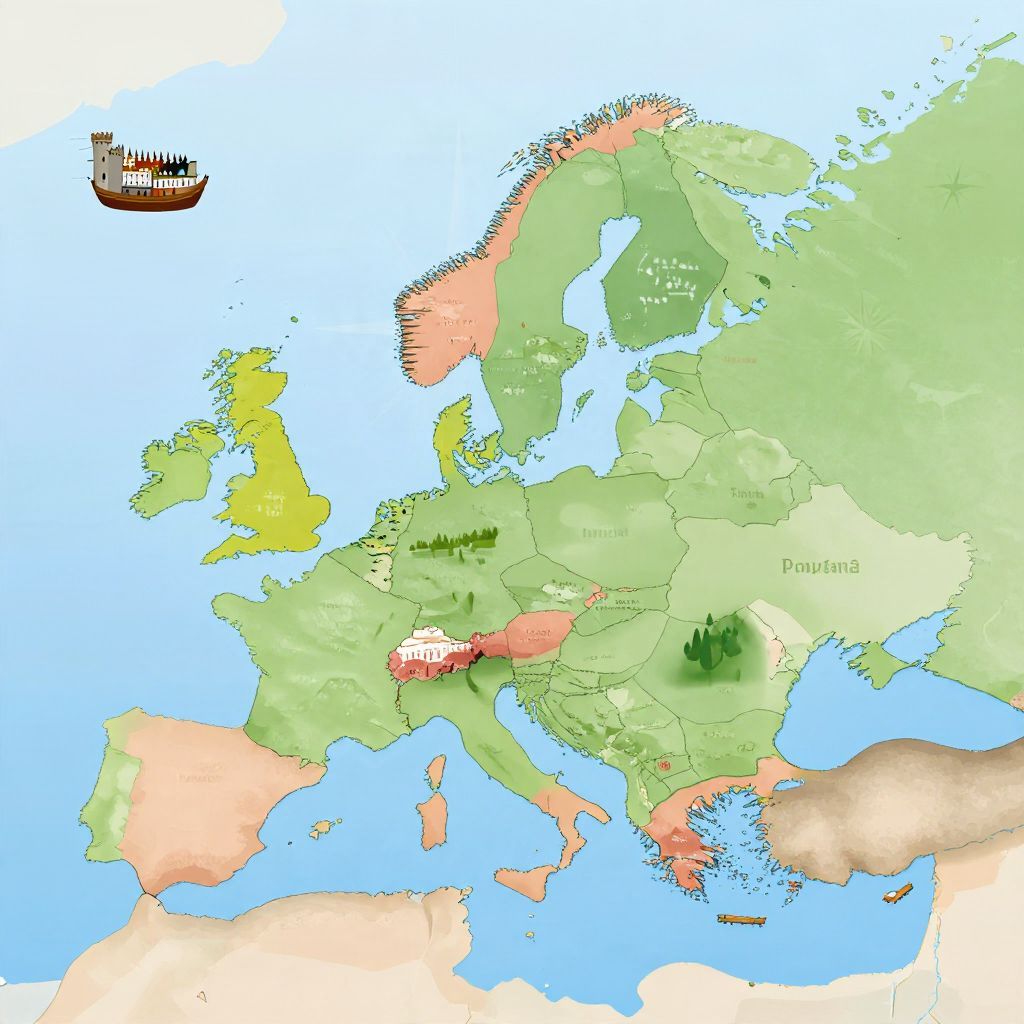
Where was Prussia? The short answer is that Prussia was a historical state in northeastern Europe, centered first on lands along the southeastern Baltic coast and later expanded into much of what is now northern Germany and western Poland. Its location changed over time, which is why the name can be confusing today.
Prussia began as a medieval territory on the Baltic frontier, but it later became a major European power. Because its borders shifted repeatedly, “Prussia” can mean different places depending on the century: the original Prussian homeland, the Duchy of Prussia, the Kingdom of Prussia, or the larger Prussian state that helped unify Germany.
Where was Prussia?
Prussia was located in northeastern Europe, along the Baltic Sea. Its earliest core lay around the southeastern Baltic coast, in areas now divided among Poland, Russia’s Kaliningrad region, and, in a broader historical sense, parts of Lithuania. Later, the Prussian state extended west and south into what is now northern Germany, including Brandenburg, Berlin, and surrounding provinces.
The original Prussian homeland
The name “Prussia” originally referred not to a German kingdom, but to the lands of the Old Prussians, a Baltic-speaking people related more closely to Lithuanians and Latvians than to Germans. Their territory lay on the southeastern shore of the Baltic Sea, especially in the region between the lower Vistula and Neman rivers.
This original area was conquered in the 13th century by the Teutonic Order, a military religious order of German crusaders. Over time, German settlement, rule, and culture transformed the region. The Old Prussian language eventually disappeared, but the geographic name remained.
Prussia in the era of the Teutonic Order
In the Middle Ages, Prussia was associated with the state of the Teutonic Knights, whose headquarters were eventually at Marienburg (today Malbork in Poland). Their territory covered much of the Baltic coast east of Pomerania and west of Lithuania. This was a frontier zone shaped by warfare, colonization, trade, and Christianization.
After the defeat of the Teutonic Order in the Thirteen Years’ War (1454–1466), Prussia was divided. Western Prussia came under the Polish crown, while eastern Prussia remained under the Teutonic Order as a Polish fief. This division is important because it set up the later political geography of the region.
How Prussia changed over time
Prussia’s location is best understood as a moving political map rather than a fixed modern country. The name shifted from a Baltic homeland to a duchy, then to a kingdom, and finally to a large state centered in Brandenburg and northern Germany. Its borders changed through war, dynastic unions, and diplomacy.
The Duchy of Prussia
In 1525, the Grand Master of the Teutonic Order secularized the order’s remaining eastern territory and created the Duchy of Prussia. This duchy lay on the Baltic coast east of Royal Prussia and was ruled by the Hohenzollern dynasty. It was initially a Polish fief, meaning it owed formal allegiance to the Polish king.
This duchy is the key to understanding later Prussia. It was geographically separate from Brandenburg, the Hohenzollern family’s other major territory farther west in the Holy Roman Empire. The two lands were joined by the same ruling house, not by immediate geography.
Brandenburg-Prussia and the rise of a power
In 1618, the rulers of Brandenburg inherited the Duchy of Prussia, creating the composite state known as Brandenburg-Prussia. Brandenburg lay around Berlin and the middle Elbe region, in what is now northeastern Germany. Prussia itself remained farther east on the Baltic coast, but the two territories were ruled together.
In 1701, the Hohenzollern ruler crowned himself King in Prussia, later styled King of Prussia. From that point on, “Prussia” increasingly referred to a powerful kingdom centered on Berlin, Brandenburg, and East Prussia, even though the original Prussian homeland was only one part of it.
What modern countries once contained Prussian territory?
Prussia no longer exists as a state, but its historical lands are now spread across several modern countries. The exact list depends on which period of Prussian history you mean, but the main modern states connected to Prussian territory are Germany, Poland, Russia, Lithuania, and, in earlier phases, Denmark and the Czech lands through border changes and influence.
- Germany: Brandenburg, Berlin, Saxony-Anhalt, Lower Saxony, North Rhine-Westphalia, Schleswig-Holstein, and other areas were once part of Prussia at different times.
- Poland: West Prussia, parts of East Prussia, Silesia, and Posen were historically Prussian provinces or territories under Prussian control.
- Russia: The northern part of East Prussia became the Soviet Kaliningrad Oblast after World War II.
- Lithuania: Small areas of historic East Prussia and the broader Baltic frontier were linked to Prussian history.
Because borders shifted so often, it is more accurate to ask “Which Prussia?” than simply “Where was Prussia?”
Why Prussia is hard to place on a modern map
Prussia is difficult to locate today because it was both a region and a state, and those two meanings did not always match. The original Prussian homeland was in the Baltic east, while the later kingdom’s political center moved toward Berlin and Brandenburg. By the 19th century, Prussia was less a single region than a large, multiethnic state.
From region to state
Many historical names begin as geographic labels and later become political ones. Prussia followed this pattern. The original Baltic region gave its name to the duchy, then to the kingdom, and eventually to the dominant state of northern Germany. As Prussia expanded, the name became attached to lands far from the original Prussian coast.
This is why a map of “Prussia” can look very different depending on the century. A 15th-century map shows a Baltic territory. An 18th- or 19th-century map shows a much larger kingdom stretching from the Rhine to the eastern frontier.
East Prussia and West Prussia
In later centuries, Prussia was often divided into provinces such as East Prussia and West Prussia. East Prussia lay on the Baltic coast and around Königsberg, while West Prussia lay farther west, including areas around the lower Vistula. These provincial names preserved the older regional identity even after Prussia became a broader political entity.
After World War I and especially after World War II, these provinces were dismantled or absorbed into neighboring states. That is why the name “Prussia” disappeared from the political map, even though it remains important in European history.
Prussia’s historical background in brief
Prussia’s history is tied to conquest, state-building, and military power. It began as a Baltic frontier region, was conquered by the Teutonic Order, transformed through German settlement, and later became the core of a powerful monarchy. Its rise helped shape the balance of power in central Europe.
- Before the 13th century: The Old Prussians lived along the southeastern Baltic coast.
- 13th century: The Teutonic Order conquered the region.
- 1466: Prussia was divided between Polish rule and the Teutonic Order’s remaining lands.
- 1525: The Duchy of Prussia was created.
- 1618: Brandenburg and Prussia came under one ruler.
- 1701: The Kingdom of Prussia was proclaimed.
- 18th–19th centuries: Prussia expanded into a major European power.
- 1918–1947: The monarchy ended, and Prussia was eventually abolished after World War II.
Prussia and the making of Germany
Prussia played a central role in German unification in the 19th century. Under leaders such as Otto von Bismarck, the Prussian state led the process that created the German Empire in 1871. At that point, Prussia was the largest and most influential German state, but it was no longer just a geographic region on the Baltic; it was the backbone of a new empire.
Still, Prussia never covered all of Germany. It coexisted with other German states, and its dominance was often resented. That tension helped shape modern German political history.
What happened to Prussia?
Prussia ceased to exist as a separate state after the upheavals of the 20th century. The monarchy collapsed in 1918 after World War I, but the Prussian state continued within the Weimar Republic. After World War II, the Allied powers dismantled Prussia because it was associated with German militarism and authoritarian rule, though historians debate how fair that simplification is.
In 1947, Prussia was formally abolished. Its territories were divided among postwar Germany, Poland, and the Soviet Union. The name survived in history books, museums, and regional memory, but not as a political entity.
So, where was Prussia in one sentence?
Prussia was originally a Baltic region on the southeastern shore of the Baltic Sea, but over time it became a powerful state centered on Brandenburg and Berlin, with lands that stretched across what are now Germany, Poland, and parts of Russia and Lithuania.
In other words, Prussia was not one fixed place on today’s map. It was a historical region that grew into a state, changed shape repeatedly, and eventually disappeared—leaving behind a name that still matters in European history. If you want to explore further, related topics include the Teutonic Order and the unification of Germany.