
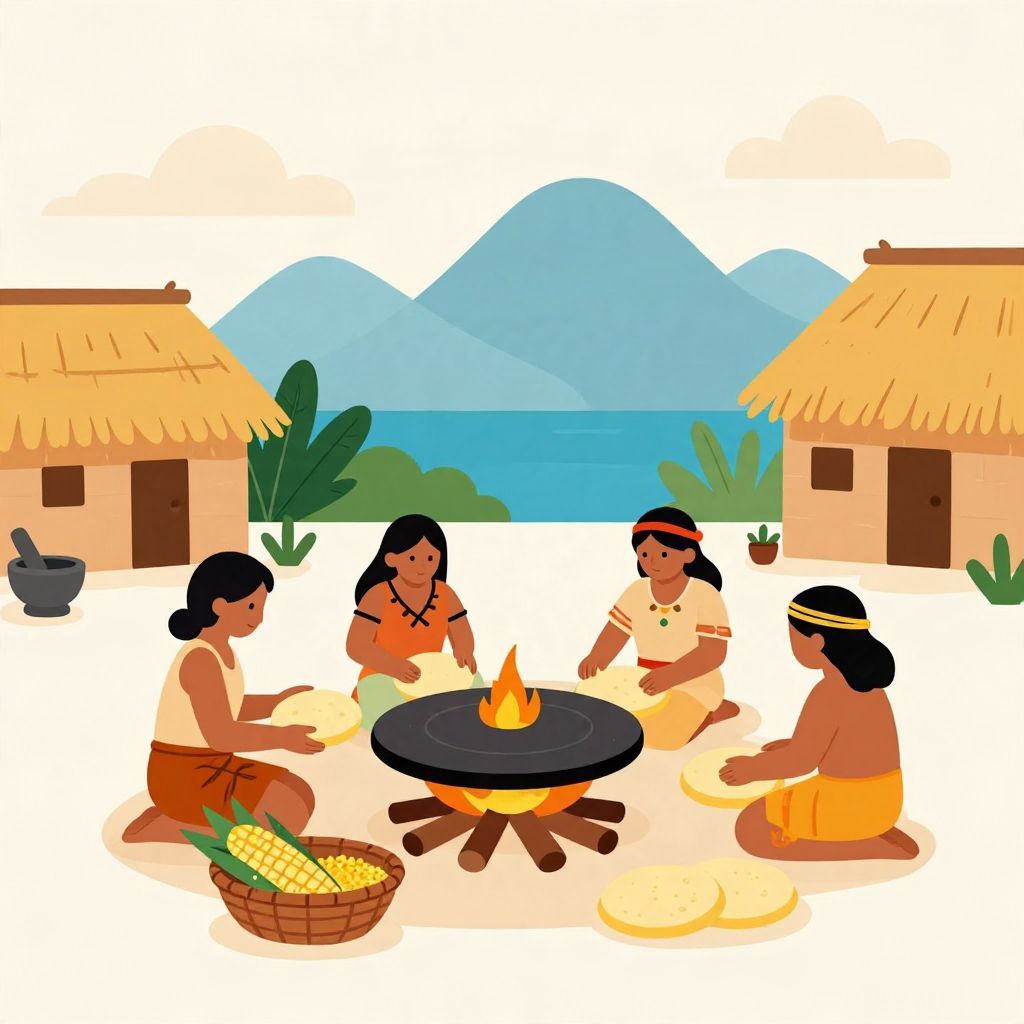
Arepas are most closely associated with Venezuela and Colombia, but their history is older than either modern nation. The answer to “where are arepas from” begins in the northern Andes and Caribbean lowlands, where Indigenous peoples made corn cakes long before Europeans arrived.
Because arepas developed across a broad region and over many centuries, they are best understood as a shared pre-Columbian food tradition rather than the invention of one single place or person.
Where Are Arepas From?
Arepas come from pre-Columbian northern South America, especially the lands that are now Venezuela and Colombia. Indigenous communities in this region ground maize into dough and cooked it on hot stones or griddles. Over time, this basic corn bread became a lasting staple in both countries and nearby areas.
The Indigenous Origins of Arepas
Long before modern borders existed, maize was central to foodways across the Americas. In the area that is now Venezuela and Colombia, Indigenous peoples developed many ways to process corn, including flat cakes that could be cooked quickly and eaten daily. Arepas likely emerged from this broader corn culture rather than from a single documented “first” recipe.
Corn as the foundation
Maize was domesticated in Mesoamerica thousands of years earlier and spread widely through trade, migration, and cultural exchange. By the time Europeans reached northern South America in the late 15th and early 16th centuries, corn had become one of the region’s most important crops. The arepa was one practical result of that agricultural world.
How early arepas were made
Early arepas were probably simpler than many versions eaten today. Indigenous cooks ground dried corn into meal or dough, shaped it into discs, and cooked it on heated clay, stone, or metal-like surfaces once those became available. The method was efficient, portable, and adaptable, which helped the food survive across centuries.
Why Venezuela and Colombia Both Claim Arepas
Both countries claim arepas because the dish predates their national boundaries. The modern states of Venezuela and Colombia emerged from the Spanish colonial period and the later breakup of Gran Colombia in the 19th century, but arepas were already part of everyday life in the region. Today, each country has its own regional styles, fillings, and meanings attached to the food.
A shared regional heritage
Rather than belonging to one nation, arepas belong to a cultural zone. In Venezuela, they became especially associated with breakfast and street food, often split and stuffed. In Colombia, they remain widely eaten in many forms, from plain and salted versions to sweet or cheese-filled varieties. These differences reflect local tastes more than separate origins.
National identity and food history
Foods often become symbols of nationhood after the fact. Arepas are a good example: a dish with Indigenous roots later became a marker of Venezuelan and Colombian identity. That does not mean one country “owns” the arepa historically. It means both inherited and transformed a common ancestral food.
What Historical Evidence Tells Us
There is no single surviving document that names the first arepa or identifies one exact birthplace. Instead, historians rely on archaeology, colonial-era descriptions, and long-standing culinary continuity. These sources point to a pre-Hispanic origin in northern South America, where corn-based flatbreads were part of daily Indigenous diets.
Colonial accounts and continuity
Spanish chroniclers described Indigenous foods made from maize in the Americas, including baked or roasted cakes. While the terminology in those records does not always match the modern word “arepa,” the descriptions support the idea that similar foods were already established when Europeans arrived. The modern name likely developed from Indigenous languages in the region, though scholars discuss its exact linguistic path.
Archaeology and food traditions
Archaeological evidence for ancient corn use is strong across the Americas, but linking a specific artifact to the modern arepa is harder. Food history often works this way: the ingredients, tools, and cooking methods are visible, while the exact names and recipes shift over time. The arepa’s history is therefore one of continuity and adaptation, not a single moment of invention.
How Arepas Changed After European Contact
After the Spanish conquest, Indigenous food traditions did not disappear. Instead, they changed through contact with new ingredients, tools, and social systems. Wheat, dairy, pork, and metal cookware entered local diets, but corn remained central. Arepas endured because they were inexpensive, filling, and easy to make with local crops.
From household staple to regional symbol
In colonial and postcolonial households, arepas stayed important because they suited everyday life. They could be eaten plain, topped, or filled with whatever ingredients were available. In rural areas, they were especially valuable as a dependable food that did not require elaborate preparation. Over generations, this practicality helped turn arepas into a cultural constant.
Industrialization and modern convenience
In the 20th century, the spread of pre-cooked corn flour made arepas faster to prepare at home and in commercial kitchens. This development broadened their popularity and standardized some recipes, especially in urban settings. Even so, many families still prefer traditional methods and regional variations, preserving older culinary habits alongside modern convenience.
Regional Variations of Arepas
Arepas are not one fixed dish. Their shape, thickness, and fillings vary by place and household tradition. This diversity is part of their history and helps explain why the question “where are arepas from” has more than one valid answer at the cultural level.
- Venezuela: Often thicker and split open for fillings such as cheese, shredded meat, or avocado.
- Colombia: Frequently eaten plain, with butter, cheese, or as a side dish, though stuffed versions also exist.
- Border regions: Styles blend across the Venezuela-Colombia frontier, showing how food traditions ignore political borders.
- Urban diaspora communities: Arepas have traveled with migrants and are now part of food culture in many countries.
Local identity in a common tradition
Regional variation does not weaken the arepa’s origin story; it strengthens it. A food that survives for centuries usually does so by adapting to local preferences. The arepa’s many forms show how a shared Indigenous base could develop into distinct national and regional traditions without losing its core identity.
Arepas in the Modern World
Today, arepas are eaten far beyond their original homeland, especially in Latin American communities abroad. Migration has carried the dish into North America, Europe, and elsewhere, where it is often presented as a comforting link to home. This global spread is recent, but it rests on a very old culinary foundation.
From local staple to international food
As Venezuelan and Colombian migrants moved abroad in larger numbers, arepas became more visible in restaurants, food trucks, and home kitchens. Their popularity overseas has introduced many people to a food with deep Indigenous roots. In that sense, the modern global arepa is both a diaspora food and a historical survivor.
Why the origin question still matters
Asking where arepas are from is not just a matter of geography. It opens a window onto Indigenous history, colonial transformation, and the way national identities are built from older regional traditions. The arepa is a reminder that some of the most familiar foods in the Americas have histories far older than the countries that now claim them.
So, Where Are Arepas From?
Arepas are from pre-Columbian northern South America, especially the region now shared by Venezuela and Colombia. They began as Indigenous corn cakes and evolved over centuries into one of the most recognizable foods in both national cuisines. Their true history is regional, ancient, and shared.
That shared origin is what makes arepas so historically interesting: they are not simply Venezuelan or Colombian, but a living continuation of Indigenous maize culture. If you want to explore more food origins, you might also enjoy reading about where ceviche is from and where tacos originated.