
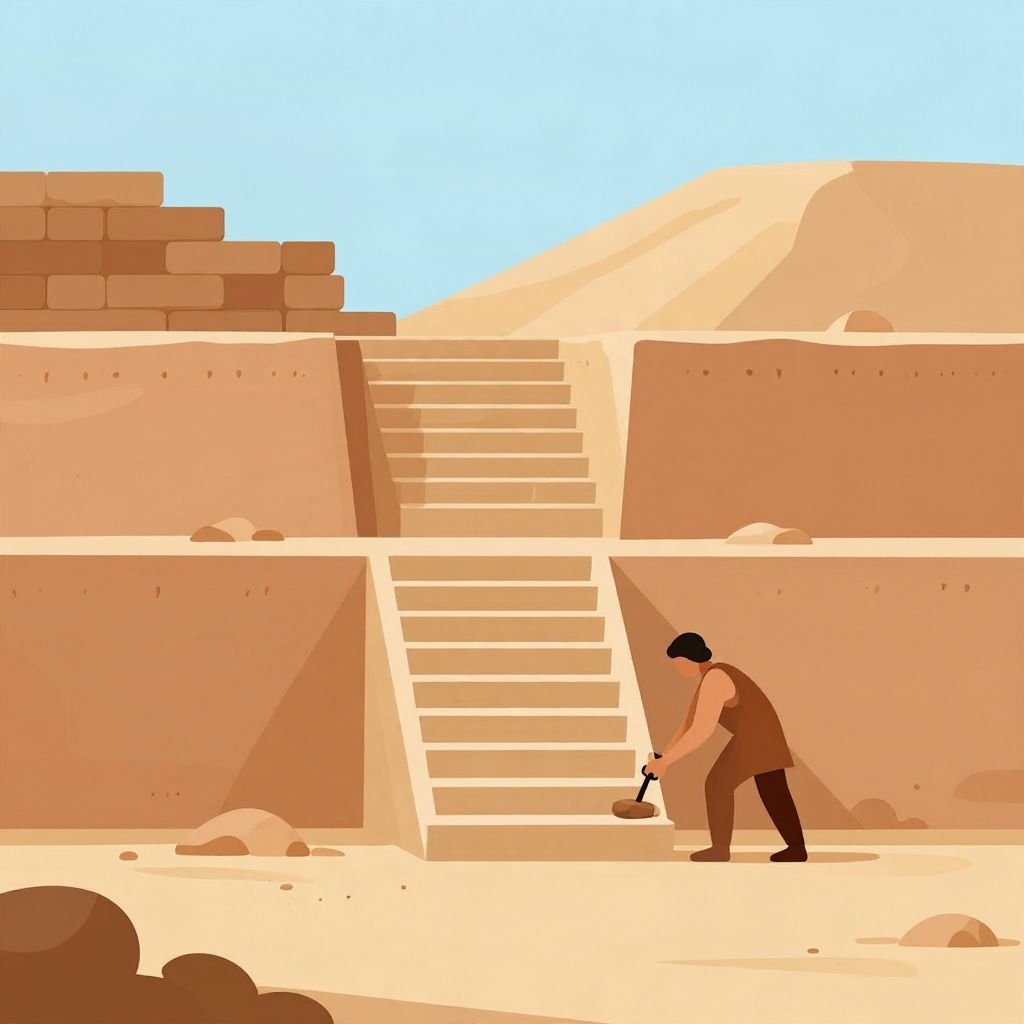
When were stairs invented? The short answer is that stairs are very ancient—older than recorded history—and they likely developed gradually as humans began shaping landscapes, caves, and buildings to move between different levels more easily.
There is no single inventor of stairs. Archaeology shows that step-like forms appeared in prehistoric shelters and early settlements, then became more deliberate in the great stone and mud-brick architectures of the ancient world.
When Were Stairs Invented?
Stairs were not invented at one exact moment. Simple steps probably existed in prehistory, while the earliest clearly built stairways appear in ancient Mesopotamia and Egypt by the 4th millennium BCE. By the time of the pyramids, ziggurats, and palace complexes, stairs were already an established architectural feature.
How Stairs Began: From Natural Steps to Built Architecture
Before there were formal staircases, people used natural slopes, rock ledges, tree roots, and cut earth to climb between elevations. The first “stairs” were likely improvised: a series of footholds carved into stone, packed earth, or timber. In that sense, stairs emerged from practical need rather than from a single technological breakthrough.
Prehistoric and early human use
Long before cities, humans lived in environments where elevation mattered. Cave entrances, cliff dwellings, terraces, and riverbanks often required climbing. Archaeologists have found evidence of carved steps in some prehistoric contexts, but these are difficult to date precisely because many early structures were made from perishable materials like wood and earth.
That uncertainty is important. We can say stairs are ancient, but we cannot point to one “first staircase” in the way we might identify a first steam engine or first airplane. The idea of steps is older than writing, and likely older than many surviving monuments.
The Earliest Known Stairways in the Ancient World
The earliest securely documented staircases come from the ancient Near East, especially Mesopotamia. By the 4th millennium BCE, large religious and civic structures often included stairways or stepped approaches. These were not just functional; they also signaled power, hierarchy, and sacred access.
Mesopotamia and stepped temples
In Mesopotamia, stairways were closely tied to temple architecture. The stepped ziggurat became one of the most recognizable forms of ancient monumental building. These structures used broad staircases or ramps to connect ground level with elevated shrines. Their design reflected both engineering skill and religious symbolism: ascent represented moving closer to the divine.
Ancient Egypt and monumental access
Egypt also used stairs in tombs, temples, and later monumental complexes. The Step Pyramid of Djoser, built around the 27th century BCE, is especially important because it transformed the idea of a tomb into a stepped stone monument. While the pyramid itself is not a staircase, its tiered form shows how the step motif became central to early monumental architecture.
A Brief Timeline of Stair Development
Because stairs evolved over thousands of years, it helps to think in stages rather than a single invention date.
- Prehistory: People use natural slopes and carve rough footholds into stone or earth.
- 4th millennium BCE: Early built stairways appear in Mesopotamian and neighboring cultures.
- 3rd millennium BCE: Monumental staircases become common in temples, tombs, and palaces.
- Classical antiquity: Greeks and Romans refine stairs for public buildings, theaters, homes, and infrastructure.
- Medieval and early modern periods: Stairs become more standardized in castles, churches, and urban buildings.
- Industrial era onward: Building codes, fire safety, and mass construction make stairs a universal architectural element.
Why Stairs Developed in the First Place
Stairs solved a basic human problem: how to move efficiently and safely between different heights. As settlements grew more complex, elevation became useful for defense, storage, drainage, ceremony, and status. Stairs made these spaces accessible and also gave architects a way to shape movement and meaning.
Practical reasons
- Access to raised platforms, terraces, and upper floors
- Movement through steep or uneven terrain
- Entry to defensive walls, towers, and fortifications
- Connection between storage areas and living spaces
Symbolic reasons
- Ritual ascent toward temples or shrines
- Display of authority in palaces and monuments
- Separation of sacred, elite, and ordinary spaces
- Visual emphasis on grandeur and order
Stairs in Classical Civilizations
By the time of ancient Greece and Rome, stairs were a familiar part of urban life. Builders used them in theaters, temples, forums, baths, villas, and apartment buildings. The classical world helped refine stair design by combining function, proportion, and aesthetics.
Greek architecture
Greek temples often stood on stepped platforms, and stairways helped define the approach to sacred buildings. The rise of stone construction allowed more durable and carefully measured steps. In theaters, stairways also helped organize crowds and shape movement through the seating areas.
Roman engineering
The Romans expanded stair use on a vast scale. Their cities included multistory buildings, monumental public spaces, and military structures that required reliable vertical circulation. Roman staircases were built in stone, brick, and concrete, and they often appeared in combination with arches, vaults, and corridors. This made stairs part of a larger engineering system rather than an isolated feature.
Were Stairs “Invented” or Gradually Improved?
Historically, stairs were gradually improved rather than invented all at once. The basic idea—creating a series of steps to overcome height—was probably discovered many times in different places. What changed over time was the precision, durability, and cultural importance of stairs.
Early steps may have been rough and utilitarian. Later staircases were carefully measured for comfort, safety, and visual effect. In many civilizations, stairs became an architectural language in their own right, signaling rank, sacredness, and civic order.
Materials and Construction: From Earth to Stone
The history of stairs is also the history of building materials. The earliest steps were likely made from whatever was available: compacted soil, timber, packed rubble, or carved rock. As societies developed masonry traditions, stairs became more permanent and more elaborate.
Common early materials
- Earth: easy to shape, but vulnerable to erosion
- Wood: flexible and accessible, but less durable
- Stone: long-lasting and suitable for monumental architecture
- Brick and mortar: useful in urban and palace construction
Stone stairways mattered because they could survive for millennia. That is one reason the archaeological record favors ancient monumental stairs over everyday wooden ones, which often disappeared long ago.
Stairs and Social History
Stairs are easy to overlook, but they reveal a great deal about how past societies lived. The presence of stairs often indicates multi-level architecture, urban density, social hierarchy, and specialized labor. They also show how people organized movement through space, from the private to the public and from the ordinary to the sacred.
In elite buildings, staircases could impress visitors and control access. In ordinary homes, they made upper floors usable. In public architecture, they helped manage crowds. In all these settings, stairs were both practical and political.
How Stair Design Changed Over Time
As architecture evolved, so did stair design. Builders learned that the height and depth of each step affected comfort and safety. Wider staircases suited ceremonial spaces, while narrower ones worked in towers and homes. Curved, spiral, and split staircases later became common in castles, mansions, and civic buildings.
These developments did not erase earlier forms. Instead, they added variety. A monumental temple stair, a narrow medieval spiral stair, and a modern fire-escape stair all serve the same basic purpose, but each reflects a different historical need.
So, What Is the Best Answer?
If you want a precise answer to “when were stairs invented,” the most accurate response is this: stairs have prehistoric origins, but the earliest clearly built stairways appear in the ancient Near East by about 4000 BCE, with major examples in Mesopotamia and Egypt soon after. Since no single inventor is known, stairs are best understood as a gradual human innovation.
Their long history explains why they remain such a fundamental part of architecture. Stairs are one of humanity’s oldest solutions to movement, access, and design—simple in principle, but historically rich in meaning.
If you want to explore the broader architectural world that gave stairs their importance, you may also enjoy reading about cultural preservation in architecture and how old the Colosseum is.