
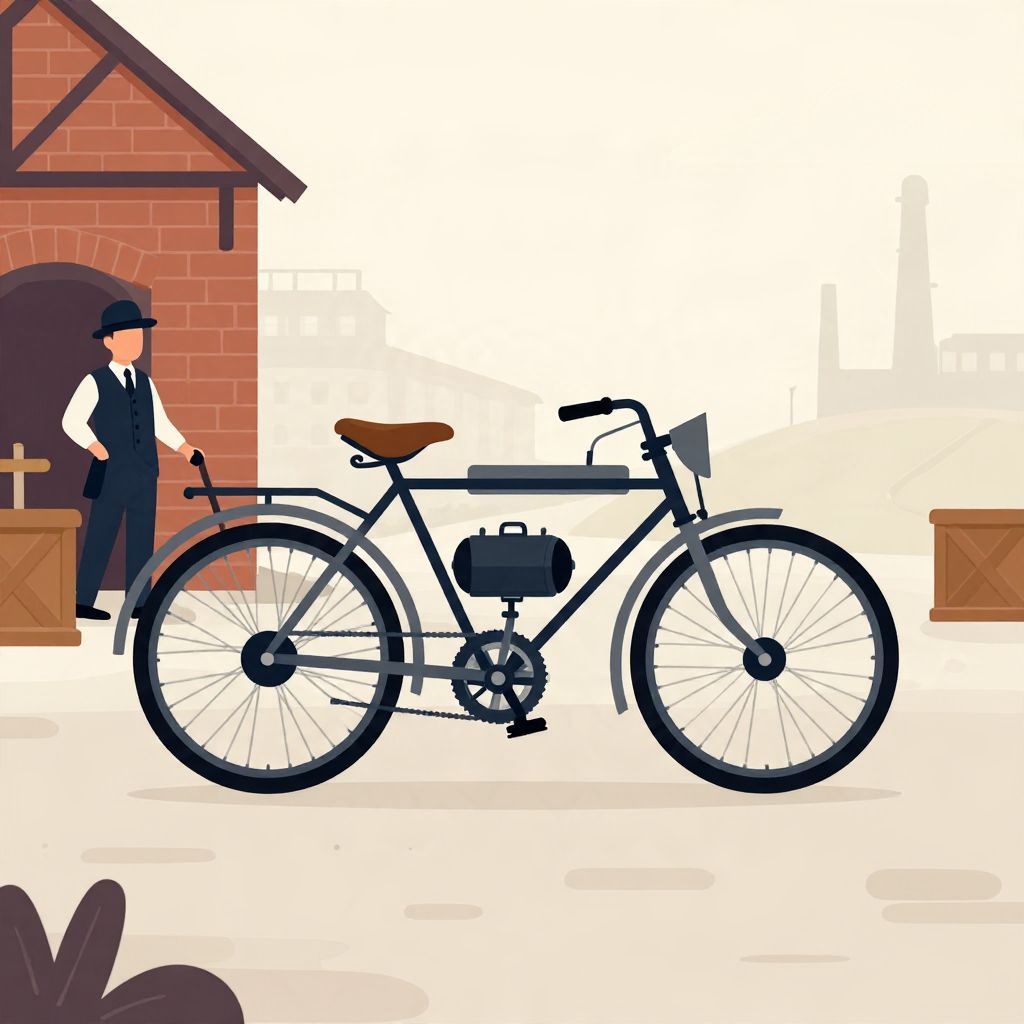
When was the first motorcycle made? The short answer is that the first recognizable motorcycle was built in 1885, when German inventors Gottlieb Daimler and Wilhelm Maybach created the Reitwagen, a gasoline-powered wooden test machine. It is widely regarded as the first true motorcycle because it used an internal combustion engine and was designed for riding, not just as a stationary engine on wheels.
The story is a little more complicated than a single date, though. Earlier steam-powered two-wheelers existed, and later inventors improved on Daimler and Maybach’s design. So the answer depends on how strictly you define “motorcycle.”
When Was the First Motorcycle Made?
The first widely accepted motorcycle was made in 1885 in Germany. Daimler and Maybach’s Reitwagen is usually credited as the first motorcycle because it was a two-wheeled, motor-driven vehicle built for riding. If steam-powered machines are included, earlier prototypes appeared in the 1860s and 1870s, but the 1885 gasoline-powered machine marks the real beginning of the motorcycle era.
What Made the Reitwagen the First Motorcycle?
The Reitwagen matters because it combined a compact internal combustion engine with a frame intended to carry a rider. It was not a practical modern motorcycle, but it was a crucial breakthrough: it showed that a small engine could propel a lightweight personal vehicle. That idea became the foundation of motorcycle development worldwide.
The machine itself
The Reitwagen was a wooden-framed test vehicle with two main wheels and small stabilizing wheels to help it balance. Its engine was a single-cylinder gasoline engine, a major innovation for the time. Daimler and Maybach were not trying to create a finished consumer product; they were experimenting with how to apply their new engine technology to transport.
Why historians usually choose 1885
Historians often call the Reitwagen the first motorcycle because it was the first machine that clearly matched the core idea of a motorcycle: a motorized, rider-controlled two-wheeler. Earlier machines may have had engines and wheels, but they were often steam-driven, experimental, or closer to mechanical curiosities than to the vehicle type that later became known as a motorcycle.
A Brief Timeline of Early Motorcycle History
The first motorcycle did not appear out of nowhere. It emerged from decades of experiments with steam power, engines, and lightweight vehicle design. Here is the basic timeline:
- 1860s–1870s: Inventors in Europe and the United States experimented with steam-powered bicycles and tricycles.
- 1885: Daimler and Maybach built the Reitwagen in Germany, the first commonly recognized motorcycle.
- 1886: Daimler demonstrated the usefulness of the gasoline engine in other vehicles, helping accelerate motor transport development.
- 1890s: Other inventors and companies began producing motorized bicycles and early motorcycles in larger numbers.
- 1900s: Motorcycle design became more recognizable to modern riders, with stronger frames, better steering, and improved engines.
Were There Motorcycles Before 1885?
There were earlier motorized two-wheelers, but most historians do not call them the first motorcycle in the modern sense. The main reason is that they relied on steam rather than gasoline, or they were too experimental to count as the direct ancestor of the motorcycle as we know it.
The steam-powered predecessors
Some inventors built steam bicycles and steam tricycles before 1885. These machines were important because they proved that a small vehicle could move under its own power. However, steam engines were bulky, slow to start, and awkward for a lightweight personal vehicle. They were steps toward motorcycling, but not the breakthrough most people mean by “the first motorcycle.”
The definition problem
There is no single universal rule for deciding what counts as a motorcycle. If “motorcycle” means any two-wheeled vehicle powered by a motor, then earlier steam experiments become relevant. If it means the first gasoline-powered two-wheeler built as a riding machine, then the Reitwagen is the strongest answer. That is why the date is sometimes explained as 1885 but with a note about earlier prototypes.
Who Invented the First Motorcycle?
The first motorcycle is usually credited to Gottlieb Daimler and Wilhelm Maybach. Both were German engineers who worked together on engine development. Daimler is often named first because he was the more publicly associated figure, but Maybach played a major role in the technical design and engineering work.
Gottlieb Daimler
Daimler was focused on making small, high-speed engines that could be used in many kinds of transport. His work helped shape the future of automobiles, boats, and motorcycles. The Reitwagen was part of that larger vision.
Wilhelm Maybach
Maybach was one of the era’s most gifted engineers and designers. He helped turn Daimler’s engine ideas into practical machines. Later, Maybach became an important figure in luxury automotive history as well, but his early work on the Reitwagen was central to motorcycle history.
Why the First Motorcycle Was Important
The first motorcycle was more than a novelty. It represented a new way of thinking about personal transport. Before this, most individual travel depended on horses, bicycles, or walking. The motorcycle promised speed, independence, and mechanical power in a compact form.
A bridge between bicycles and cars
The motorcycle developed in the same broader era as the automobile. In many ways, it occupied the middle ground between the bicycle and the car: lighter and cheaper than a car, but faster and more powerful than a pedal cycle. That made it especially attractive in the early 20th century, when roads and transport systems were changing rapidly.
Influence on later engineering
The Reitwagen was not a mass-produced vehicle, but it demonstrated that internal combustion engines could be made small enough for personal transport. That idea influenced motorcycle manufacturers, automobile builders, and engine designers. The machine’s importance lies less in how it looked and more in what it proved possible.
How Motorcycle Design Evolved After 1885
After the Reitwagen, inventors and manufacturers worked to solve practical problems. Early motorcycles needed better stability, stronger frames, more reliable engines, and safer steering. The result was a rapid evolution from experimental contraptions into usable vehicles.
From experimental to practical
Early motorcycles were often fragile and difficult to ride. As production expanded in the 1890s and early 1900s, builders improved suspension, tires, braking systems, and engine reliability. These changes made motorcycles more than engineering demonstrations; they became real transportation for commuters, messengers, racers, and military users.
The rise of motorcycle companies
By the turn of the 20th century, several companies were producing motorcycles or motorized bicycles. This commercial phase helped standardize the machine and spread motorcycle culture beyond inventors’ workshops. Racing also played a major role, because competition pushed manufacturers to improve speed and durability.
Common Myths About the First Motorcycle
Because the history of the motorcycle is often simplified, a few myths appear again and again. The most common one is that there was a single obvious “first motorcycle” with no debate. In reality, the answer depends on how the vehicle is defined.
- Myth: The first motorcycle was a modern-looking bike.
Reality: The Reitwagen was a wooden experimental machine, not a sleek modern motorcycle. - Myth: There were no earlier motorized two-wheelers.
Reality: Steam-powered predecessors existed, though they are usually not counted as the first motorcycle. - Myth: One inventor alone created the motorcycle.
Reality: Motorcycle history developed through many inventors, with Daimler and Maybach making the key breakthrough in 1885.
The Historical Legacy of the First Motorcycle
The first motorcycle helped launch a new era of mobility. It showed that a small engine could power a personal vehicle efficiently enough to be useful. From that point on, motorcycles evolved into practical transport, sporting machines, military vehicles, and cultural symbols of freedom and speed.
Its legacy is also tied to broader industrial history. The motorcycle emerged from the same late-19th-century world that produced the automobile, mass manufacturing, and modern mechanical engineering. In that sense, the first motorcycle was not just a vehicle; it was part of a larger transformation in how people moved through the world.
So, When Was the First Motorcycle Made?
The best historical answer is 1885, when Gottlieb Daimler and Wilhelm Maybach built the Reitwagen in Germany. If you are asking about the first gasoline-powered motorcycle-like machine, that is the date most historians use. If you include earlier steam-powered experiments, the story begins a little earlier, in the decades before 1885.
For readers interested in other origin stories, you may also enjoy related history articles on what was the first and the first war. The first motorcycle remains a classic example of how invention develops through experimentation, not a single isolated moment.