
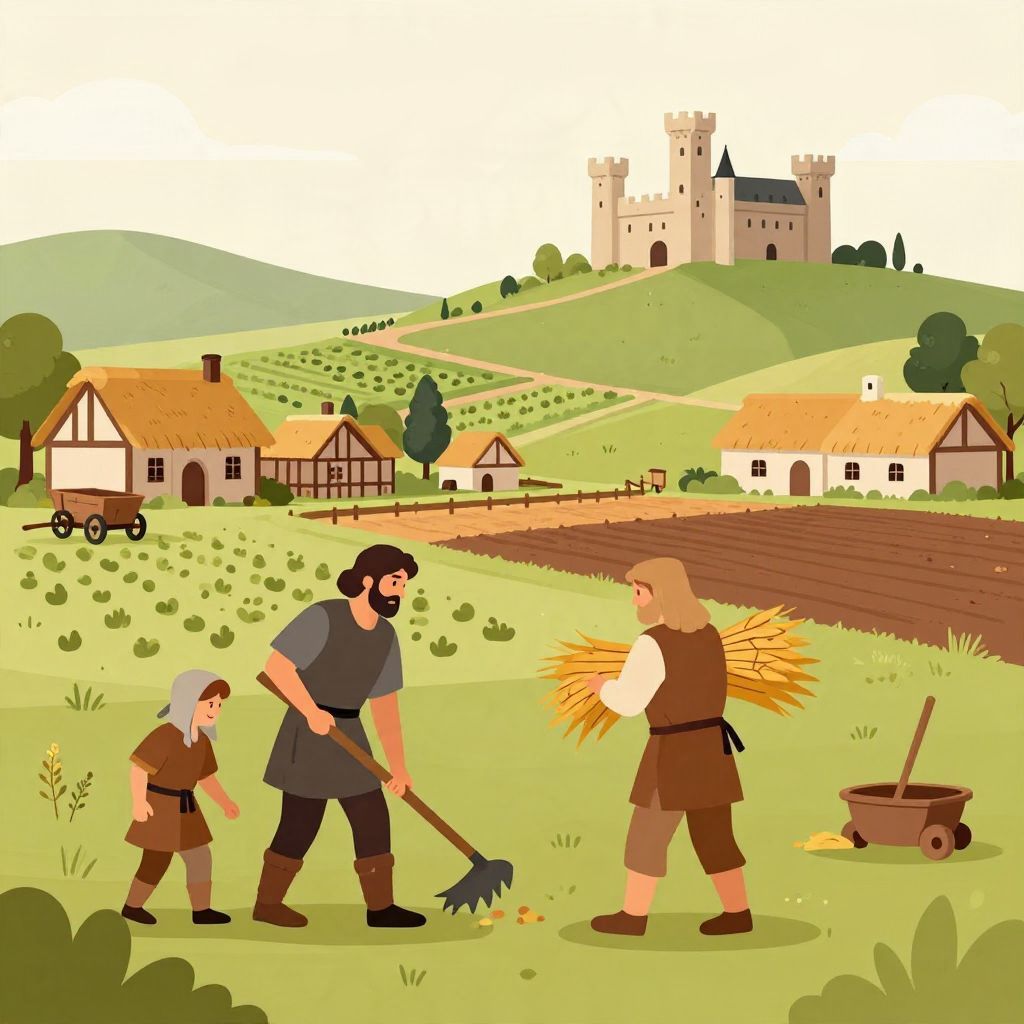
Serfs were unfree peasants tied to a lord’s land in medieval and early modern Europe. They were not enslaved in the same legal sense as chattel slaves, but they also were not free to leave, marry, or pass property without their lord’s permission. Their lives sat between freedom and bondage.
Serfdom shaped rural society for centuries, especially after the collapse of the Western Roman Empire and during the feudal age. To understand serfs is to understand how land, labor, law, and power worked in much of Europe before modern ideas of individual freedom took hold.
What Are Serfs?
Serfs were peasants legally bound to a lord’s estate, required to work the land, pay dues, and obey local obligations in exchange for protection and the right to farm a plot for their own subsistence. They were a core part of manorial society in medieval Europe. Unlike free tenants, serfs could not simply move away or choose another employer without permission.
Where Did Serfdom Come From?
Serfdom developed gradually from the late Roman world into the early Middle Ages, roughly from the 4th to 10th centuries. It did not appear all at once. As central Roman authority weakened, large landowners increasingly controlled rural populations through local custom, debt, and legal dependence. Over time, these arrangements hardened into hereditary status in many regions.
From Roman estates to medieval manors
Late Roman agriculture already included dependent tenants, especially coloni, who were tied to land by law and custom. After the empire in the West fragmented, many rural communities sought protection from local lords, bishops, or monasteries. In exchange for security and access to land, peasants accepted obligations that limited their freedom. Medieval serfdom was therefore not a sudden invention, but a transformation of older dependency.
Why did serfdom spread?
Several forces encouraged it:
- Political instability after Roman rule made local protection valuable.
- Weak central governments meant local lords could enforce custom on the ground.
- Labor scarcity in some regions increased the value of tied agricultural workers.
- Manorial agriculture depended on dependable labor to cultivate a lord’s demesne, or estate land.
How Did Serfdom Work in Daily Life?
Serfs usually lived in villages and worked strips of land in open-field systems or on mixed estates. They farmed for their own households, but also owed labor services, rent in kind, or cash payments to their lord. Their obligations varied widely by region, period, and local custom, which is why serfdom was never identical everywhere.
Common duties and restrictions
A serf might be required to:
- Work several days a week on the lord’s fields
- Give part of the harvest or produce as rent
- Use the lord’s mill, oven, or wine press for a fee
- Pay marriage dues or inheritance dues
- Ask permission to leave the manor, marry outside it, or pass land to heirs
These duties were burdensome, but serfs usually retained some rights. They could often cultivate family plots, inherit customary holdings, and appeal to manorial courts. Their status was restrictive, yet it was also structured by law and tradition rather than arbitrary violence alone.
Serfs were not the same as slaves
It is important to distinguish serfdom from slavery. Slaves were generally treated as property and could be bought and sold as individuals. Serfs were attached to land and community; they were unfree, but they often had recognized customary rights. Still, the boundary could blur in practice, especially where lords exercised harsh control or where legal protections were weak.
What Did Serfs Do for a Living?
Most serfs were farmers, because medieval Europe was overwhelmingly rural. They grew grain, kept livestock, maintained tools, repaired fences, and participated in communal agricultural routines. In some areas, serfs also practiced crafts, forestry, fishing, or seasonal labor, but agriculture remained the foundation of their existence.
The manorial economy
The manor was both an economic unit and a social order. A typical manor included the lord’s demesne, peasant holdings, common pasture, woods, and a village settlement. The lord extracted labor and dues, while peasants relied on the manor for land access and legal stability. This system linked production and power very closely.
Life was local and customary
Because transport was limited and markets were smaller than in later centuries, most serfs lived within a narrow local world. Their lives were shaped by the agricultural calendar, church festivals, village obligations, and the authority of the manor court. Custom mattered enormously, and in many places disputes were settled by local precedent rather than written law alone.
When Were Serfs Most Common?
Serfdom was widespread in medieval Europe from about the 9th to the 14th centuries, though its exact timing varied by region. It was especially prominent in parts of France, England, Germany, central Europe, and eastern Europe. In some areas it weakened earlier; in others it became more severe later.
Western Europe
In western Europe, serfdom began to decline in many places after the late Middle Ages. Population loss from the Black Death in the 14th century increased labor bargaining power, and growing towns and markets offered alternatives to rural dependence. By the 15th and 16th centuries, many western regions had moved toward rent-paying tenants rather than fully bound serfs, though local variations remained.
Eastern Europe
In parts of eastern Europe, serfdom intensified later, especially from the 15th through 18th centuries. Landlords there often sought to increase grain production for export, and weaker urban economies gave peasants fewer alternatives. This later “second serfdom” is a major reason historians avoid treating serfdom as a single uniform European experience.
How Did Serfdom Change Over Time?
Serfdom was not static. It evolved as warfare, demography, trade, and law changed. In some places, lords converted labor services into cash rents. In others, peasants negotiated better terms or won greater mobility. Over the long term, market growth and stronger states gradually undermined the old manorial order.
Black Death and labor shortages
The plague that struck Europe in the mid-14th century killed a large share of the population. With fewer workers available, many peasants could demand better conditions. Some lords tried to freeze wages or restore old obligations, but they often struggled to enforce them. The result was not immediate freedom everywhere, but a major shift in the balance of power.
Law, revolt, and negotiation
Peasant uprisings sometimes challenged serfdom directly. The English Peasants’ Revolt of 1381, for example, reflected anger over taxation, labor obligations, and social inequality. Not all revolts ended serfdom, but they showed that peasants were not passive. In many regions, freedom expanded through negotiation, legal change, and economic pressure rather than through a single dramatic abolition.
What Was the Social Meaning of Being a Serf?
Being a serf meant living in a society where status was inherited and inequality was normal. A person’s obligations were tied to birth, land, and custom. Serfdom limited mobility and opportunity, but it also gave rural households a place within a recognized social order. The system was exploitative, yet it was also deeply embedded in medieval ideas of duty, hierarchy, and mutual obligation.
Religion and legitimacy
Medieval Christian thought did not create serfdom, but it often helped explain social hierarchy as part of an ordered world. Clergy sometimes criticized cruelty and urged fair treatment, yet they also lived within the same social system. Monasteries and bishops could themselves be major landholders with dependent peasants. This made serfdom a religious as well as economic reality.
Women and family life
Serfdom affected men and women differently, but both were constrained by it. Women labored in the fields, managed households, processed food, and contributed to family survival. Marriage could be subject to manorial dues or approval. Inheritance patterns also mattered, because family holdings had to be preserved across generations under the lord’s control.
When Did Serfdom End?
There is no single date when serfdom ended. It declined at different times across Europe and survived in some forms much longer than many people assume. In western Europe it faded gradually from the late medieval period onward. In Russia, serfdom remained powerful until the 19th century, and it was formally abolished in 1861 under Tsar Alexander II.
Why did it disappear?
Serfdom weakened because of several long-term changes:
- Urban growth offered peasants alternative livelihoods.
- Commercial agriculture encouraged cash rents and wage labor.
- Stronger states reduced the power of local lords in some regions.
- Legal reform gradually replaced customary dependence with new property relations.
Even after formal serfdom ended, rural poverty, debt, and landlord power often remained. Legal freedom did not automatically produce economic equality.
Why Do Serfs Matter in History?
Serfs matter because they reveal how power worked in premodern societies. They show that freedom has a history: it was not always assumed, and it was not distributed equally. Serfdom also helps explain the rise of towns, markets, revolts, state power, and modern ideas about rights and labor.
In simple terms, serfs were unfree rural workers bound to land and lordship, central to medieval agriculture and social order. Their history stretches from the post-Roman world to the gradual transformation of European society over many centuries. If you want to explore the wider system around them, see what a vassal state is and what the Holy Roman Empire was.