
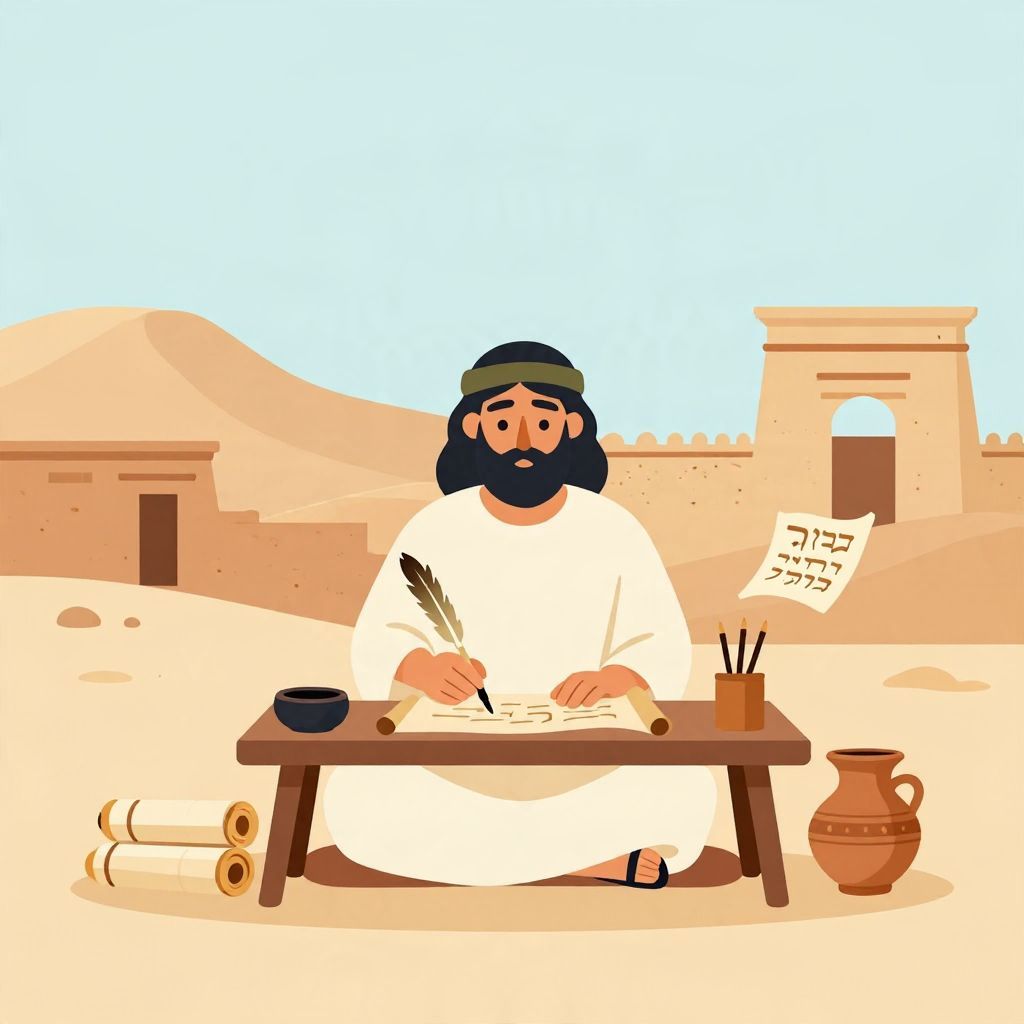
What language was the Old Testament written in? The short answer is that it was written primarily in Hebrew, with smaller sections in Aramaic. That simple answer, however, hides a long history of composition, editing, translation, and preservation across many centuries in the ancient Near East.
The Old Testament did not appear all at once. Its books were written, copied, and collected over time by different communities in ancient Israel and Judah, then preserved by Jewish scribes and later translated for wider audiences. Understanding its languages helps explain how the text developed and why it survives in multiple forms today.
What Language Was the Old Testament Written In?
The Old Testament was written mostly in Biblical Hebrew, the main language of ancient Israelite literature, religion, and administration. A few passages are in Aramaic, a related Northwest Semitic language that became widely used across the Near East in the first millennium BCE. The original language mix reflects the long and complex history of the text.
Hebrew: The Main Language of the Old Testament
Why Hebrew dominates the text
Most of the Old Testament was composed in Hebrew because Hebrew was the language associated with the kingdoms of Israel and Judah. It was used in everyday life, royal administration, legal traditions, poetry, and religious writing. Many of the oldest biblical traditions likely began as oral material before being written down in Hebrew.
Hebrew belongs to the Semitic language family, alongside Aramaic and Phoenician. In the biblical period, it was especially suited to poetry, law, prophecy, and narrative. Books such as Genesis, Exodus, Samuel, Kings, Psalms, and Proverbs are overwhelmingly Hebrew, though scholars recognize that these books were edited over time rather than written by a single hand at one moment.
Biblical Hebrew and its historical setting
Biblical Hebrew developed in the Iron Age, roughly the late second and first millennia BCE. It was not identical to modern Hebrew, though the two are historically connected. The language changed over time, and biblical books preserve older and later forms of Hebrew. Some texts reflect early linguistic features, while others show signs of later revision or scribal updating.
Because the Old Testament spans many centuries, its Hebrew is not uniform. Early poetry can look different from later prose, and some books show vocabulary or grammar shaped by the period of exile and return from Babylon in the 6th and 5th centuries BCE. This does not mean the books are unreliable; it means they were living texts in a living language.
Which Parts of the Old Testament Are in Aramaic?
A few sections of the Old Testament are written in Aramaic, not Hebrew. These include parts of Ezra and Daniel, and a short phrase in Jeremiah. Aramaic became an important international language in the ancient Near East, especially during the Assyrian, Babylonian, and Persian empires, so its presence in the Bible reflects historical reality.
The Aramaic passages
- Jeremiah 10:11 contains a single Aramaic verse amid Hebrew text.
- Ezra 4:8–6:18 and Ezra 7:12–26 contain substantial Aramaic sections.
- Daniel 2:4b–7:28 is largely written in Aramaic.
These passages likely survived because they were associated with imperial administration, diplomatic correspondence, or court settings. Aramaic served as a practical language across a large empire, much as a shared administrative language does in later historical periods. Its presence in the Old Testament is one of the clearest signs that the Bible emerged in a multilingual ancient world.
Why Aramaic mattered
By the 6th century BCE, Aramaic had become a major lingua franca from Mesopotamia to the Levant. Jewish communities living under imperial rule would have encountered it regularly. After the Babylonian exile, many Jews were bilingual or lived in environments where Aramaic was increasingly common. That shift helps explain why later biblical material includes Aramaic alongside Hebrew.
When Was the Old Testament Written?
The Old Testament was written over a very long period, likely from around the 10th century BCE to the 2nd century BCE, though many books took shape gradually and were edited after their earliest composition. There is no single date for the whole Old Testament. Instead, it is a library of texts that developed across centuries of Israelite, Judahite, exilic, and post-exilic history.
A broad timeline of composition
- Early traditions likely circulated orally before being written down.
- Monarchic period texts may have begun to form in the kingdoms of Israel and Judah, especially legal, court, and prophetic materials.
- Exilic period (6th century BCE) likely saw major editing and preservation efforts after the Babylonian conquest.
- Post-exilic period (5th–4th centuries BCE) produced further compilation and theological shaping.
- Later Second Temple period saw continued transmission and final stabilization of many books.
Scholars debate the exact dating of individual books, and some biblical texts may preserve much older traditions than the form in which they now appear. For example, some poems and laws may reflect early material, while the final literary shape of a book could be much later. The important point is that the Old Testament was not written in a single burst but assembled over generations.
How the Old Testament Was Preserved and Edited
From oral tradition to written text
Ancient societies often preserved history, law, and sacred memory orally before committing them to writing. The Old Testament likely contains material that moved from oral tradition into written form, then through copying and editing by scribes. In the ancient world, scribes were essential cultural workers who maintained texts, standardized language, and adapted older material for new audiences.
The role of scribes
Scribal activity helped preserve the Hebrew Bible through periods of political upheaval, including the fall of the northern kingdom of Israel in the 8th century BCE, the Babylonian conquest of Judah in the 6th century BCE, and life under Persian rule afterward. As communities changed, scribes copied texts carefully but not mechanically. Small updates in spelling, grammar, and explanation could enter the tradition without altering the core message.
This is one reason scholars speak of the Old Testament as a text with layers. A passage may contain older language, later editorial framing, and theological interpretation shaped by different historical moments. That layered character is not a flaw; it is part of what makes the Old Testament a record of long-term cultural memory.
What Does the Language Tell Us About History?
Hebrew as a marker of identity
The use of Hebrew in the Old Testament is historically significant because language was tied to identity, worship, and memory. After the destruction of Jerusalem and the exile to Babylon, preserving Hebrew texts helped maintain continuity with the past. The language itself became part of the community’s sense of heritage, even as Aramaic grew more common in daily life.
Aramaic as evidence of empire and contact
The Aramaic sections show that the people behind the Old Testament were not isolated. They lived under empires, interacted with imperial bureaucracy, and adapted to multilingual realities. Rather than weakening the Bible’s historical value, this linguistic diversity helps place it firmly within the political world of the Assyrian, Babylonian, and Persian periods.
Why language matters for interpretation
Knowing the original languages helps readers understand wordplay, poetry, legal terms, and theological concepts that do not always translate neatly. Some Hebrew words carry shades of meaning that are hard to capture in English. Aramaic passages also remind readers that the Bible’s language reflects real historical change, not a single fixed moment.
Old Testament, Hebrew Bible, and Translation History
The terms Old Testament and Hebrew Bible overlap but are not identical in religious usage. “Old Testament” is the Christian term for these books in relation to the New Testament. “Hebrew Bible” is often used in Jewish and academic contexts to refer to the same core collection, emphasizing its original language and canon history.
Long before modern Bible translations, the Hebrew text was translated into other languages. The most famous early translation is the Greek Septuagint, produced beginning in the 3rd century BCE for Jewish communities in the Greek-speaking world. This translation history shows that the Old Testament was already being read beyond its original language community in antiquity.
Why translations became necessary
As Jewish communities spread across the Mediterranean and Near East, not everyone could read Hebrew fluently. Translation made the sacred texts accessible in new settings. Over time, versions in Greek, Aramaic, Latin, Syriac, and later many modern languages helped the Old Testament reach global audiences. The original Hebrew and Aramaic, however, remain the foundation of the text’s earliest form.
Common Misconceptions About the Old Testament’s Language
- Misconception: The Old Testament was written entirely in Hebrew.
Reality: Most of it was, but some important sections are in Aramaic. - Misconception: It was written at one time by one author.
Reality: It developed over many centuries and through multiple authors and editors. - Misconception: The language never changed.
Reality: Biblical Hebrew evolved, and later books reflect later stages of the language. - Misconception: Translation means the original text is lost.
Reality: The Hebrew and Aramaic traditions remain central, even though translations are important for interpretation.
Historical Significance of the Old Testament’s Language
The language of the Old Testament is historically significant because it preserves the intellectual and religious world of ancient Israel and Judah. Hebrew connects the text to the ancient Levant, while Aramaic reveals the influence of imperial rule and cross-cultural contact. Together, they show how sacred literature can grow within changing political and linguistic environments.
For historians, the Old Testament is not only a religious text but also a cultural archive. Its languages preserve traces of monarchy, exile, restoration, and community memory. For readers today, understanding those languages deepens appreciation of how the text was formed and why it has endured for so long.
So, what language was the Old Testament written in? Primarily Hebrew, with some Aramaic. That answer opens onto a much larger story of ancient Israel, empire, scribal culture, and the long preservation of sacred literature. If you want to explore further, you may also like what language the Bible was originally written in and related historical background on ancient cultural origins.