
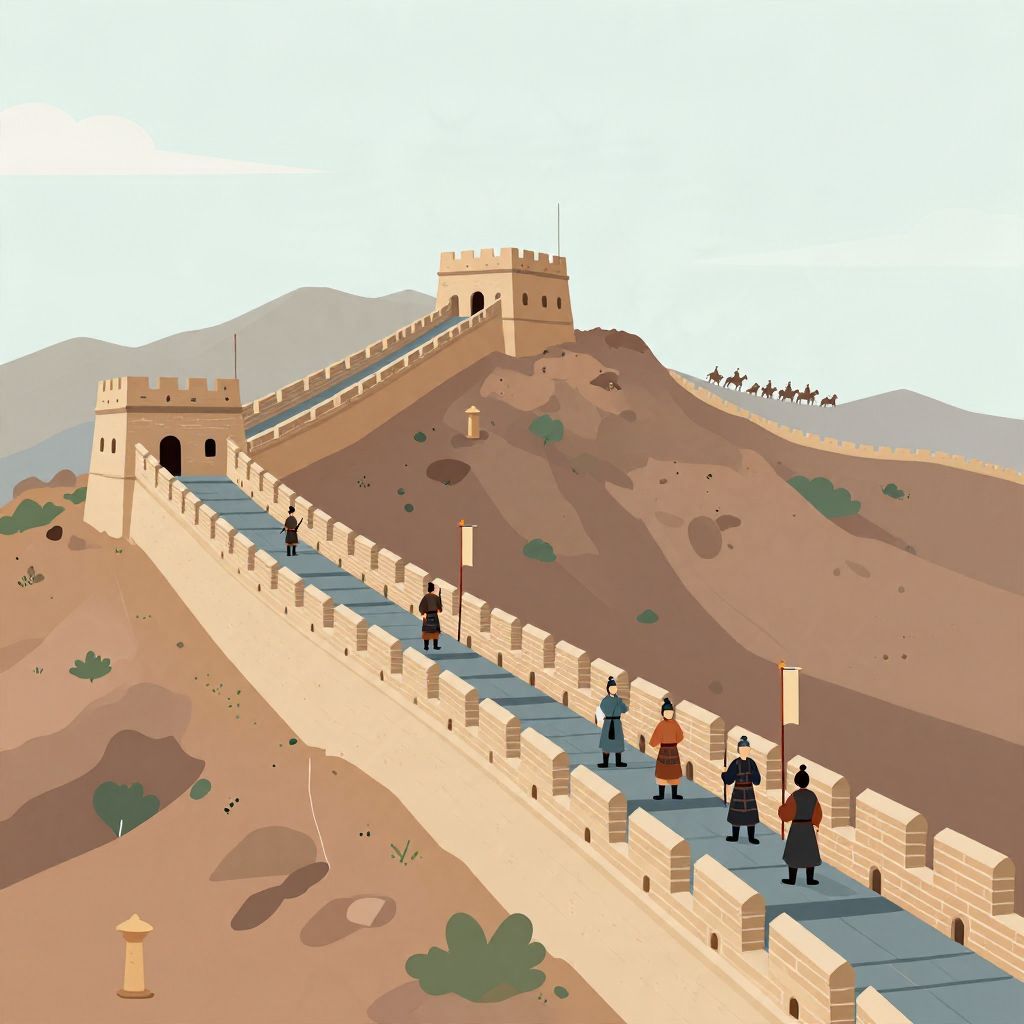
The Great Wall of China was built for one main reason: to protect Chinese states and later the Chinese empire from raids, invasions, and border instability. But it was never a single wall with one simple job. Over many centuries, different rulers used it to defend frontier regions, control movement, signal military threats, and project imperial power.
Its purpose changed over time, which is why the Great Wall is best understood as a long-running border system rather than one continuous monument. The wall’s history stretches from the Warring States period to the Ming dynasty, and its meaning reflects changing military, political, and symbolic needs.
What Was the Purpose of the Great Wall of China?
The Great Wall of China was built primarily to defend Chinese territories from northern nomadic groups and other threats, especially during periods of political fragmentation. It also helped rulers monitor borders, move troops, and assert control over frontier lands. In later centuries, it became a symbol of imperial strength and Chinese statecraft.
Why Was the Great Wall Built in the First Place?
The earliest walls were not built as a single national project. Different kingdoms in northern China began constructing defensive walls during the Warring States period (roughly 5th to 3rd centuries BCE), when rival states fought each other and needed fortified borders. These early walls were meant to slow enemy armies, protect farmland, and secure strategic passes.
When Qin Shi Huang unified China in 221 BCE, he ordered connections and extensions of earlier walls to strengthen the northern frontier. Later dynasties, especially the Han and Ming, rebuilt or expanded sections for their own military needs. So the wall’s purpose was not fixed; it evolved with the political situation.
Defense Against Raids and Invasions
The most direct purpose of the Great Wall was military defense. Chinese rulers on the northern frontier faced pressure from mobile pastoral groups such as the Xiongnu in earlier centuries and later Mongol and other steppe powers. The wall could not stop every attack, but it made surprise raids harder and gave defenders time to respond.
Its value lay less in being an impregnable barrier and more in shaping the battlefield. Towers, passes, and garrisons allowed soldiers to watch for movement, send signals, and concentrate forces where needed. In this sense, the wall was part of a broader frontier defense system.
Border Control and Administration
The wall also served an administrative purpose. It marked where imperial authority was strongest and where military command began. Gates and checkpoints helped regulate trade, migration, and the movement of people and goods. Rulers could use the wall to distinguish “inside” from “outside,” even though the frontier was often more porous than the wall’s image suggests.
This mattered because Chinese dynasties did not only fear invasion; they also wanted to manage commerce and taxation. Frontier walls could help authorities collect tolls, supervise caravans, and limit unauthorized travel. In that way, the Great Wall was as much about governance as warfare.
How Did the Purpose Change Over Time?
The Great Wall’s purpose changed with the needs of each dynasty. Sometimes it was a military line of defense; sometimes it was a symbol of legitimacy; sometimes it was a costly reminder of a ruler’s attempt to control a vast borderland. The wall’s history is best understood in phases rather than as one continuous project.
Early Walls in the Warring States Period
Before China was unified, states such as Zhao, Yan, and Qin built regional walls to defend against rivals and frontier threats. These were practical military works, often made of packed earth and stone. They were not designed as a single national barrier but as separate defenses for separate states.
The Qin Dynasty and Unification
After unification, the Qin government linked older walls and expanded frontier defenses. Traditional accounts credit Qin Shi Huang with ordering large-scale wall construction, and later Chinese history made him famous for this project. However, the popular image of him “building the Great Wall” can be misleading: he did not create one wall from nothing, but rather tied together and extended existing fortifications.
The Qin state used forced labor on a massive scale, and the project became associated with hardship and suffering. That memory helped shape the wall’s later reputation in Chinese culture.
The Han Dynasty and the Silk Road Frontier
Under the Han dynasty (206 BCE–220 CE), the wall served a wider strategic role. The Han expanded westward and built frontier defenses along routes tied to the early Silk Road. These walls and forts protected trade corridors, military outposts, and agricultural settlements in the northwest.
Here the wall was not only about repelling attacks. It helped the Han maintain influence over distant territories and support long-distance trade. The frontier was a zone of contact as well as conflict.
The Ming Dynasty and the Wall Most People Know Today
The most famous surviving sections of the Great Wall were built or rebuilt under the Ming dynasty (1368–1644). After the Ming expelled the Mongol-led Yuan dynasty, they invested heavily in frontier defense. The wall became more elaborate, with brickwork, watchtowers, garrisons, and fortified passes.
For the Ming, the wall was a serious military system designed to protect the northern heartland, especially near Beijing. It reflected a more settled and centralized state facing powerful steppe neighbors. Many of the dramatic stone sections tourists see today date from this period, not from the earliest wall-building centuries.
What the Great Wall Was Not
Popular culture sometimes presents the Great Wall as a single, perfectly continuous barrier built to keep all outsiders out. That image is powerful, but historically inaccurate. The wall was not one uninterrupted line, and it did not completely prevent invasions. Several major powers, including the Mongols and later the Manchus, eventually overcame or bypassed frontier defenses.
It also was not built only for “keeping people out.” In many periods, the wall helped rulers manage borderlands, patrol trade routes, and show that the dynasty had the power to organize large labor forces and defend the realm. Its meaning was therefore both military and political.
Did the Great Wall Actually Work?
Yes, but only in a limited and context-dependent way. The wall could delay attacks, channel enemies toward guarded passes, and give defenders warning. It was useful as part of a larger system of forts, troops, supply lines, and diplomacy. But it could not guarantee security by itself.
Steppe warfare often depended on mobility, and no wall could fully neutralize that advantage. In some eras, Chinese rulers relied as much on alliances, tribute systems, cavalry, and negotiation as on walls. The Great Wall worked best when it was integrated into broader frontier policy.
Military, Political, and Symbolic Purposes
- Military: slow raids, defend passes, and support frontier troops.
- Political: mark the reach of imperial authority and organize border administration.
- Economic: protect trade routes, farmland, and tax-producing regions.
- Symbolic: display the power, ambition, and continuity of the Chinese state.
Why Is the Great Wall So Important in Chinese History?
The Great Wall matters because it reveals how Chinese states understood security, territory, and power. It shows the long tension between settled agricultural empires and mobile frontier societies in Inner Asia. It also demonstrates that Chinese history was not isolated; it was shaped by exchange, conflict, and adaptation across a broad Eurasian frontier.
Over time, the wall became more than a military structure. It entered literature, art, and national memory as a symbol of endurance and statecraft. At the same time, historians recognize that its construction came at enormous human cost and that its practical effectiveness varied widely by era and location.
Common Misconceptions About the Great Wall
There are several myths worth clearing up. First, the wall was not built in one campaign by one emperor. Second, it was not originally a tourist monument; it was a military frontier system. Third, it did not make invasion impossible. Finally, the wall we see today is mostly the product of later rebuilding, especially under the Ming.
Another common misunderstanding is that the wall was always meant to separate “China” from “the barbarians” in a simple civilizational sense. In reality, frontier zones were dynamic places of trade, diplomacy, intermarriage, and conflict. The wall was one tool among many used to manage that complexity.
The Lasting Meaning of the Great Wall
The Great Wall’s purpose was practical at first: defense, control, and frontier management. But over centuries it became a lasting symbol of Chinese resilience and imperial authority. Its history reflects the changing needs of dynasties that faced threats from the north, sought to secure trade and territory, and wanted to project power across a vast landscape.
In short, the Great Wall of China was built to protect and organize a frontier—not to create an absolute barrier. Its real significance lies in how it combined military strategy, state administration, and symbolic power across more than two thousand years of Chinese history. For related context, see how tall the Great Wall of China is and why the Silk Road was important.