
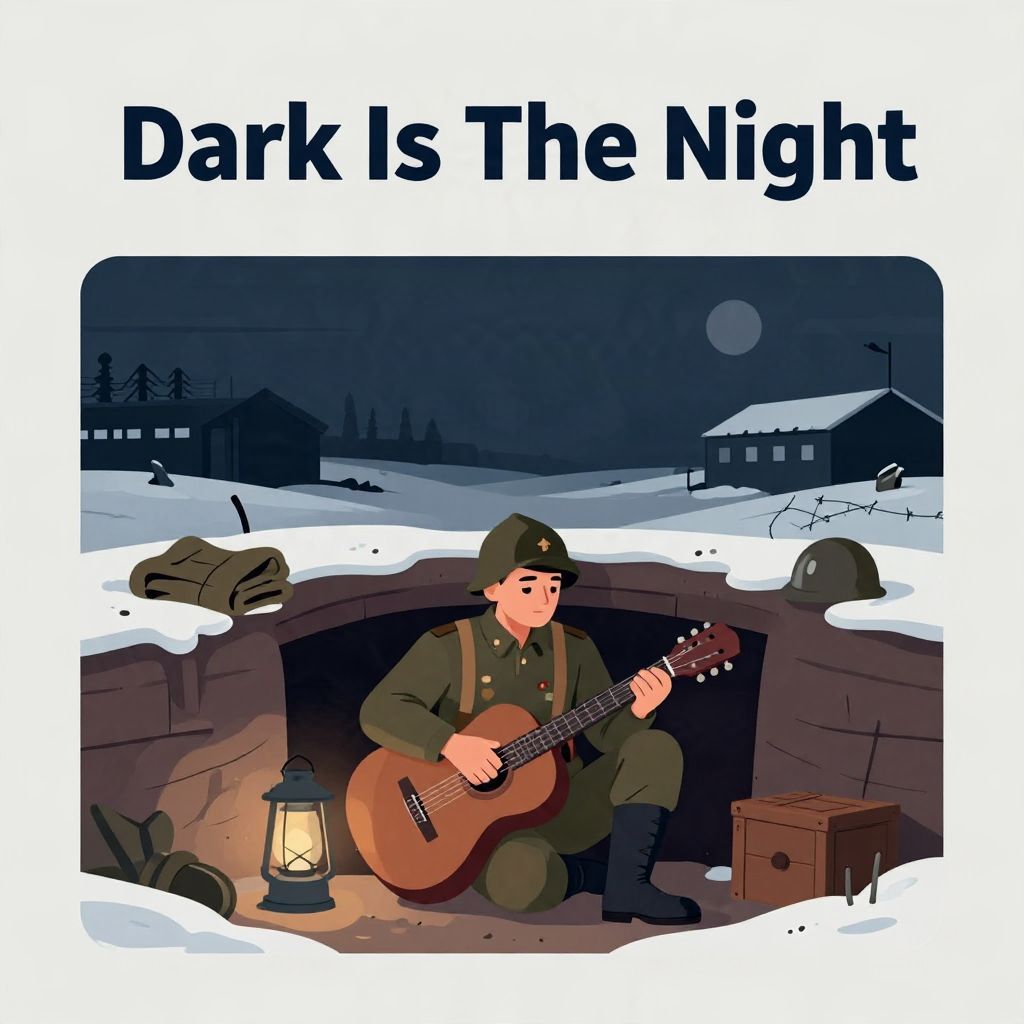
“Dark Is the Night” is best known as a Soviet-era song, not a medieval event or a political slogan. Written in the early 1940s for the film Two Soldiers, it became one of the most enduring wartime songs in Russian cultural memory and later a global symbol of longing, separation, and resilience.
Its history is tied to the Soviet home front during the Second World War, when music was used to sustain morale, express private emotion, and frame sacrifice in human terms. Understanding the song means looking at its wartime origins, its artists, and the way it outlived the conflict that produced it.
What is “Dark Is the Night”?
“Dark Is the Night” is the English title commonly used for the Soviet song Tyomnaya noch (“Dark Night”), composed in 1943 by Nikita Bogoslovsky with lyrics by Vladimir Agatov. It first appeared in the war film Two Soldiers and quickly became famous for its intimate, emotional portrayal of a soldier thinking of his family while at war.
Origins of “Dark Is the Night”
The song was created in the Soviet Union during the most difficult years of the Second World War, when millions of families were separated by military service, evacuation, and occupation. Unlike many official wartime songs that emphasized collective heroism, this one focused on private feeling: a soldier’s loneliness, fear, and hope. That emotional directness helped it resonate widely.
The film Two Soldiers
Two Soldiers was released in 1943 and directed by Leonid Lukov. The film follows Soviet soldiers and their wartime experiences, blending front-line action with moments of friendship and home-front memory. “Dark Is the Night” appears in one of its most memorable scenes, helping define the film’s emotional tone.
The song was not written as a detached patriotic anthem. It was designed for a specific cinematic moment, which is one reason it feels so personal. Its success showed that wartime culture could move audiences not only through slogans and marches, but also through quiet, reflective music.
Who wrote it?
Nikita Bogoslovsky was a prolific Soviet composer known for film music and popular songs. Vladimir Agatov, the lyricist, wrote words that are simple, direct, and easy to remember. That simplicity mattered: in wartime, songs had to be immediately accessible to soldiers and civilians of many backgrounds.
There is no serious historical dispute about the song’s authorship, though like many famous works, it has accumulated stories and anecdotes over time. The best-supported account is straightforward: it was composed for a wartime film and then took on a life of its own.
Why did the song become so famous?
The song became famous because it captured a feeling that millions of people recognized: the emotional distance between the front and home. Its melody is tender rather than triumphant, and its words speak of darkness, sleeplessness, and the hope that a loved one remains safe. In wartime, that combination gave it unusual power.
A song of private emotion in a public war
Soviet wartime culture often balanced two needs. It had to encourage endurance and collective sacrifice, but it also had to acknowledge grief, separation, and fear. “Dark Is the Night” did this especially well. It did not deny the harshness of war; instead, it gave listeners a language for missing someone.
That emotional honesty helped the song travel beyond the film itself. Soldiers sang it, radio audiences remembered it, and later generations associated it with the broader experience of the Eastern Front. It became part of the cultural memory of the Great Patriotic War, the Soviet term for the Second World War from 1941 to 1945.
The role of performance
The song’s popularity was also shaped by performance. In the film, it is associated with actor and singer Mark Bernes, whose delivery helped make the song unforgettable. Bernes was already a well-known performer, and his interpretation gave the lyrics warmth and vulnerability. For many listeners, the performance and the song became inseparable.
Timeline of “Dark Is the Night”
The song’s history can be understood through a short chronology:
- 1943: Two Soldiers is released in the Soviet Union, featuring “Dark Is the Night.”
- 1943–1945: The song spreads widely during the war and becomes associated with soldiers, families, and wartime memory.
- Postwar decades: It remains one of the most recognizable Soviet songs, performed in concerts, recordings, and films.
- Late 20th century onward: The song is rediscovered by international audiences and used in new cultural contexts, often as a symbol of melancholy and endurance.
Historical significance in the Soviet wartime experience
“Dark Is the Night” matters historically because it reveals how culture functioned during total war. Songs were not just entertainment; they were tools of emotional survival. They could reassure, unite, and humanize. This song is especially important because it shows that Soviet wartime culture was not only about victory and sacrifice, but also about tenderness and loss.
Home front and front line
Millions of Soviet citizens were displaced during the war. Families were split apart, letters were delayed or never arrived, and soldiers lived with constant uncertainty. “Dark Is the Night” gave shape to that experience. Its emotional setting—night, distance, longing—fit the reality of a war fought across enormous spaces and under extreme pressure.
In this sense, the song is a historical source of feeling, even though it is not a documentary record. It tells us how wartime life could be imagined and emotionally processed. That makes it valuable to historians of culture, memory, and everyday life in the Soviet Union.
Propaganda, art, and sincerity
Soviet wartime art often served political purposes, but that does not mean it was emotionally false. “Dark Is the Night” shows the overlap between state culture and genuine feeling. It was created within a wartime film industry and became part of a broader patriotic message, yet its appeal rested on sincerity rather than doctrine alone.
That balance helps explain its longevity. Songs that feel purely official often fade when the moment passes. Songs that speak to ordinary human experience can survive much longer.
How the song was received after the war
After 1945, “Dark Is the Night” remained popular in the Soviet Union and later across the post-Soviet world. It was performed by many singers and became a standard of Russian-language popular music. Its meaning expanded over time: for some listeners it evoked wartime sacrifice, while for others it became a more universal song of separation and memory.
International recognition
Outside the former Soviet Union, the song is often encountered through recordings, film soundtracks, and translations. Its mood is immediately accessible even to listeners who do not understand Russian. The melody and emotional structure carry much of its meaning across language barriers.
That international recognition has made the song a cultural artifact of the Second World War, alongside better-known Western wartime songs. It is frequently included in discussions of Soviet music, wartime cinema, and the emotional history of the 1940s.
Common misunderstandings about “Dark Is the Night”
Because the English title sounds poetic and general, some readers assume it refers to a historical period, a folk tradition, or a medieval era. In fact, it is a specific 20th-century song. Its title is sometimes confused with broader cultural phrases about darkness, but its historical identity is clear and well documented.
Not the “Dark Ages”
The phrase should not be confused with the historical concept of the “Dark Ages,” a term used for certain periods of early medieval European history, and now often treated cautiously by historians. “Dark Is the Night” is not about that era at all. It belongs to the Soviet wartime context of the 1940s.
Not a folk song of unknown origin
Another common misunderstanding is that it is an old folk song. It is not. Although it has the feel of something timeless, its authors, film context, and wartime date are known. Its power comes partly from the way a modern composed song can sound as emotionally universal as a traditional lament.
Why it still matters today
The lasting significance of “Dark Is the Night” lies in its ability to preserve the emotional texture of wartime life. It reminds us that history is not only battles, leaders, and treaties. It is also the experience of waiting, remembering, and hoping. That is why the song continues to be studied and performed long after the war that produced it.
For readers interested in the wider cultural background, it can be useful to compare this wartime song with other historical ideas about memory and identity, including discussions of what caused the Dark Ages and the modern aesthetic movement known as dark academia.
In historical terms, “Dark Is the Night” is a wartime cultural artifact that outlived its original moment. Born in the Soviet Union in 1943, it became a lasting symbol of separation, endurance, and emotional truth during the Second World War—and it remains one of the most recognizable songs of the era.