
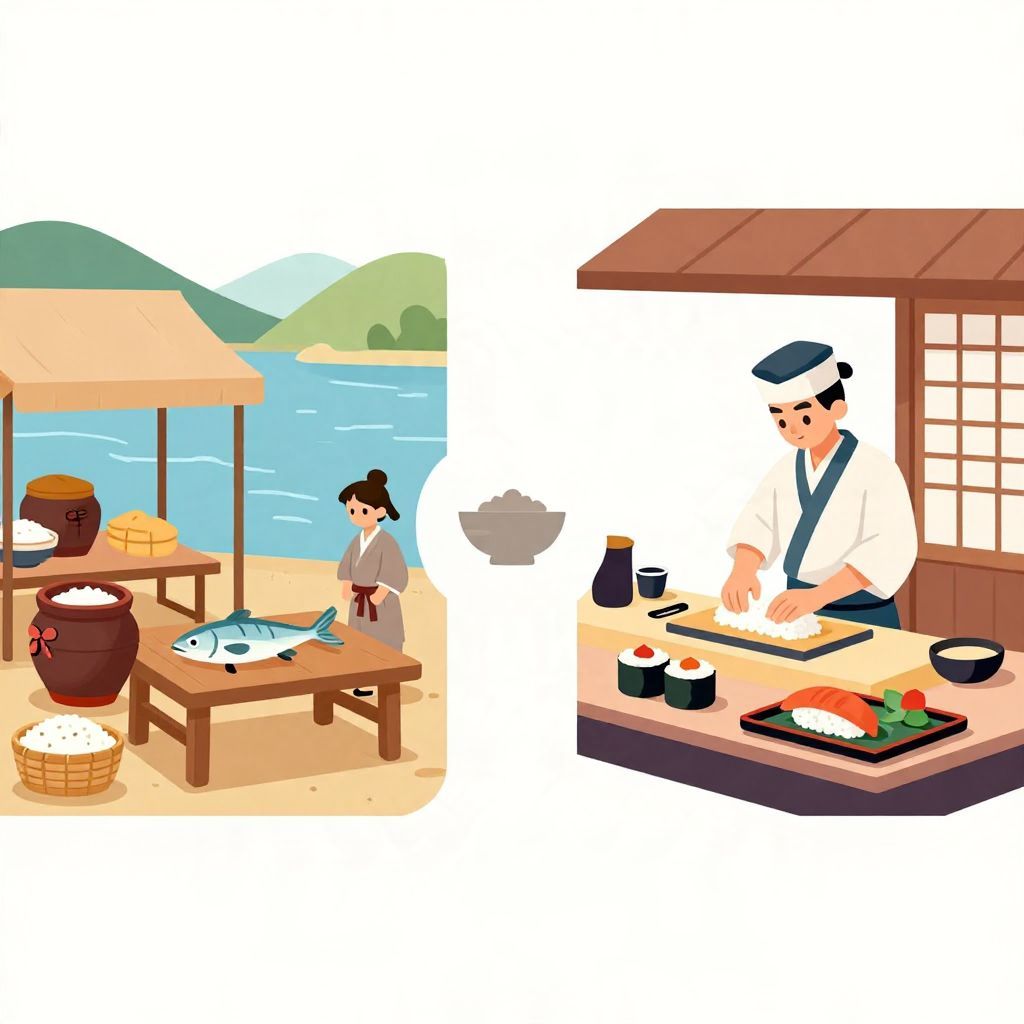
Is sushi Chinese or Japanese? The short historical answer is: both, in different ways. The earliest ancestor of sushi began in ancient China as a method of preserving fish with fermented rice, but the food known worldwide as sushi was developed in Japan over many centuries.
So if you are asking where sushi “came from,” the roots are Chinese; if you are asking where sushi as a recognizable cuisine was created, the answer is Japan.
Is sushi Chinese or Japanese?
Sushi is Japanese in its modern form, but its earliest historical ancestor likely came from China. Ancient East Asian preservation techniques used fermented rice and fish long before sushi became a Japanese culinary tradition. Over time, Japan transformed that idea into a distinct food culture, especially from the medieval period onward.
The Chinese origins of the earliest sushi-like food
Fermented fish and rice in ancient Asia
Long before modern sushi bars, people in parts of China and Southeast Asia preserved fish by packing it in salt and rice and allowing it to ferment. This method helped store food before refrigeration. The rice was not always eaten; in many early versions, it was mainly a fermentation aid and was often discarded.
Historians generally trace the broad technique behind sushi to these older preservation practices. In this sense, the “idea” behind sushi predates Japan as a national culinary identity and belongs to a wider East Asian food history.
How the technique may have spread to Japan
Exact transmission routes are difficult to prove in detail, but cultural exchange between China, Korea, and Japan was extensive in antiquity and the early medieval era. Japanese society adopted and adapted many continental practices, including writing, religion, and food preservation methods. Sushi likely arrived through this broader exchange rather than as a single, clearly documented import.
How sushi became Japanese
From preservation method to cuisine
Japan did not simply copy an imported food and leave it unchanged. Over time, Japanese cooks shortened fermentation periods, changed ingredients, and eventually developed forms where rice was meant to be eaten with the fish. This shift was crucial: sushi moved from being a preservation method to becoming a culinary dish valued for taste, texture, and presentation.
By the medieval period, Japanese regional styles of sushi had emerged. These included forms such as narezushi, in which fish fermented for long periods with rice, and later varieties that used less fermentation and were more directly edible.
The Edo period and the rise of modern sushi
The version most people recognize today—rice seasoned with vinegar and topped with fish or other ingredients—developed in Japan during the Edo period, especially in the 18th and early 19th centuries. This style, often associated with nigiri-zushi, was fast, practical, and suited to urban life in Edo, the city now known as Tokyo.
Vinegar replaced long fermentation as a way to create a tangy flavor quickly. That innovation mattered because it made sushi a fresh, convenient street food rather than a preservation technique that required weeks or months. This is one of the main reasons sushi is historically understood as Japanese cuisine.
What counts as “sushi” historically?
The word and the food are not exactly the same thing
One reason the question “Is sushi Chinese or Japanese?” can be confusing is that the term has changed over time. Early forms of sushi were not identical to the sushi served today. Some versions were strongly fermented, some were semi-fermented, and some were almost entirely fresh. The modern global image of sushi usually refers to Japanese styles, not the older preservation method.
In other words, if you define sushi by the oldest preservation technique, its ancestry is not exclusively Japanese. If you define sushi by the dish people order in restaurants today, it is unmistakably Japanese.
Common historical forms of sushi
- Narezushi – an older fermented form, closer to the preservation tradition.
- Nama-narezushi – a shorter-fermented transitional style.
- Hayazushi – “quick sushi,” using vinegar to imitate the sour taste without long fermentation.
- Nigiri-zushi – the modern hand-pressed style that became popular in Edo-period Japan.
Why people sometimes call sushi Chinese
Because the earliest ancestor was not uniquely Japanese
It is understandable to associate sushi with China because the preservation method behind it appears to have originated in ancient Chinese food culture. That does not mean sushi as a dish is Chinese in the modern sense. Rather, it means Japan inherited and transformed an older regional practice.
Because East Asian culinary history is interconnected
Modern national cuisines can make ancient food history look simpler than it was. China, Korea, and Japan all influenced one another over centuries. Foods, religious practices, writing systems, and technologies moved across borders and were reshaped locally. Sushi is a good example of this shared history: its deepest roots are regional, but its mature identity is Japanese.
Why sushi is considered Japanese today
Japan created the recognizable form
When most people say “sushi,” they mean vinegared rice combined with seafood, vegetables, or other toppings in styles developed in Japan. The culinary techniques, presentation, terminology, and restaurant culture surrounding sushi were refined in Japan. That is why sushi is classified internationally as Japanese cuisine.
Japanese culinary identity shaped global sushi
From the late 19th century onward, sushi spread beyond Japan, and in the 20th century it became a global food. As it traveled, it was adapted in many countries. Even so, the standard reference point remained Japanese. The worldwide popularity of sushi has made it one of the best-known Japanese foods in history.
The historical timeline of sushi’s development
- Ancient period – Fermented fish-and-rice preservation methods appear in parts of East and Southeast Asia, including China.
- Early Japan – The preservation technique is adopted and adapted in Japanese regions.
- Medieval Japan – Sushi evolves into multiple local styles, some with shorter fermentation.
- Edo period – Vinegar-based quick sushi develops, especially in urban centers.
- Modern era – Sushi becomes a national Japanese symbol and then an international cuisine.
What historians agree on, and what remains uncertain
What is well established
There is broad agreement that the oldest sushi-like preservation techniques were not uniquely Japanese and that Japan played the decisive role in developing sushi into the dish known today. The Japanese contribution is especially clear in the shift toward fresh, vinegared rice and the creation of modern sushi styles.
What is less certain
The exact earliest origin of the preservation method is harder to pin down. Food history from antiquity rarely leaves a neat paper trail, and practices likely developed in more than one place. Scholars therefore tend to speak carefully about “ancestors” and “influences” rather than claiming a single inventor or a single birthplace with absolute certainty.
So, is sushi Chinese or Japanese?
Sushi is historically both Chinese-influenced and Japanese in its developed form. Its oldest roots lie in an ancient East Asian preservation tradition associated with China, but the sushi that became famous around the world was shaped in Japan. If you mean origin of the technique, China is part of the answer. If you mean the cuisine people know today, Japan is the answer.
That balance is what makes sushi such an interesting historical food: it reflects long-distance cultural exchange, adaptation, and reinvention. For more on related food history, see where sushi originated and the broader cultural context in whether Japan celebrates Lunar New Year.