
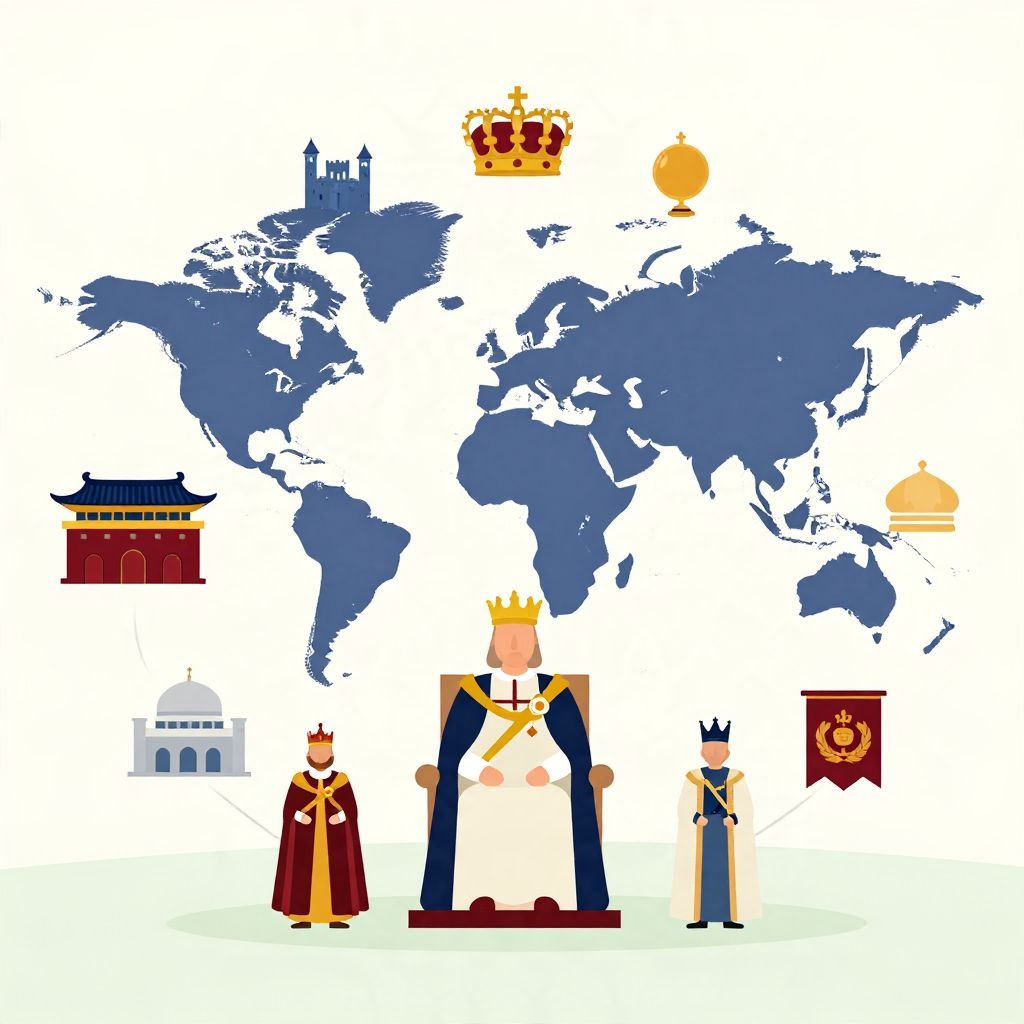
When people ask, “What countries have a monarchy?” they usually mean which sovereign states are still ruled by kings, queens, emperors, or similar hereditary heads of state. The short answer is that monarchy remains a real form of government today, but in most places it is constitutional rather than absolute.
Monarchies survive in Europe, Asia, the Middle East, Africa, and Oceania, though their powers vary widely. Some monarchs reign mainly as national symbols, while others still exercise substantial political authority. Their histories stretch from ancient dynasties to modern constitutional systems shaped by revolution, decolonization, and reform.
What Countries Have a Monarchy Today?
As of the mid-2020s, about two dozen sovereign states have monarchs. Most are constitutional monarchies, where elected governments hold real political power. A smaller number are absolute or heavily monarchical in practice, with the ruler retaining major governing authority. The exact list can shift if a state changes its constitution or status.
Current monarchies by region
- Europe: United Kingdom, Spain, Sweden, Norway, Denmark, Netherlands, Belgium, Luxembourg, Monaco, Liechtenstein
- Asia: Japan, Thailand, Cambodia, Bhutan, Brunei, Malaysia, Saudi Arabia, Jordan, Qatar, Kuwait, Bahrain, Oman
- Africa: Eswatini
- Oceania: Tonga, Samoa, Papua New Guinea, Solomon Islands, Tuvalu
Some of these states have a monarch as head of state but not as head of government. In others, especially in the Gulf, the ruler’s authority is far broader. A few countries, such as Malaysia and the United Arab Emirates, have unusual federal or rotating monarchical arrangements rather than a single hereditary throne.
How Did Monarchy Begin?
Monarchy is one of the oldest political forms in human history. It emerged in early states where military leadership, religious authority, and control of land or tribute often concentrated in one person or one family. Ancient Egypt, Mesopotamia, China, and many other early civilizations developed hereditary rulers long before modern nation-states existed.
In many societies, monarchy was justified through divine favor, sacred ancestry, or tradition. Kingship was not merely political; it was often tied to cosmic order, law, and ritual. Over time, some monarchies became more bureaucratic and centralized, while others remained limited by nobles, parliaments, or local elites.
Why Do Some Countries Still Have Monarchies?
Modern monarchies survived because they adapted. In many places, monarchs gave up direct governing power in exchange for a constitutional role, allowing them to remain as unifying national figures. This helped preserve continuity during periods of democratization, empire collapse, and social change.
Monarchy also persists because it can carry symbolic value. Supporters argue that a hereditary head of state can stand above party politics, represent national identity, and provide institutional stability. Critics counter that hereditary office conflicts with democratic equality and can preserve outdated privilege. Both views have shaped modern debates.
Constitutional versus absolute monarchy
- Constitutional monarchy: The monarch’s powers are limited by law or constitution; elected officials govern. Examples include Japan, the United Kingdom, Sweden, and Spain.
- Absolute or semi-absolute monarchy: The monarch retains major executive power. Examples include Saudi Arabia, Brunei, and Eswatini, though each has its own legal structure.
- Elective monarchy: The ruler is chosen through a formal process rather than direct hereditary succession. Malaysia is the best-known modern example.
A Brief Timeline of Monarchy’s Historical Development
Monarchy has changed dramatically over millennia. Its survival today is not a sign of political stasis, but of adaptation to new ideas about law, citizenship, and sovereignty.
- c. 3000 BCE and earlier: Early kingdoms emerge in Egypt, Mesopotamia, and other river-valley civilizations.
- Classical antiquity: Monarchies coexist with republics and empires; legitimacy often rests on conquest, ancestry, or divine sanction.
- Middle Ages: Kingship becomes central in Europe, Asia, and the Islamic world, though power is often negotiated with nobles, clergy, or local rulers.
- 16th–18th centuries: Absolute monarchy strengthens in some states, while constitutional limits expand in others.
- Late 18th–19th centuries: Revolutions, liberal reform, and nationalism reduce or transform many monarchies.
- 20th century: Empires collapse, former colonies become republics or constitutional monarchies, and many thrones lose direct power.
- 21st century: Monarchy remains in a smaller number of states, often as a ceremonial institution or a culturally important symbol.
Which Monarchies Are the Most Politically Powerful?
Not all monarchies function the same way. In most constitutional monarchies, the monarch reigns but does not rule. In a few states, however, the monarch still plays a decisive role in appointing governments, shaping policy, or controlling key institutions.
Examples of monarchies with broader ruling power
- Saudi Arabia: A hereditary monarchy with a strong royal role in executive authority.
- Brunei: The sultan holds extensive governing power.
- Eswatini: The king remains a central political figure in a system that blends traditional and modern institutions.
- Qatar, Kuwait, Bahrain, and Oman: Monarchs retain meaningful authority, though the degree varies by constitution and political practice.
Even in these states, modern administration, diplomacy, and legal systems have become far more complex than older models of personal rule. Monarchs now operate within a world of constitutions, ministries, international law, and global media scrutiny.
How Did Europe’s Monarchies Change?
Europe is often associated with monarchy because many of its states were historically ruled by kings and queens. Yet Europe also produced some of the strongest limits on royal power. The English Civil War, the Glorious Revolution, the French Revolution, and the rise of parliamentary government all reshaped monarchy’s role.
By the 19th and 20th centuries, many European monarchies had either been abolished or transformed into constitutional systems. Today, monarchs in the United Kingdom, Sweden, Norway, Denmark, the Netherlands, Belgium, Luxembourg, Spain, Monaco, and Liechtenstein remain important symbols, but elected governments make policy.
Why did European monarchies endure?
They endured because reform often proved more politically workable than abolition. In several countries, monarchies were retained as a compromise between old elites and democratic movements. The crown could symbolize continuity while power shifted to parliaments, cabinets, and constitutions.
Monarchy in Asia: Tradition, Reform, and Modern Identity
Asia contains some of the world’s oldest and most culturally influential monarchies. Japan’s imperial institution has a long history, though its political role changed sharply over time. Thailand, Cambodia, Bhutan, Brunei, and several Gulf states also preserve monarchical systems shaped by local history and modern constitutional reform.
Japan is especially notable because the emperor remains a deeply symbolic figure, while the state is a constitutional monarchy. Thailand’s monarchy has also played a major role in national identity, though the political balance between crown, military, and elected institutions has changed repeatedly in modern times.
Special cases in Asia
- Japan: The emperor is a constitutional symbol, not a governing ruler.
- Malaysia: A federal monarchy with an elected king chosen from hereditary state rulers.
- Brunei: One of the clearest surviving examples of strong monarchical rule.
- Bhutan: A monarchy that has moved toward constitutional government while keeping the king as a national symbol.
Monarchy Outside Europe and Asia
Monarchy also survives in Africa and Oceania. In Eswatini, the king remains central to the political system. In the Pacific, monarchies such as Tonga preserve indigenous royal traditions that predate colonial borders and modern nationhood.
Some Commonwealth realms, including Papua New Guinea, Solomon Islands, and Tuvalu, recognize the British monarch as head of state even though they are fully independent countries. This arrangement is a legacy of empire and decolonization, not a sign of subordination in the older imperial sense.
Why Did So Many Monarchies Disappear?
Monarchies declined for several reasons. Revolutions challenged the idea that political legitimacy came from birth. Nationalism encouraged the belief that sovereignty belonged to “the people” or the nation rather than a royal house. Industrialization, mass politics, and constitutionalism also made hereditary rule harder to defend.
In some cases, monarchies fell after war or occupation. In others, they were abolished by popular vote or parliamentary action. The 20th century was especially important: the end of the Russian, German, Austro-Hungarian, Ottoman, and many colonial monarchies dramatically reduced the number of ruling royal houses worldwide.
What Is the Historical Significance of Monarchy?
Monarchy matters because it shaped how states formed, how law was justified, and how power was inherited. For centuries, kingship was one of the main ways people understood sovereignty. Even where monarchs no longer govern, royal institutions can still influence national identity, ceremony, diplomacy, and public memory.
Monarchy also reveals a major historical pattern: political institutions rarely vanish overnight. They are often reworked, limited, or repurposed. The modern monarchies that remain are not simply survivals from the past; they are institutions that have been repeatedly redefined by constitutional change, colonial history, and public opinion.
So, What Countries Have a Monarchy?
Today, countries with monarchies include the United Kingdom, Spain, Sweden, Norway, Denmark, the Netherlands, Belgium, Luxembourg, Monaco, Liechtenstein, Japan, Thailand, Cambodia, Bhutan, Brunei, Malaysia, Saudi Arabia, Jordan, Qatar, Kuwait, Bahrain, Oman, Eswatini, Tonga, Samoa, Papua New Guinea, Solomon Islands, and Tuvalu. Their systems range from ceremonial crowns to powerful hereditary rule.
For readers interested in related royal institutions, see also whether Japan still has an emperor and whether the Vatican is its own country. The larger historical lesson is simple: monarchy has not disappeared, but it has been transformed by centuries of political change.