
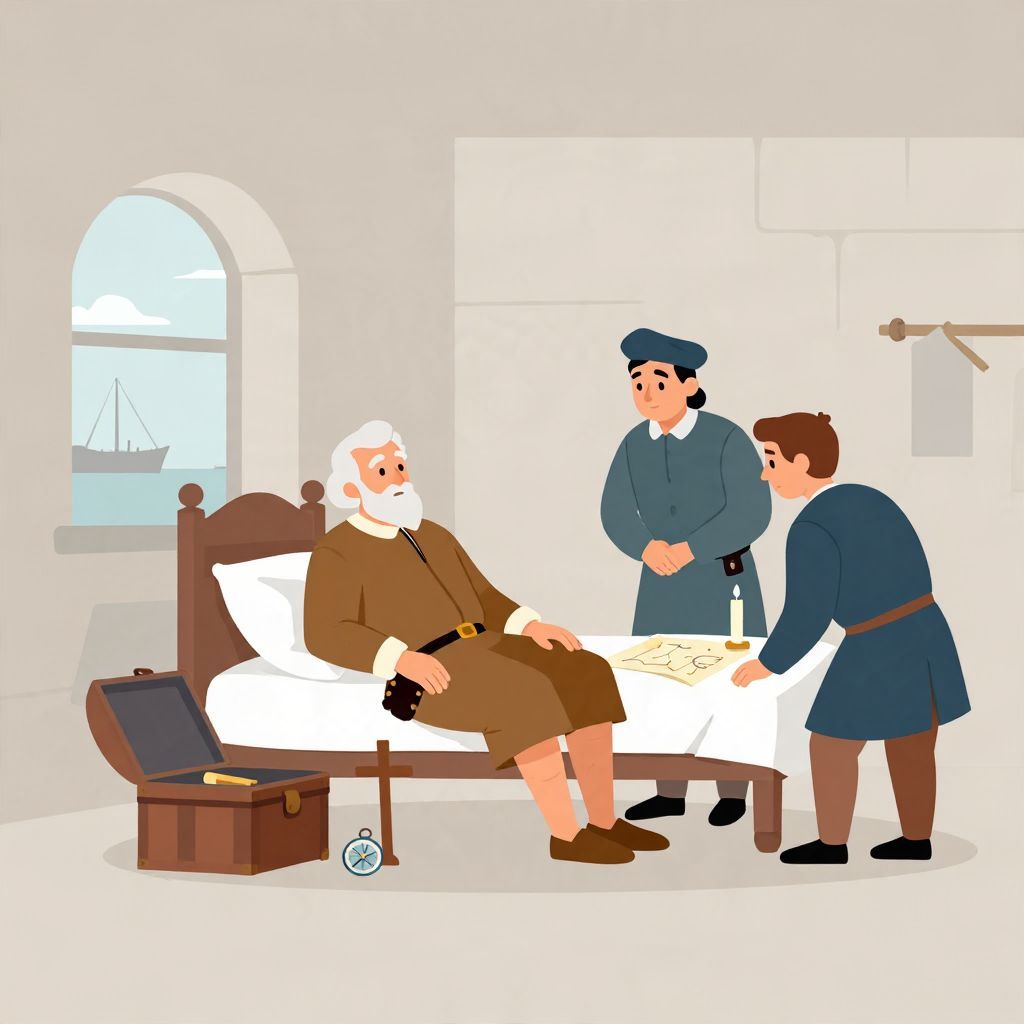
Christopher Columbus died in Spain in 1506, after years of declining health and disappointment over the rewards he believed he had earned from his voyages. He was not killed in battle or at sea. Instead, historical evidence shows that he died of illness, likely worsened by chronic medical problems that had affected him for years.
His death came after a long and complicated final period in which his status had fallen sharply at the Spanish court. Columbus remained famous for opening the way for sustained European contact with the Americas, but in his last years he was also a frustrated, aging man struggling with pain, travel, and political setbacks.
How did Christopher Columbus die?
Christopher Columbus died of illness on May 20, 1506, in Valladolid, Spain. Most historians believe he suffered from a combination of chronic health problems, including severe joint pain and possible complications from gout, arthritis, or another long-term inflammatory disease. He died in bed, not during a voyage, and there is no credible evidence of murder or a dramatic accident.
What do historians know about his final illness?
The surviving evidence for Columbus’s last days is limited, so historians cannot diagnose him with certainty. What is clear is that he had been ill for some time and was physically weakened. Contemporary accounts and later reconstructions suggest he experienced serious pain, swelling, and reduced mobility. The exact disease remains debated, but his death was almost certainly the result of natural causes rather than violence.
Likely causes of death
- Chronic illness: Columbus had suffered recurring health problems for years.
- Possible gout or arthritis: Many historians think painful joint disease may have contributed to his decline.
- General physical exhaustion: His later life included repeated Atlantic crossings, political stress, and long periods of weakness.
- Age-related decline: He was likely in his mid-50s or early 60s, depending on the uncertain year of his birth.
Where and when did Columbus die?
Columbus died in Valladolid, in the Crown of Castile, on May 20, 1506. Valladolid was an important political center in early modern Spain, and Columbus was there while seeking to recover status, privileges, and financial benefits from the Spanish monarchy. He died before those disputes were fully resolved.
Why was he in Valladolid?
In his final years, Columbus was trying to secure recognition for the promises made to him before his first voyage. He had once been granted titles and rights connected to his discoveries, but many of those privileges were later reduced or challenged. By 1506, he was no longer the triumphant explorer of earlier years. He was instead an embattled claimant pressing his case at court.
What happened in the years before his death?
Columbus’s last decade was marked by hardship. After his later voyages to the Caribbean and Central America, he faced criticism from Spanish officials and lost much of the influence he had briefly enjoyed. He also suffered from illness and spent long periods in discomfort. These troubles shaped the final chapter of his life and help explain why his death was relatively quiet compared with his fame.
Key events leading up to 1506
- 1492: Columbus made his first voyage across the Atlantic under Spanish sponsorship.
- 1493–1504: He completed additional voyages, but his administration of the colonies became increasingly controversial.
- 1500: He was arrested and sent back to Spain in chains after complaints about his rule in Hispaniola, though he was later released.
- 1504: Queen Isabella died, weakening one of his main sources of support at court.
- 1506: Columbus died in Valladolid while still trying to recover former privileges.
Was Columbus’s death sudden?
No. Columbus’s death appears to have been the end of a gradual decline rather than a sudden collapse. He had been unwell for years, and his final illness likely intensified an already fragile condition. This is one reason historians describe his death as natural and expected, even if the exact medical cause cannot be pinned down with modern certainty.
Did Columbus know he was dying?
There is no reliable record of Columbus leaving a clear final statement about his death, and many popular quotations attributed to him are not secure historical evidence. Still, it is reasonable to infer that he understood his condition was serious. He had lived with recurring illness and had enough experience of his own weakness to know that his health was failing.
What happened after Columbus died?
Columbus was buried in Spain, though the story of his remains became complicated over time. His body was later moved more than once, and different places have claimed to hold his bones. This uncertainty has made his burial history almost as famous as his life. For that reason, questions about his death often lead naturally to the question of where he was ultimately laid to rest.
Why his burial matters
Columbus’s posthumous journey reflects how his legacy changed over time. During his life, he was a controversial figure whose achievements and failures were both visible. After death, he became a symbol claimed by different nations and traditions, which helped turn his remains into an object of historical debate. The uncertainty around the burial sites does not change the basic fact of his death in Valladolid in 1506.
Why does Columbus’s death matter historically?
Columbus’s death marks the end of the explorer’s personal story, but not the end of the world he helped set in motion. His voyages connected Europe permanently to the Americas, setting off far-reaching changes in trade, empire, migration, disease, and conquest. By the time he died, those consequences were already beginning to reshape the Atlantic world.
At the same time, his final years remind us that historical fame does not always bring personal success. Columbus died disappointed, politically weakened, and still arguing for rewards. That contrast between global impact and private frustration is one reason his death remains a revealing part of his biography.
Common myths about how Columbus died
Several popular stories about Columbus’s death are not supported by strong evidence. He was not executed, assassinated, or lost at sea. He also did not die in the New World. The most reliable historical accounts point instead to a natural death in Spain after a period of illness.
- Myth: Columbus died during a voyage.
- Fact: He died in Valladolid, Spain.
- Myth: He was murdered because of his discoveries.
- Fact: There is no credible evidence for that claim.
- Myth: His exact disease is known with certainty.
- Fact: Historians can only make informed medical guesses from limited evidence.
Conclusion
Christopher Columbus died of illness in Valladolid on May 20, 1506, after years of declining health and political disappointment. The exact medical cause is uncertain, but the historical record clearly shows a natural death rather than a dramatic one. His final days were shaped by age, pain, and unresolved disputes over his legacy. For more context, see related articles on when Columbus sailed the ocean blue and where Christopher Columbus is buried.