
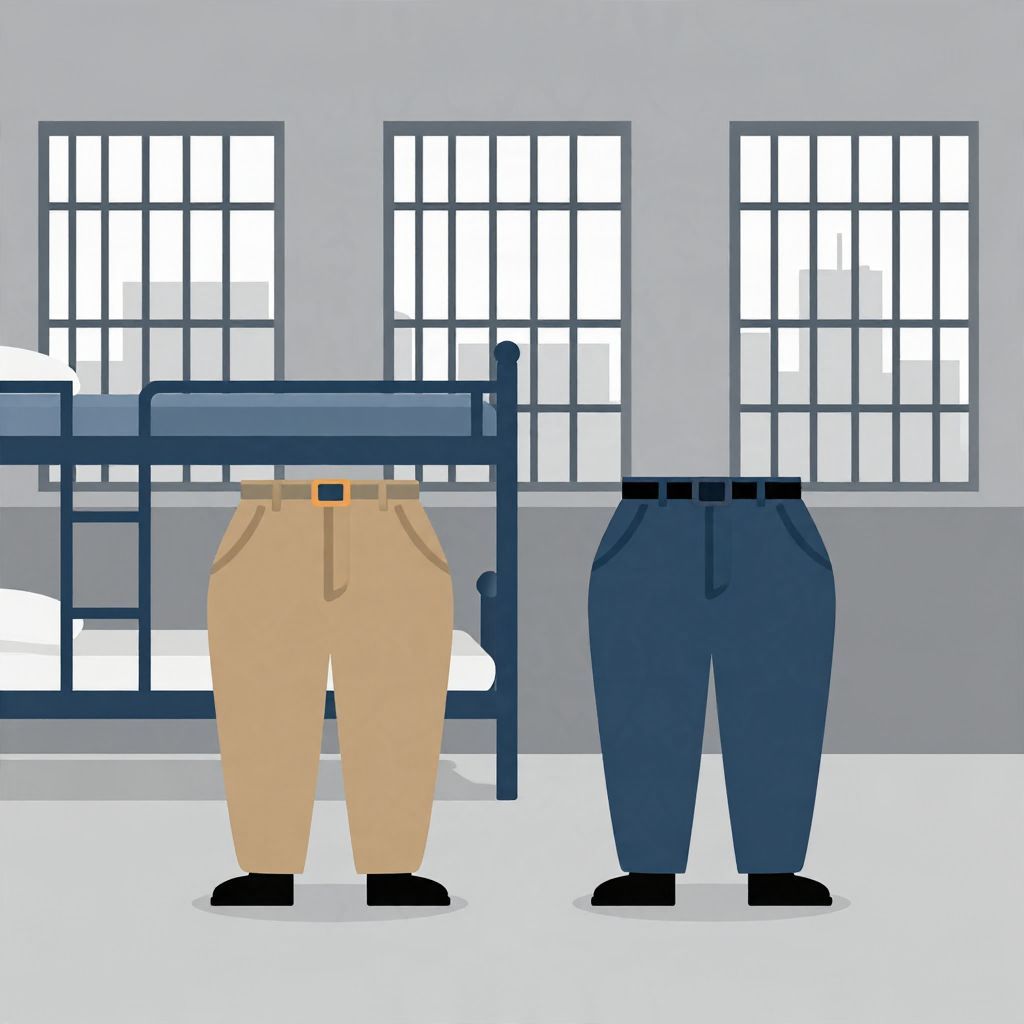
What does sagging pants mean in jail? In the historical and prison context, sagging pants most often signaled vulnerability, control, and sometimes sexual availability or humiliation, though the meaning was never fixed everywhere. The style became especially associated with incarceration in the late 20th century, when prison rules, lack of belts, and inmate culture shaped how clothing was worn and read.
Outside prison, sagging later spread into street fashion and youth culture, which changed its meaning again. To understand it historically, you have to separate prison practice from later popular style and from the myths that grew around both.
What does sagging pants mean in jail?
In jail, sagging pants usually mean a prisoner is wearing trousers low on the hips, often because belts are restricted or removed for safety. Historically, the look could also carry social meaning inside prison: it might suggest a lower status, forced vulnerability, or a sexualized signal in some settings, but these meanings varied by institution and inmate culture.
How prison rules helped create the look
Prisons and jails have long restricted belts, drawstrings, and other items that could be used for self-harm, assault, or escape. As a result, inmates often had to hold up loose uniforms without a belt. That practical limitation helped make sagging a visible feature of prison life, even when it was not intended as a fashion statement.
Safety and control in correctional institutions
Modern jails developed strict clothing policies to reduce risk. Belts could be used as weapons, ligatures, or tools for concealment. Uniforms were also designed for easy inspection and quick identification. In that setting, pants worn low were not necessarily a chosen style; they were often the result of institutional rules and ill-fitting clothing.
Why the appearance mattered socially
Even when caused by practical restrictions, clothing in prison still communicated status. Prison life is highly symbolic: posture, walking style, tattoos, and clothing all become part of a social code. Sagging pants could be read as a sign that someone was new, powerless, or not in control of his body and space.
The historical meaning of sagging in prison culture
Within some prison environments, sagging pants acquired meanings beyond simple inconvenience. In certain accounts, low-worn pants were associated with sexual dominance and submission, especially in hypermasculine prison hierarchies. But this was not universal, and historians and criminologists caution against treating one prison symbol as if it meant the same thing everywhere.
Power, humiliation, and prison hierarchy
Prisons often create informal systems of rank that exist alongside official authority. Clothing can become part of that system. Sagging pants may have been interpreted as humiliating because they exposed the body and suggested a lack of self-possession. In some contexts, that made the look a marker of vulnerability rather than rebellion.
Not every prison used the symbol the same way
There is no single, universal “jail code” for sagging pants. Meaning depended on the era, the facility, and the local inmate culture. In some places, it was simply the result of poor-fitting uniforms. In others, it could be read as a sexualized or subordinate signal. Historical caution matters here because prison symbolism is often described through rumor as much as through documentation.
Where the style came from before jail associations
Sagging did not begin in prison. Loose or low-slung trousers appeared in different forms across fashion history, especially in youth and working-class styles. In the late 20th century, the look became strongly associated with hip-hop culture in the United States, where oversized clothing could signal defiance, identity, and street credibility.
Late 20th-century street fashion
By the 1980s and 1990s, baggy jeans and oversized clothes were common in hip-hop and skate culture. Some wearers let pants sit low intentionally, while others simply wore oversized garments that slipped down. This street style overlapped with prison imagery because many young men had family or community ties to incarceration, and prison aesthetics often circulated back into popular culture.
The prison-to-street feedback loop
Fashion historians often note that prison and street culture influence each other. Clothing associated with incarceration can be adopted outside prison as a symbol of toughness, resistance, or authenticity. Over time, the original meaning can blur. What began as a practical or humiliating condition inside jail could be reinterpreted as a deliberate style outside it.
A brief timeline of sagging pants and prison meaning
The history of sagging pants is not a single straight line, but a series of overlapping developments. A simplified chronology helps show how the meaning changed over time.
- Pre-20th century: Loose or low-slung trousers appear in various fashion traditions, but not as a prison-specific symbol.
- 20th century prison systems: Many correctional institutions restrict belts and other accessories for safety, making low-worn pants a practical reality behind bars.
- Late 20th century: Sagging becomes visible in some prison cultures and is also linked to hip-hop and youth fashion outside prison.
- 1990s–2000s: The style becomes widely recognized in the United States and is often criticized by schools, employers, and public officials.
- 21st century: The meaning remains contested: for some it is fashion, for others a symbol of prison culture, rebellion, or disrespect.
Why people connected sagging pants with crime and incarceration
As the style spread beyond prison, many adults and institutions began to associate it with delinquency. That connection was shaped by media coverage, moral panic, and the visibility of young men in urban neighborhoods. Once a style is linked to prison, it can be read as a sign of criminality even when the wearer has no direct connection to jail.
Media, stereotypes, and public reaction
News reports and political commentary in the 1990s and 2000s often treated sagging as a symbol of disorder. Schools and city governments in some places tried to ban it. Those reactions mattered historically because they turned a clothing style into a public debate about race, class, masculinity, and discipline.
Race and class in the meaning of the style
Although sagging was never limited to one group, it was disproportionately associated in public discourse with Black and Latino youth. That made the symbol politically charged. Critics saw disrespect; supporters saw cultural expression or resistance to respectability politics. The meaning of sagging, then, was never only about pants. It was also about who was wearing them and how society judged them.
Historical significance: what sagging pants reveal about jail culture
Sagging pants matter historically because they show how prison life shapes bodies, symbols, and identity. In jail, clothing is not just clothing. It is regulated, inspected, and interpreted. A simple wardrobe detail can reflect institutional control, inmate hierarchy, and the movement of prison symbolism into wider society.
Clothing as a record of power
Historians often study uniforms and dress because they reveal how authority works. In prison, the removal of belts and the issue of ill-fitting clothing reduce individuality and increase surveillance. Sagging pants, in that sense, are part of the material history of confinement: they show how the state manages bodies through everyday objects.
From prison sign to cultural symbol
The broader significance of sagging is that its meaning changed as it moved across contexts. Inside jail, it could reflect restriction, vulnerability, or prison hierarchy. Outside jail, it became a fashion trend, a cultural marker, and a target of criticism. That shift is a classic example of how symbols travel and change over time.
What sagging pants do not reliably mean
It is important not to overstate the symbol. Sagging pants do not automatically prove that someone has been in jail, belongs to a gang, or intends anything sexual. Those assumptions are part of popular stereotype, not reliable historical evidence. Clothing can suggest affiliation or influence, but it cannot by itself establish a person’s life history.
Separating fact from myth
Popular explanations often claim there is one fixed prison meaning behind sagging. In reality, the history is messier. The look can come from practical clothing restrictions, fashion preference, peer influence, or deliberate symbolism. Historical accuracy requires holding all of those possibilities together rather than choosing a single dramatic story.
Takeaway
Historically, sagging pants in jail most often reflected the practical realities of prison clothing rules, but it could also carry social meanings tied to vulnerability, hierarchy, and sexualized interpretation. Outside jail, the style took on new meanings in street fashion and youth culture. For related symbolism in carceral and cultural history, see what a teardrop tattoo means and what an upside-down flag means.