
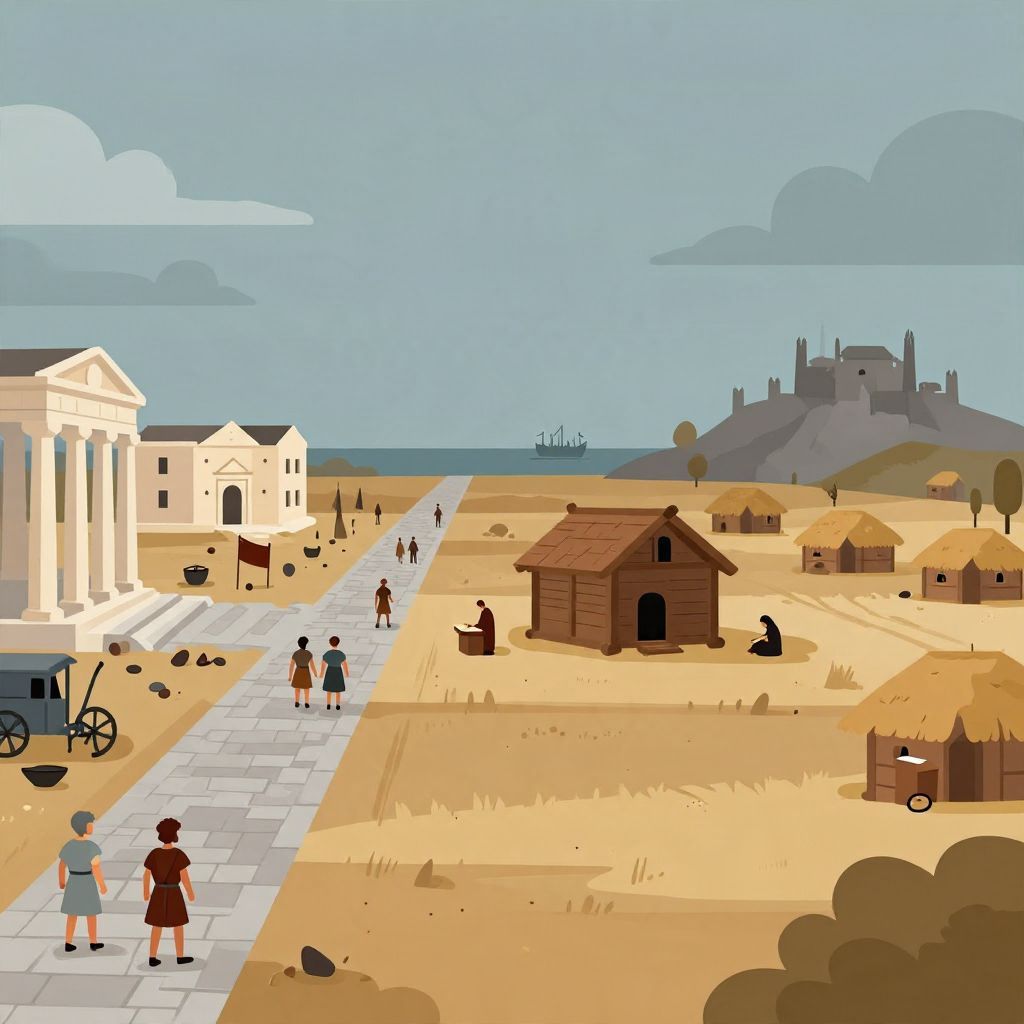
What caused the Dark Ages is a question that gets to the heart of how Europe changed after the fall of the Western Roman Empire. The short answer is that there was no single cause and no sudden “collapse” everywhere at once. Instead, a combination of political fragmentation, warfare, economic disruption, population decline, and the loss of long-distance trade reshaped western Europe after the 5th century.
The term “Dark Ages” is also debated by historians. It once suggested a period of cultural darkness, but many scholars now prefer more precise labels such as the Early Middle Ages. Even so, the phrase remains useful for discussing why parts of Europe became less urban, less literate, and less politically stable in the centuries after Rome’s decline.
What caused the Dark Ages?
The Dark Ages were caused by the breakdown of Roman political authority in western Europe, repeated invasions and civil wars, shrinking trade networks, falling tax revenues, and major demographic losses. These pressures weakened cities, education, and centralized government, especially from the 4th to 7th centuries. The result was not total cultural collapse, but a long period of transformation and regional instability.
The collapse of Roman authority
The most important cause was the weakening and eventual fall of the Western Roman Empire in the 5th century. Rome had provided roads, law, taxation, armies, and administrative order across much of western Europe. When that system broke down, local rulers, bishops, and military leaders filled the gap unevenly, creating a patchwork of small kingdoms rather than one stable empire.
Why Rome became harder to govern
By the late Roman period, the empire faced enormous strain. Defending long borders required money and manpower, while internal power struggles made the state less effective. Emperors changed frequently, armies were often tied to rival generals, and the western provinces became more vulnerable to outside pressure and internal fragmentation.
The division of the empire into eastern and western halves in the late 3rd and early 4th centuries helped administration in some ways, but it also made the western empire weaker over time. The eastern half, centered on Constantinople, survived and remained wealthy. The west, by contrast, lost territory, revenue, and military capacity.
Invasions, migrations, and warfare
Another major cause was the movement of peoples across Roman frontiers, often driven by pressure from other groups and by the attraction of Roman wealth and land. Germanic groups such as the Visigoths, Vandals, Ostrogoths, Franks, and Lombards established kingdoms in former Roman territories. These were not simply “barbarian invasions” in a modern sense; they were complex migrations, alliances, and military takeovers.
The role of the Huns
The arrival of the Huns in Europe during the late 4th and 5th centuries intensified instability. Their expansion pushed other groups into Roman territory, increasing conflict and migration. Roman authorities sometimes settled these groups as foederati, or allied troops, but such arrangements could break down into rebellion and war.
Key political shocks in the West
- 410: Rome was sacked by the Visigoths, a symbolic blow to Roman prestige.
- 455: Rome was sacked again, this time by the Vandals.
- 476: The last western emperor, Romulus Augustulus, was deposed, often used as the conventional date for the fall of the Western Roman Empire.
These events did not instantly end Roman life, but they marked the end of western imperial unity. In many regions, war became more localized and frequent, which damaged agriculture, trade, and civic institutions.
Economic decline and the loss of trade
Roman Europe depended on a broad Mediterranean economy. Grain, wine, oil, pottery, metal goods, and luxury items moved across seas and roads that linked cities and provinces. As political control weakened, trade routes became less secure, ports declined, and markets shrank. This mattered because cities relied on commerce and state spending to survive.
Why cities suffered
Roman cities were not just places of residence; they were administrative and economic centers. They depended on taxes, imported food, and public works. When the state could no longer maintain roads, aqueducts, and urban supply systems, many cities became smaller and poorer. Some survived as religious or regional centers, but fewer remained vibrant commercial hubs.
Archaeology supports this broad decline in many western areas: fewer imported goods, less building in stone, and reduced evidence of large-scale craftsmanship in some regions. However, the decline was uneven. Some towns and regions adapted better than others, especially where local elites or churches stepped in to preserve order.
Population loss, disease, and climate stress
Demographic decline also contributed to the so-called Dark Ages. Warfare and insecurity reduced populations in some regions, but disease may have had an even larger impact. The Justinianic Plague, beginning in 541, spread across the Mediterranean and killed many people over several waves. It weakened labor forces, tax bases, and military recruitment.
Environmental pressures
Some historians also point to climate variability. Cooler or wetter conditions in certain periods may have affected harvests, settlement patterns, and mobility. Climate alone did not cause the Dark Ages, but it could intensify existing weaknesses by making food production less reliable and societies more vulnerable to famine and unrest.
Because evidence varies by region, scholars are cautious about making climate the main explanation. It is better understood as one factor among several, reinforcing political and economic instability rather than creating it on its own.
The decline of literacy and classical education
One reason the period later seemed “dark” was the reduction in written records and classical learning in western Europe. Roman education had been tied to urban life, elite patronage, and government service. As those structures weakened, fewer people received formal schooling in Latin rhetoric, law, and literature.
What was lost, and what survived
This does not mean literacy disappeared. Monasteries, churches, and some courts preserved texts and learning. But the range of people who could read and write narrowed, and the production of books became more limited and expensive. Greek learning remained stronger in the eastern Roman Empire, while the west became more dependent on ecclesiastical institutions.
The decline in written sources is one reason historians once called the period “dark”: not because people were unintelligent or inactive, but because fewer documents survived, and fewer were produced in the first place. Modern historians are careful not to equate reduced documentation with cultural emptiness.
The rise of local power and the church
As imperial authority faded, power shifted to local kings, landowners, and bishops. This decentralization helped preserve some stability, but it also meant that law, defense, and taxation were no longer coordinated across large territories. Local loyalties became more important than imperial identity.
Why the church mattered
The Christian church became one of the most durable institutions in post-Roman Europe. Bishops often acted as civic leaders, mediators, and protectors of urban life. Monasteries preserved learning, copied texts, and sometimes managed land efficiently. In this sense, the church did not cause the Dark Ages; it helped western society adapt to the collapse of Roman structures.
Over time, the church also shaped political legitimacy. Kings sought religious approval, and Christian institutions became central to education, record-keeping, and moral authority. This helped create a new medieval order, even as it reflected the loss of older Roman systems.
Was the Dark Ages really a “dark” period?
Historians increasingly reject the idea that the early medieval centuries were simply a time of ignorance and decline. The phrase “Dark Ages” can be misleading because it suggests a uniform collapse across Europe. In reality, the period saw both setbacks and innovations: new kingdoms, changing art styles, missionary activity, legal traditions, and the blending of Roman, Germanic, and Christian cultures.
Why the term remains controversial
The label was originally used by Renaissance and Enlightenment writers who admired classical antiquity and viewed the Middle Ages as inferior. Modern scholarship recognizes that this was a value judgment, not a neutral description. The early Middle Ages were difficult in many places, but they were also a time of adaptation and state formation.
For example, the Frankish kingdoms developed stronger political structures in parts of western Europe, while Anglo-Saxon England produced sophisticated metalwork and literary culture. Meanwhile, the Byzantine Empire preserved Roman state traditions in the east. So the “darkness” was uneven, regional, and partly dependent on what evidence survives.
How the causes worked together
The Dark Ages were not caused by one event but by a chain reaction. Political breakdown weakened taxation and defense. Invasions and civil wars disrupted farming and trade. Disease and demographic loss reduced labor and military strength. As cities shrank and literacy narrowed, the institutions that had sustained Roman civilization became harder to maintain.
- Political fragmentation reduced centralized control.
- Military pressure destabilized borders and provinces.
- Economic contraction weakened cities and markets.
- Population decline reduced productivity and resilience.
- Institutional change shifted power to local rulers and the church.
Together, these forces transformed western Europe between roughly the 5th and 10th centuries. The process was gradual and uneven, but the cumulative effect was a less urban, less interconnected, and more locally governed society than the Roman world that came before it.
Historical significance and lasting impact
The causes of the Dark Ages matter because they explain the transition from the ancient world to medieval Europe. The period was not merely a pause between two better eras; it was the foundation of new political and cultural systems. Feudal relationships, Christian kingship, monastic learning, and regional identities all developed in the aftermath of Rome’s decline.
In that sense, the Dark Ages were both an ending and a beginning. They marked the loss of Roman unity in the west, but they also created the conditions for the medieval world that followed.
So, what caused the Dark Ages? Above all, the collapse of Roman imperial power in the west, intensified by war, migration, economic breakdown, disease, and political fragmentation. If you want to explore the chronology in more detail, see when the Dark Ages were and how later medieval institutions developed in relation to the Holy Roman Empire.