
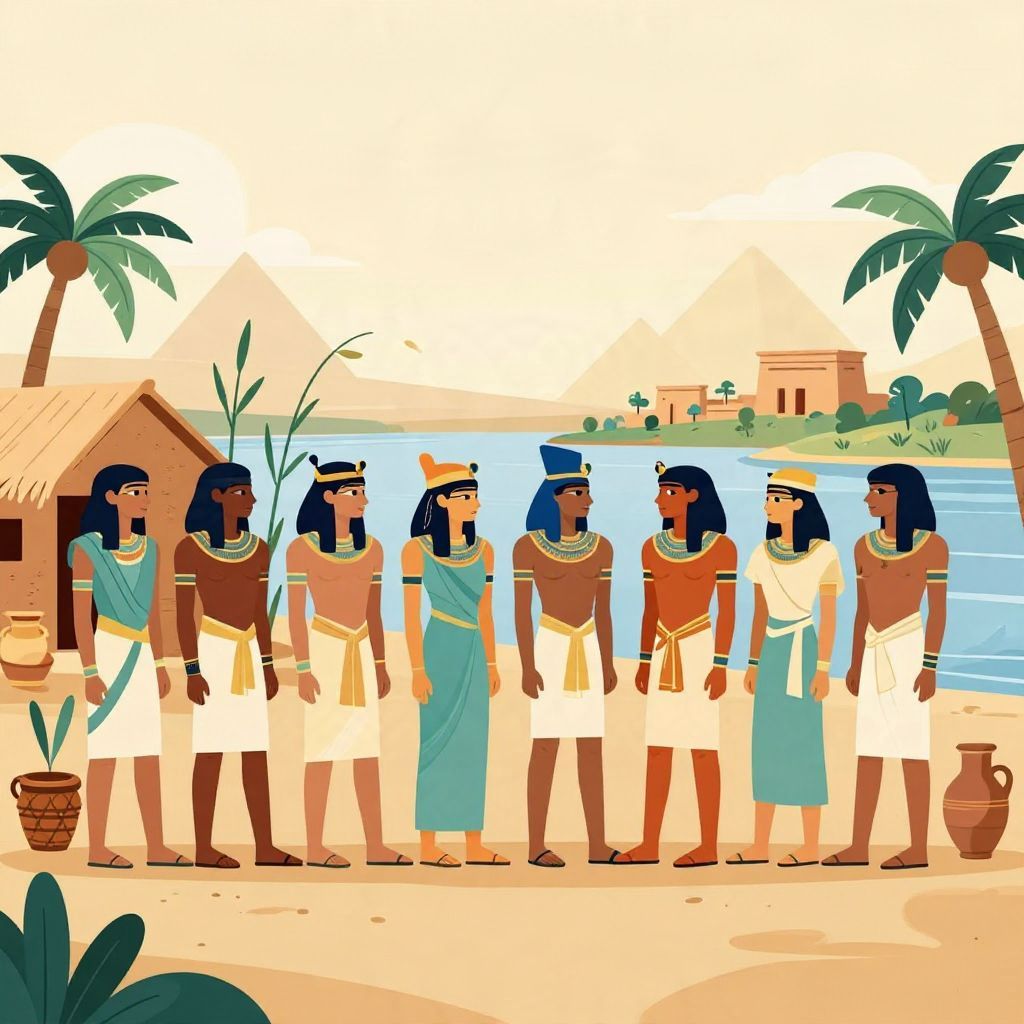
What did Egyptians look like? The shortest accurate answer is that there was no single “Egyptian look.” Ancient and modern Egyptians have always been a diverse population shaped by Nile Valley ancestry, regional mixing, migration, and long continuity over thousands of years. Their appearance varied by time, place, social class, and family background.
What we can say with confidence is that Egyptians in antiquity were generally Northeast Africans, with features spanning the broad range seen across the eastern Mediterranean, North Africa, and the Nile corridor. Art, mummies, skeletal evidence, and written sources help us understand that diversity, but they do not support a simple modern stereotype.
What did Egyptians look like?
Ancient Egyptians were not a single uniform “race” or appearance type. They were a Nile Valley people with varied skin tones, hair textures, and facial features, reflecting local continuity and centuries of contact with Nubia, the Levant, Libya, Greece, Rome, and other regions. Their look changed over time, and elite art often idealized appearance rather than recording exact reality.
Understanding Egyptian appearance in historical context
To answer this question well, it helps to separate three things: what people actually looked like, how they were portrayed in art, and how later generations imagined them. Ancient Egyptian images were symbolic as well as realistic. Artists used conventions to show status, gender, age, and role, so wall paintings and statues are useful but not literal photographs.
Why there is no single “Egyptian” appearance
Egypt stretched along the Nile, connecting Africa and the eastern Mediterranean. Over millennia, people moved through the region for trade, warfare, marriage, diplomacy, slavery, and settlement. As a result, Egyptians were never biologically isolated. Some had darker complexions typical of northeastern Africa; others had lighter or more Mediterranean features; many fell somewhere in between.
What evidence do historians and archaeologists use?
Historians reconstruct ancient Egyptian appearance from several kinds of evidence, each with limits. No single source tells the full story, but together they show a population with real diversity and strong local continuity.
1. Tomb art and temple reliefs
Egyptian art often depicts men with reddish-brown skin and women with lighter yellow-brown skin, but these are artistic conventions, not exact skin-color records. The differences often reflected gender roles, indoor versus outdoor labor, or symbolic contrast. Foreign peoples were usually shown with distinctive clothing, hairstyles, and skin tones to mark identity.
2. Mummies and skeletal remains
Preserved bodies and bones can reveal general body structure, health, and some aspects of ancestry, though not every detail of appearance. Studies show continuity in the Nile Valley over long periods, alongside evidence of admixture from surrounding regions. Hair, teeth, and skin preservation can sometimes offer clues, but mummies do not represent the whole population evenly.
3. Written descriptions
Ancient texts sometimes mention physical traits, but they were not written as scientific ethnographies. Greeks, Romans, and Egyptians themselves described people in ways shaped by politics and cultural bias. Such descriptions are useful, but they must be read carefully and compared with archaeology.
How did Egyptians look in different periods?
Egyptian appearance was not static. Over more than three thousand years of pharaonic history, plus the later Greco-Roman and Islamic periods, population movement and cultural change affected how Egyptians looked and how they were represented.
Predynastic and Early Dynastic Egypt
Before and around the unification of Egypt, roughly before and after 3100 BCE, the population of the Nile Valley was already connected to neighboring Saharan, Nubian, and Levantine groups. Predynastic art suggests people with a range of complexions and body types. There is no evidence for a single founding ethnic “type.”
Old, Middle, and New Kingdom Egypt
During the Old Kingdom, Middle Kingdom, and New Kingdom, Egyptian society became more centralized, but the population remained mixed. Most people were farmers, laborers, and artisans living in the Nile Valley. Elite portraits emphasize idealized youth, symmetry, and order. Real people likely showed the effects of outdoor work, diet, disease, and age more strongly than royal images suggest.
Late Period, Greek, and Roman Egypt
After the first millennium BCE, Egypt experienced more intense contact with foreign powers. Persians, Greeks, Romans, and later others settled in the country or ruled it. In cities such as Alexandria, the population became even more cosmopolitan. By this time, “Egyptian” referred as much to culture and language as to ancestry alone.
Medieval and modern Egyptians
After the Arab conquest in the seventh century CE, Egypt became part of a wider Arabic-speaking world. Over time, the population absorbed additional influences from the Arabian Peninsula, the Levant, Sudan, North Africa, and the Mediterranean. Modern Egyptians therefore reflect a long history of continuity and mixing, not a break from the ancient past.
What did ancient Egyptians probably look like in daily life?
Most ancient Egyptians would have had practical, work-shaped bodies: lean from physical labor, weathered by sun, and dressed for the climate. Clothing, grooming, and social rank mattered greatly. Appearance in daily life was less about uniform ethnicity and more about class, occupation, hygiene, and access to resources.
Skin tone
Egyptians lived under strong sunlight, so many would have had medium to dark brown skin tones, with variation across regions and families. People in the far south of Egypt and in Nubian-adjacent areas may have tended to darker complexions on average, while delta communities and foreign-descended groups could appear lighter. Ancient art should not be read as a precise skin-color chart.
Hair and hairstyles
Hair in ancient Egypt varied naturally from straight to wavy to tightly curled. Many elite Egyptians shaved their heads or wore short hair and wigs for cleanliness and status. Wigs were common in formal settings, and both men and women used oils, combs, and cosmetics. Hair length and style often signaled age, rank, and ritual role.
Facial features and body build
There was no single Egyptian facial type. Broadly speaking, ancient Egyptians likely displayed the range of features common among populations of the Nile Valley and northeast Africa: different nose shapes, lip fullness, jawlines, and eye shapes. Their bodies were shaped by nutrition and labor, so farmers, soldiers, scribes, and nobles could look quite different from one another.
How did Egyptians represent themselves and others?
Ancient Egyptian art is one of the main reasons people think of Egyptians as having a fixed appearance. But Egyptian artists followed conventions that served religious and political purposes. These images were meant to communicate identity, not to create modern-style realism.
The meaning of color in Egyptian art
Skin color in Egyptian art often had symbolic meaning. Male figures were frequently painted reddish-brown, while female figures were often painted lighter. This likely reflected ideals of gender and labor rather than exact pigmentation. Gods, foreigners, and the dead were also shown according to artistic rules that could change by period and context.
Foreign peoples in Egyptian imagery
Egyptian artists distinguished Nubians, Libyans, Asiatics, and others through clothing, hairstyles, and skin tone. These categories were political and cultural, not modern racial classifications. The images tell us that Egyptians saw themselves as distinct from neighboring peoples, but they also recognized a world of interaction and exchange.
Were ancient Egyptians Black, white, or something else?
This question is often asked in modern racial terms, but those terms do not map neatly onto ancient Egypt. Ancient Egyptians were an African people, and the population of the Nile Valley included a wide range of appearances. Some individuals likely looked darker than many modern people imagine; others may have looked lighter. The best historical answer is that Egyptians were diverse Northeast Africans, not a single modern racial category.
Why modern labels can mislead
Modern racial categories were created in much later historical contexts, especially in the era of European colonialism and scientific racism. Applying them directly to ancient Egypt can distort the evidence. Ancient identity was shaped more by language, region, religion, family, and political belonging than by the rigid racial taxonomies used today.
What does Egyptian history tell us about identity?
The history of Egyptian appearance is also a history of identity. Egyptians preserved strong cultural continuity in language, religion, and statecraft for millennia, even as their population changed through contact and migration. Their visual identity was therefore both local and connected to a wider world.
Continuity along the Nile
One of the most important historical facts is that Egypt was never empty, isolated, or suddenly “replaced.” The Nile Valley supported long-term settlement, and many communities descended from earlier populations in the same region. That continuity helps explain why Egyptian culture remained recognizable across such a long span of time.
Contact with neighboring regions
Egypt’s location made it a crossroads. Nubia to the south, the Levant to the northeast, and the Mediterranean world to the north all influenced Egyptian society. This contact affected trade, warfare, religion, and family life, and it also influenced how Egyptians looked over generations.
Why does this question matter today?
Questions about what Egyptians looked like often reflect modern debates about race, ancestry, and belonging. A historically grounded answer matters because it resists oversimplification. Ancient Egypt was African, diverse, and deeply connected to surrounding regions. Its people cannot be reduced to a single modern image or identity claim.
In the end, Egyptians looked like the people of a long-lived Nile Valley civilization: varied, changing, and unmistakably shaped by Africa, the Mediterranean, and the Near East. If you want to explore the civilization further, see what Egyptians looked like in more detail and what Egypt is known for.