
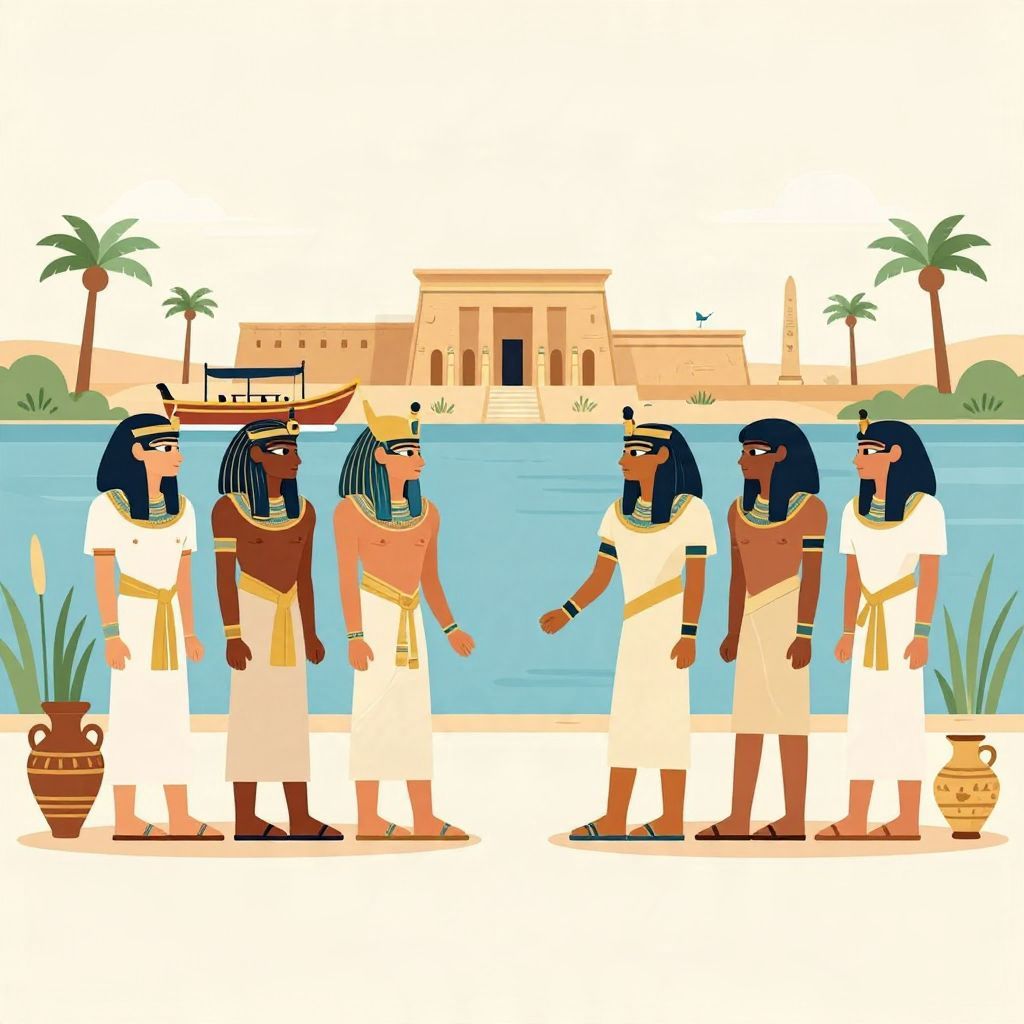
What do Egyptians look like? The shortest historical answer is that Egyptians have never been one single “look.” Across thousands of years, people in Egypt have reflected the country’s position between Africa, the Mediterranean, the Levant, and the Red Sea, producing a wide range of skin tones, hair textures, facial features, and cultural styles.
That diversity is not a modern development. Ancient, medieval, and modern Egyptians have all been shaped by migration, trade, empire, local continuity, and intermarriage. To answer the question well, we need to separate appearance from identity and look at Egypt’s long history.
What do Egyptians look like?
Egyptians are a diverse people, not a single racial type. Historically and today, they can range from lighter to darker complexions, with features influenced by North African, Northeast African, Mediterranean, Middle Eastern, and local Nile Valley ancestry. Ancient Egyptian art, archaeology, and modern genetics all point to variation rather than one fixed appearance.
In other words, there is no historically accurate “one Egyptian face.” Egyptians have included urban and rural communities, Nile Valley populations, Nubians, Copts, Bedouins, and others, each with different histories and visible traits. Any simple stereotype flattens a population with deep regional and historical diversity.
Why there is no single Egyptian appearance
Egypt sits at a crossroads. The Nile connected Upper and Lower Egypt internally, while the Mediterranean linked Egypt to southern Europe, and the eastern desert and Sinai connected it to the Levant and Arabia. Over millennia, people moved into, out of, and through the region. That long process made Egyptian appearance historically mixed and locally varied.
Climate and adaptation also matter, but they do not create a single “Egyptian look.” Skin color, for example, varies widely in populations across Africa and the Near East. Hair and facial features vary just as much. History is better at explaining population movement and cultural identity than at producing a checklist of physical traits.
Ancient Egyptians: what the evidence shows
Ancient Egyptians were the people who lived along the Nile Valley from the formation of the Egyptian state around 3100 BCE onward. Their art often shows men with reddish-brown skin and women with lighter tones, but these are artistic conventions, not photographs. Ancient art used color symbolically and stylistically, so it cannot be read too literally.
What tomb paintings and statues can tell us
Egyptian wall paintings, reliefs, and statues show a society that understood itself as distinct from neighboring peoples, but not as visually uniform. Artists often distinguished Egyptians from Nubians, Libyans, Asiatics, and others through clothing, hairstyle, skin tone, and body posture. That tells us Egyptians recognized difference, but it does not prove all Egyptians looked alike.
Statues of pharaohs and elites were idealized. They were meant to project power, order, and divine legitimacy, not everyday realism. Common people appear far less often in surviving art, which means our visual evidence is skewed toward kings, nobles, and religious settings.
What archaeology and genetics suggest
Burial remains, mummy studies, and modern genetic research suggest that ancient Egyptians were part of a broader Northeast African population with connections to the Levant and, at different times, other regions. The evidence does not support a single, simple origin story. Instead, it points to continuity in the Nile Valley alongside periodic outside contact and gene flow.
Scholars disagree on how to weigh different kinds of evidence, especially because ancient DNA from Egypt is still limited compared with some other regions. But the broad conclusion is clear: ancient Egyptians were not one monolithic group, and their appearance likely varied by time, place, and social background.
How Egyptian appearance changed over time
Egyptian history spans more than five thousand years, so appearance and identity changed with political shifts, migration, and empire. The population of the Nile Valley was never static. Each major era brought new contacts that affected language, culture, and sometimes ancestry.
- Predynastic and Early Dynastic Egypt (before and around 3100 BCE): Nile Valley communities formed the foundations of the Egyptian state.
- Pharaonic Egypt (c. 3100–332 BCE): long periods of continuity, but with trade and occasional foreign rule.
- Greco-Roman Egypt (332 BCE–7th century CE): Greek and Roman settlement added new layers of diversity, especially in cities like Alexandria.
- Islamic and medieval Egypt (from 641 CE): Arab conquest and later migrations changed language and elite culture, while many local populations remained in place.
- Modern Egypt: a modern nation shaped by centuries of continuity, regional mixing, and urbanization.
Pharaonic Egypt
During the pharaonic period, Egypt was ruled by native dynasties much of the time, but it also experienced foreign dynasties and outside influence. The Hyksos period, Nubian rule, Assyrian intervention, Persian conquest, and later Greek and Roman control all added to the country’s demographic complexity. None of these eras erased the local population.
Most Egyptians in this long period were farmers living along the Nile, and their appearance would have varied by region and family history. Upper Egypt, Lower Egypt, the oases, and border zones likely differed in subtle but real ways. Ancient sources do not support a single uniform phenotype.
Greco-Roman and Byzantine Egypt
After Alexander the Great conquered Egypt in 332 BCE, Greek-speaking elites settled especially in urban areas. Under the Ptolemies and later the Romans, Egypt became a cosmopolitan province. Alexandria in particular was home to Greeks, Egyptians, Jews, and others. This did not replace the local population, but it did increase visible diversity in the cities.
By the late Roman and Byzantine periods, Egypt had also become deeply Christian, and Coptic identity began to take shape. That religious and cultural continuity matters as much as ancestry when discussing how Egyptians identified themselves.
Islamic Egypt to the modern era
After the Arab conquest in the 7th century CE, Arabic gradually became the dominant language, but language shift did not mean total population replacement. Many Egyptians descended from earlier Nile Valley populations, with later contributions from Arabs, Turks, Circassians, Sudanese, and others over the medieval and Ottoman periods.
Modern Egyptians therefore reflect a long history of continuity and mixture. Their appearance can overlap with people from North Africa, the Levant, the Arabian Peninsula, and the Horn of Africa, while still being distinctly Egyptian in cultural and historical identity.
How ancient Egyptians represented themselves and others
Ancient Egyptian art is one of the main reasons the question “What do Egyptians look like?” is so common. But Egyptian artists were not trying to create modern ethnographic portraits. They used visual conventions to communicate order, status, gender, and foreignness.
Color conventions in art
Men were often painted with reddish-brown skin, while women were often shown with lighter yellowish tones. This likely reflected artistic convention, social roles, and symbolic ideas rather than strict observation. It does not mean all men were darker than all women, or that these colors mapped neatly onto modern racial categories.
Foreign peoples were often depicted with different clothing, hairstyles, and skin tones. These distinctions helped viewers understand who belonged inside the Egyptian world and who stood outside it. Still, art simplified reality, and it should be used carefully.
Clothing, hair, and grooming
Ancient Egyptians often wore linen clothing suited to the climate. Hairstyles varied by era and class. Many elites wore wigs, shaved heads, or closely cropped hair, partly for hygiene and partly for style. Jewelry, cosmetics, and scented oils were important markers of status and identity.
These details matter because appearance was not only about ancestry. It was also about grooming, dress, occupation, and social rank. A wealthy official, a temple worker, a farmer, and a soldier could all look quite different even if they shared the same broader population background.
Egyptians in modern times
Today, Egyptians are a modern national population of more than 100 million people. Their appearance is highly varied. Many Egyptians are Arabophone, but that is a linguistic and cultural identity, not a simple description of biological appearance. Most are Muslim, with a significant Coptic Christian minority, and both communities are part of Egypt’s long historical fabric.
Modern Egyptians may have olive, brown, or darker skin tones; straight, wavy, or curly hair; and a range of facial features. Regional differences can be noticeable between the Nile Delta, Upper Egypt, the western desert, Sinai, and border communities. Urbanization and migration have also increased mixing within the country.
Common stereotypes and why they are misleading
Popular media sometimes portrays Egyptians as either “Middle Eastern” in a narrow sense or as visually identical to ancient pharaohs seen in museum art. Both images are incomplete. Egypt is African and Mediterranean, and its people are historically connected to both continents and to the Near East.
It is also misleading to assume that modern Egyptians must look exactly like ancient Egyptians or, conversely, that they are unrelated to them. History usually produces continuity with change, not total replacement or total sameness.
Why this question matters historically
Asking what Egyptians look like is really asking how identity, ancestry, and representation work over time. Egypt is one of the world’s oldest continuous civilizations, so it has accumulated layers of population history, cultural change, and outside influence. Appearance became a marker used by outsiders, but it never captured the whole truth.
This matters because Egypt has often been described through myths rather than evidence. Some writers have tried to claim ancient Egyptians were exclusively one modern racial category or another. The historical record does not support such simplifications. Egyptians were, and are, a diverse people rooted in the Nile Valley and connected to surrounding regions.
Conclusion
So, what do Egyptians look like? Historically and today, they look like a diverse population shaped by the Nile Valley’s long history of continuity, contact, and migration. There is no single Egyptian appearance, only a broad range of looks within a shared historical identity. For more context, you may also find what country has the most pyramids and what Moses might have looked like useful related reads.