
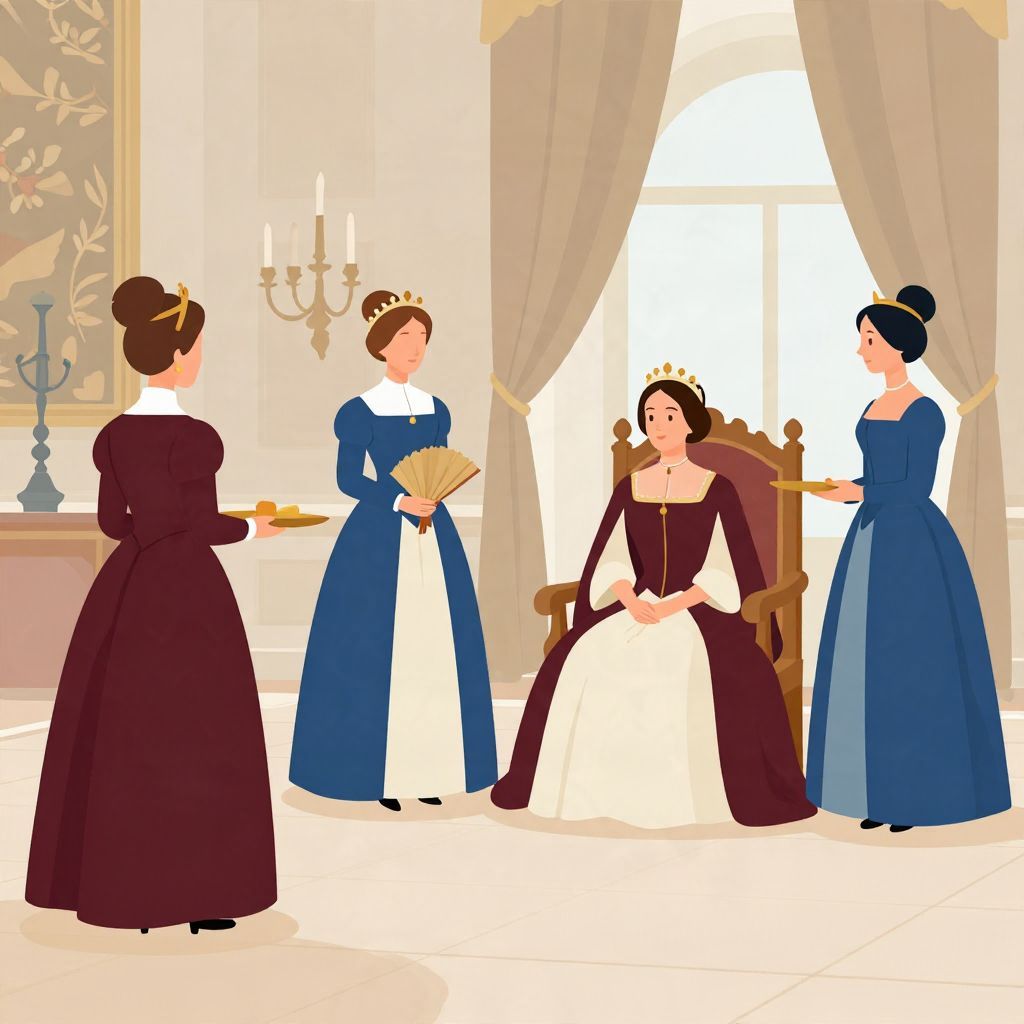
What is a lady in waiting to the queen? In historical terms, she was a woman of noble or gentle birth who attended a queen in her private and public life. The role combined companionship, ceremonial presence, and practical assistance, but it also reflected the politics and hierarchy of royal courts.
The office changed over time. In medieval and early modern Europe, ladies in waiting could be close confidantes, household managers, or important figures in court patronage. In modern constitutional monarchies, the title survives in a more limited ceremonial form, and in some courts it has been replaced by different arrangements.
What Is a Lady in Waiting to the Queen?
A lady in waiting was a female attendant assigned to serve a queen, usually drawn from aristocratic or upper-class families. She helped with daily routines, accompanied the queen at ceremonies, and often acted as a trusted companion. The exact duties varied by country, period, and the queen’s own household.
The Origins of the Lady-in-Waiting Role
The idea of women attending a ruler’s wife or female sovereign is very old, but the recognizable court office developed in medieval Europe. As royal households became more structured, queens maintained their own staffs, separate from the king’s, and ladies in waiting became part of that formal household.
From household service to court office
In earlier medieval courts, service was often personal and informal. Over time, monarchies created more organized households with ranks, duties, and budgets. A queen’s attendants were not simply servants in the modern sense; many were women of status whose presence reinforced the dignity of the queen and the prestige of her court.
Why queens needed attendants
Queens, especially in premodern courts, were rarely private individuals in the modern sense. They were public figures whose clothing, travel, meals, prayers, and audiences were closely managed. Ladies in waiting helped maintain etiquette, protect access to the queen, and ensure that daily life followed court custom.
What Did a Lady in Waiting Actually Do?
The duties of a lady in waiting could range from intimate personal assistance to highly ceremonial service. She might dress the queen, keep her company, relay messages, supervise parts of the household, or accompany her to religious services, receptions, hunts, and state occasions.
Common duties
- Attending the queen during dressing, travel, and formal appearances
- Serving as a companion in private chambers
- Assisting with letters, messages, and introductions
- Accompanying the queen at court events and religious observances
- Helping enforce court etiquette and protocol
Not just personal service
Because court life was political, attendance could mean influence. A lady in waiting might hear private conversations, observe visitors, and shape access to the queen. In some cases, she became an intermediary for petitions, favors, and alliances. This made the role socially important far beyond routine service.
Who Became a Lady in Waiting?
Traditionally, ladies in waiting were selected from noble or well-connected families. Their rank mattered because royal courts were deeply hierarchical, and the queen’s attendants were expected to reflect her status. In many courts, the role was also a way to reward families loyal to the crown.
Social status and marriage
For many women, service at court could enhance family prestige and provide access to influential networks. It might also help arrange a favorable marriage. At the same time, court life could be demanding, competitive, and politically risky, since favor could rise and fall quickly.
Different ranks within the household
Not every female attendant had the same position. Courts often distinguished between senior ladies, chamber attendants, maids of honor, and other household officers. The term “lady in waiting” is sometimes used broadly in modern writing to cover several related roles, even though historical titles varied from one monarchy to another.
How the Role Worked in Different Historical Periods
The meaning of lady in waiting changed as monarchies changed. In the Middle Ages and Renaissance, the role was often embedded in a larger aristocratic household. In the early modern period, court ceremony became more elaborate, and attendance on the queen could be highly formalized. By the nineteenth and twentieth centuries, the role became more symbolic in many kingdoms.
Medieval and early modern courts
In medieval Europe, queens often had their own household staffs, especially when they were queens consort or regents. By the sixteenth and seventeenth centuries, many courts had detailed rules about who could approach the queen, who could dress her, and who could remain in her presence. These rules turned personal service into a visible expression of monarchy.
Victorian and modern monarchy
In Britain and some other monarchies, ladies in waiting remained part of royal households into the modern era, though their work became more ceremonial and less intrusive into daily life. In contemporary usage, the title may refer to a woman who accompanies a queen at official events rather than someone who lives in constant attendance.
Was a Lady in Waiting a Servant or an Aristocrat?
She could be both, depending on how the term is understood. In social rank, many ladies in waiting were aristocrats or members of the gentry. In function, they served the queen. This combination is one reason the role can seem confusing to modern readers: it was service performed within a framework of privilege.
A courtly rather than domestic relationship
Unlike household servants who performed manual labor, ladies in waiting operated in the refined world of court etiquette. They were expected to know rank, precedence, dress codes, and forms of address. Their work was personal, but it was also ceremonial and political.
Influence through proximity
Because they were close to the queen, ladies in waiting could become powerful informal actors. They might recommend candidates for office, help shape social introductions, or influence how information reached the queen. Courts were often places where access mattered as much as formal authority.
Famous Examples in History
Many queens had notable attendants, though the historical record often preserves the queens more clearly than the women who served them. Still, ladies in waiting appear throughout European history as visible participants in court culture, diplomacy, and household politics.
Queens and their households
English, French, Spanish, and other European courts all maintained female attendants for queens and princesses. In some cases, these women were remembered because they were involved in major political events, religious disputes, or succession crises. Their presence reminds us that royal power was never exercised by monarchs alone.
Notable exceptions and variations
Some queens relied on a smaller or more personal circle of attendants, while others presided over large and elaborate households. The exact structure depended on the kingdom, the queen’s rank, and the customs of the court. There was no single universal model for the office.
How the Term Is Used Today
Today, “lady in waiting” is often used in a simplified way to describe a female royal attendant. In some monarchies, the office still exists, though duties are usually limited to accompanying a queen at engagements, helping with introductions, and providing support during official duties.
Modern usage versus historical reality
Modern readers sometimes imagine a lady in waiting as a personal maid, but historically the role was usually more prestigious and more political than that. The title also varied by language and court tradition, so direct translation into modern terms can be misleading.
Why the title still matters
The survival of the term shows how royal households preserve older forms of ceremony. Even when the practical need for constant attendance has faded, the language of court service continues to signal continuity, tradition, and rank.
Why the Role Mattered in History
Lady-in-waiting service reveals how monarchy worked in practice. Courts were not only centers of ceremony; they were workplaces, households, and political arenas. Women in these roles helped sustain royal life, shaped access to power, and participated in the social logic of aristocratic society.
What the role tells us about gender and power
The office shows that women could hold influence even in societies that formally limited their authority. A lady in waiting did not rule, but she could be close to rulers, observe political life firsthand, and sometimes affect decisions indirectly. Her role depended on birth, trust, and courtly skill.
In Summary
A lady in waiting to the queen was a high-status female attendant who served in the queen’s household, provided companionship, and helped manage the routines and ceremonies of court life. The role began in medieval aristocratic households, evolved with royal ceremony, and remained a symbol of monarchy’s social hierarchy. For related reading, see what ladies in waiting were and how royal titles worked.