
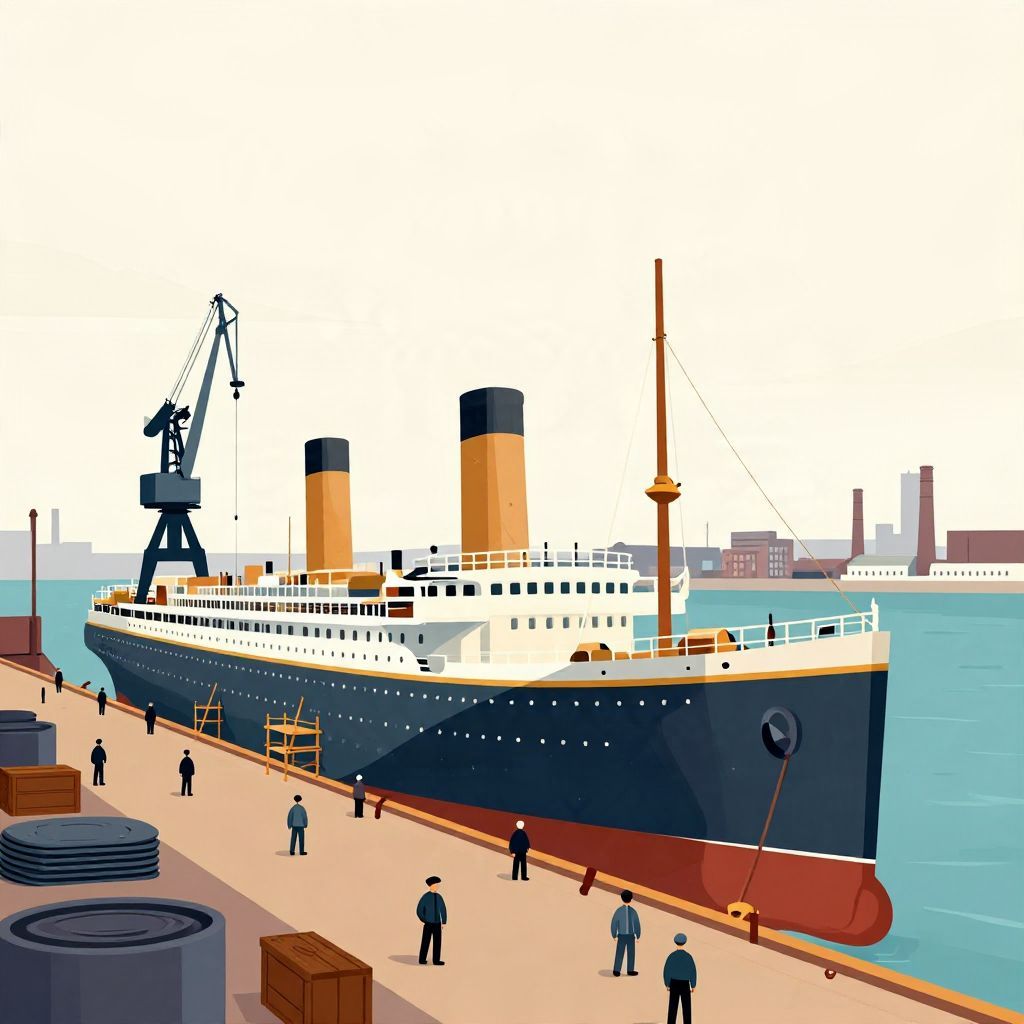
The Titanic was built in Belfast, Ireland, at the Harland and Wolff shipyard on Queen’s Island in Belfast Lough. Construction began in 1909, and the ship was launched in 1911 before being fitted out for sea trials and service.
It was one of the most famous engineering projects of the early 20th century, created for the White Star Line during an era of intense competition in transatlantic passenger travel. Its construction site and the industrial world around it help explain both the ship’s scale and its historical significance.
Where Was Titanic Built?
Titanic was built at the Harland and Wolff shipyard in Belfast, in what is now Northern Ireland. The ship was assembled on Queen’s Island in Belfast Lough, where Harland and Wolff had become one of the world’s leading shipbuilders. The yard’s massive slipways, cranes, and workshops made it possible to construct a ship of Titanic’s unprecedented size.
The Belfast Shipyard Behind Titanic
Harland and Wolff was the industrial firm responsible for building Titanic and her sister ships, Olympic and Brittanic. The company had a long-standing relationship with the White Star Line, and by the early 1900s it was known for producing large, technologically advanced ocean liners. Titanic was built in the same yard as Olympic, with both ships sharing a similar design and construction process.
Why Belfast?
Belfast was a major center of shipbuilding, heavy industry, and skilled labor. The city had access to experienced engineers, metalworkers, and riveters, along with the infrastructure needed to handle enormous steel vessels. Belfast Lough provided a practical water route for launching and fitting out ships, while the industrial economy of the city supported the enormous workforce required.
The scale of the project
Titanic was not built in a single enclosed structure like a modern ship. Instead, her hull was assembled outdoors on a slipway, using giant gantry cranes and thousands of workers. The ship’s construction reflected the industrial methods of the time: steel plates were riveted together, sections were fabricated in workshops, and the vessel gradually took shape in public view.
When Was Titanic Built?
Titanic’s construction began in 1909, and the ship was launched on 31 May 1911. After launching, she still required many months of fitting out, including the installation of engines, boilers, interiors, and safety equipment. Titanic was completed in early 1912 and departed on her maiden voyage from Southampton in April of that year.
Key construction milestones
- 1909: Construction began at Harland and Wolff in Belfast.
- 31 May 1911: Titanic was launched into Belfast Lough.
- 1911–1912: Fitting out continued with machinery, interiors, and final preparations.
- 2 April 1912: Titanic completed sea trials.
- 10 April 1912: She began her maiden voyage.
How Titanic Was Built in Belfast
The ship’s construction was a huge industrial undertaking. Titanic’s hull was made from steel plates fastened with millions of rivets. Her interior spaces were built to serve first-class passengers, second-class travelers, and third-class emigrants, reflecting the social hierarchy of transatlantic travel in the Edwardian era. The ship also included advanced features such as watertight compartments, though these proved insufficient in the disaster that followed.
Labor and craftsmanship
Thousands of workers contributed to the project, including riveters, boilermakers, carpenters, engineers, and fitters. Many of them worked under difficult and dangerous conditions. While Titanic is often remembered as a symbol of luxury, she was also a product of intense industrial labor and the shipbuilding culture of early 20th-century Belfast.
Design and purpose
Titanic was built to be a luxurious and competitive ocean liner, not a warship or cargo vessel. White Star Line wanted a ship that emphasized comfort, size, and prestige. The goal was to attract wealthy passengers and maintain a strong presence on the North Atlantic route, one of the busiest and most prestigious shipping lanes in the world.
Historical Background: Belfast and the Age of Ocean Liners
The early 1900s were the height of the great ocean liner era. Shipping companies competed to build larger, faster, and more luxurious ships to carry passengers between Europe and North America. Belfast became one of the key industrial centers supporting this competition, and Harland and Wolff stood at the center of that achievement.
Industrial Belfast
At the time Titanic was built, Belfast was a city shaped by shipbuilding, linen production, and heavy industry. The shipyard was one of its most important employers and a source of civic pride. Titanic’s construction was therefore not only a commercial project but also a major event in the city’s industrial history.
Relationship to the White Star Line
The White Star Line, based in Liverpool, commissioned Titanic from Harland and Wolff because of the yard’s reputation for quality and reliability. Although the shipping company was not based in Belfast, the city became inseparable from Titanic’s story because that was where the ship was physically built and launched.
What Happened After the Launch?
Launching Titanic in 1911 was not the end of construction. After the hull entered the water, the ship was moved to a fitting-out berth where engines, electrical systems, furnishings, and other equipment were installed. This stage was essential, and it took many months before the vessel was ready to sail. The completed ship then underwent sea trials to test speed, steering, and machinery.
Why the launch matters
The launch was a major public event, but it can be misleading to think of it as the ship’s completion. Titanic was still unfinished after she left the slipway. The launch marked the transition from hull construction to final outfitting, a standard process in shipbuilding at the time.
Why Titanic’s Building Site Still Matters
Titanic’s Belfast origins remain important because they connect the ship to the industrial world that produced it. The story of Titanic is not only about the sinking in 1912; it is also about the engineering ambitions, labor systems, and commercial rivalries of the era that created her. Belfast’s shipyard was central to that history.
Legacy in Belfast today
The Titanic story has become a major part of Belfast’s historical identity. The shipyard area, the city’s maritime heritage, and the memory of the workers who built the ship are now part of how Titanic is understood. For historians and visitors alike, the building site helps explain why Titanic became such a powerful symbol of modernity, ambition, and tragedy.
So, if you are asking where Titanic was built, the direct answer is Belfast, at Harland and Wolff on Queen’s Island. That location places the ship firmly within the industrial history of early 20th-century shipbuilding. If you want to explore more, you may also be interested in how long it took to build the Titanic and how far down the Titanic is.