
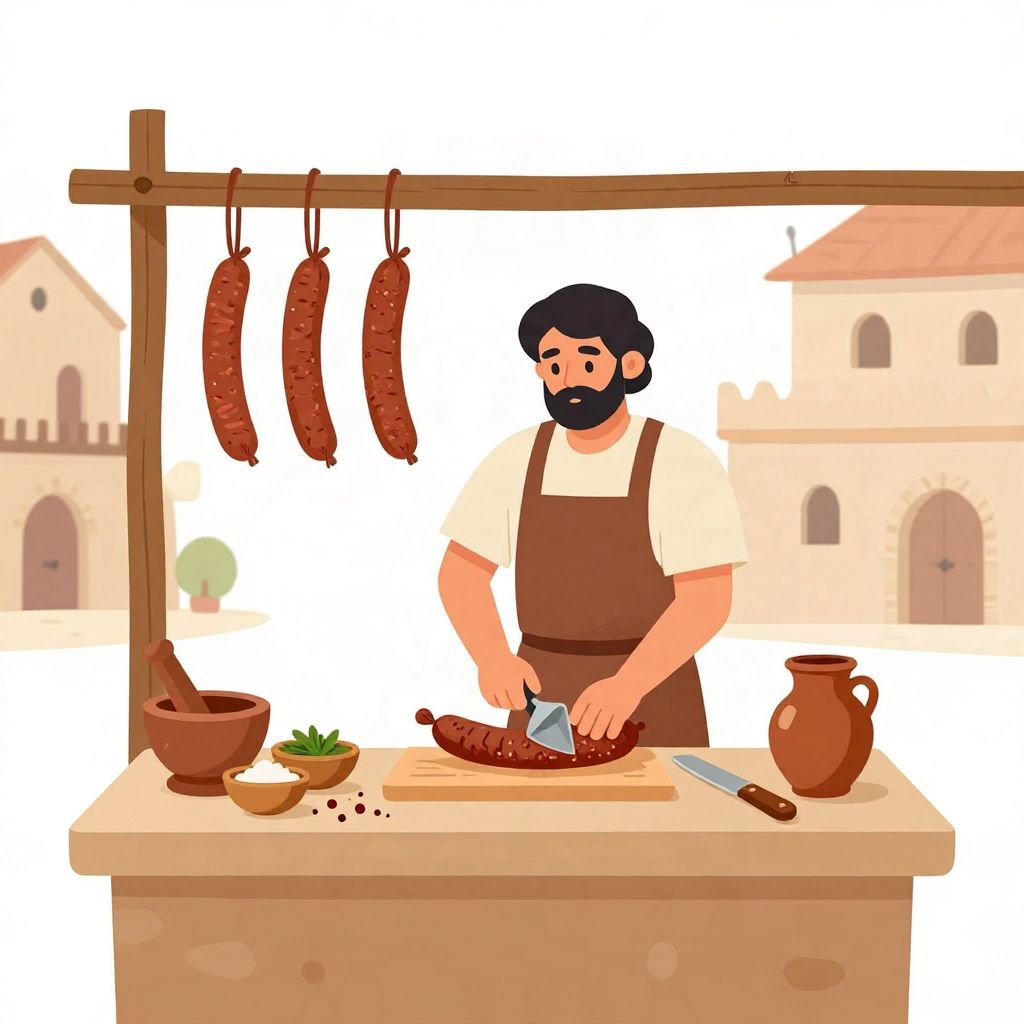
Where does sausage come from? The short historical answer is that sausage is one of humanity’s oldest meat-preservation foods, developed in multiple places rather than invented in a single country. Its earliest known forms likely emerged in the ancient Near East and Mediterranean world, where people needed practical ways to use meat, salt, and animal casings to store food safely.
Over time, sausage spread across Europe, Asia, and beyond, changing with local livestock, spices, and cooking traditions. Because it is a technique as much as a dish, sausage has many regional “origins” rather than one fixed birthplace.
Where does sausage come from?
Sausage comes from ancient meat-preservation practices, probably first developed in the ancient Near East and later refined in Greece, Rome, and many other societies. The basic idea was simple: chop or grind meat, mix it with salt and seasonings, and pack it into a casing or container. This made meat easier to store, transport, and cook.
The earliest sausage was a solution to preservation
Before refrigeration, people had to find ways to keep meat from spoiling. Salting, drying, smoking, and stuffing meat into cleaned intestines all helped slow decay. Sausage was not just a recipe; it was a technology of survival. It allowed households, herders, soldiers, and travelers to make use of slaughtered animals more efficiently and waste less.
Because these methods were practical, they likely developed independently in several regions. Historians generally avoid naming one single “inventor” of sausage. Instead, they trace the food’s history through ancient texts, trade networks, and the spread of animal husbandry.
The ancient roots of sausage
The earliest written evidence for sausage-like foods appears in the ancient world, especially in Mesopotamia, Greece, and Rome. Exact “firsts” are difficult to prove, but there is strong evidence that stuffed meat preparations were known by the classical period and probably earlier. By then, sausage had become part of everyday food culture in many places around the Mediterranean.
Mesopotamia and the ancient Near East
The ancient Near East is often treated as one of the most likely regions where sausage-making emerged early, because it was among the first areas with settled agriculture, large-scale herding, salt use, and complex food processing. Even if surviving records do not always use a modern word for sausage, the broader preservation methods were clearly in use.
Ancient Greece and Rome
Greek and Roman writers provide clearer evidence. The Romans, in particular, were familiar with many kinds of sausages and meat mixtures. Roman cookery valued seasoned minced meat, and sausages could be fresh, smoked, or cured. They were eaten by ordinary people and also appeared in more elaborate meals.
Roman expansion helped spread sausage-making throughout Europe. As soldiers, merchants, and settlers moved across the empire, they carried food habits with them. Local populations adapted the technique to their own animals and tastes, creating new regional styles over time.
Why sausage spread so widely
Sausage spread because it was useful everywhere people raised livestock. It worked with pork, beef, lamb, goat, and even game. It also made use of parts of the animal that might otherwise spoil quickly. In many societies, sausage became a way to stretch meat further and turn leftovers into a valuable food.
Portability and economy
Sausage was especially valuable for travelers, armies, and workers. It was compact, easy to cook, and often more durable than fresh meat. Cured sausages could be carried on long journeys, making them important in trade and military supply. In cold climates, smoking and drying added another layer of preservation.
Local ingredients shaped regional sausage traditions
As sausage moved from place to place, it changed. Spices, herbs, grains, garlic, wine, blood, and fat all appeared in different combinations depending on local availability and taste. This is why the world now has such a wide range of sausages: bratwurst, chorizo, salami, kielbasa, and many others all reflect local history as much as a shared ancient technique.
How sausage changed in the Middle Ages
During the Middle Ages, sausage became deeply embedded in European food culture. Rural households, town butchers, monasteries, and noble kitchens all made versions of it. In many places, winter slaughtering traditions encouraged sausage production because fresh meat had to be preserved before it spoiled.
Butchery and household food culture
In medieval towns, sausage-making was often tied to butchers’ guilds and local markets. Families also made sausages at home after seasonal slaughter. The practice fit well with a peasant economy in which nothing from the animal should be wasted. Fat, trimmings, organs, blood, and spices could all be transformed into useful food.
Religious and cultural rules
Religious dietary laws influenced sausage traditions too. Jewish and Islamic food practices shaped what meats could be used and how animals were slaughtered. In Christian Europe, fasting periods also affected when meat could be eaten, stored, or processed. These rules did not create sausage, but they influenced how it was made and consumed.
What counts as sausage?
The word “sausage” can mean different things in different times and places. Historically, it refers to minced or chopped meat mixed with seasoning and usually stuffed into a casing. But some foods that are sausage-like may not fit every modern definition. Blood sausage, liver sausage, fresh sausage, cured sausage, and smoked sausage all belong to the broader family.
Fresh, cured, and smoked sausages
- Fresh sausage is sold uncooked and must be cooked before eating.
- Cured sausage uses salt and sometimes nitrates or fermentation to preserve the meat.
- Smoked sausage gains flavor and preservation from smoke exposure.
- Blood sausage includes blood as a major ingredient and has ancient roots in many cultures.
These categories show why sausage cannot be traced to one simple origin. It is a family of foods built around a preservation method, not a single recipe.
Sausage outside Europe
Although European history is often emphasized, sausage-like foods existed in many other regions. Across Asia, the Middle East, and parts of Africa, people developed their own ways of stuffing, curing, drying, or spicing meat. Some traditions used rice, grains, or offal mixed with meat; others relied on drying and fermentation rather than casings alone.
Trade and migration carried sausage traditions
Trade routes helped spread ingredients such as black pepper, nutmeg, paprika, and other spices that transformed sausage flavor. Migration also carried techniques from one region to another. As a result, many modern sausages reflect centuries of contact between peoples, empires, and markets.
Modern sausage and industrial production
In the modern era, sausage changed again. Urbanization and industrial meat processing made it easier to produce sausages on a large scale. Refrigeration reduced the need for preservation, but sausage remained popular because of taste, convenience, and affordability. Factories standardized many products, while local artisans preserved older styles.
From necessity to cuisine
What began as a preservation method gradually became a culinary tradition. In earlier centuries, sausage was often valued because it prevented waste and extended meat supplies. Today, in many places, it is prized for flavor, texture, and regional identity. Yet the older logic still survives in cured and smoked varieties.
So, where did sausage really come from?
If you want the most accurate historical answer, sausage came from ancient meat-preservation practices that developed in the early civilizations of the Near East and Mediterranean world, then spread and diversified across many regions. It was not invented once in one place. Instead, it evolved wherever people needed to store meat efficiently and had the tools to grind, season, and encase it.
That long history is why sausage is both universal and local: universal because many societies made it, and local because every region shaped it differently. If you are interested in how other foods and animal products developed historically, you may also enjoy reading about where silver comes from and where oxtail comes from.