
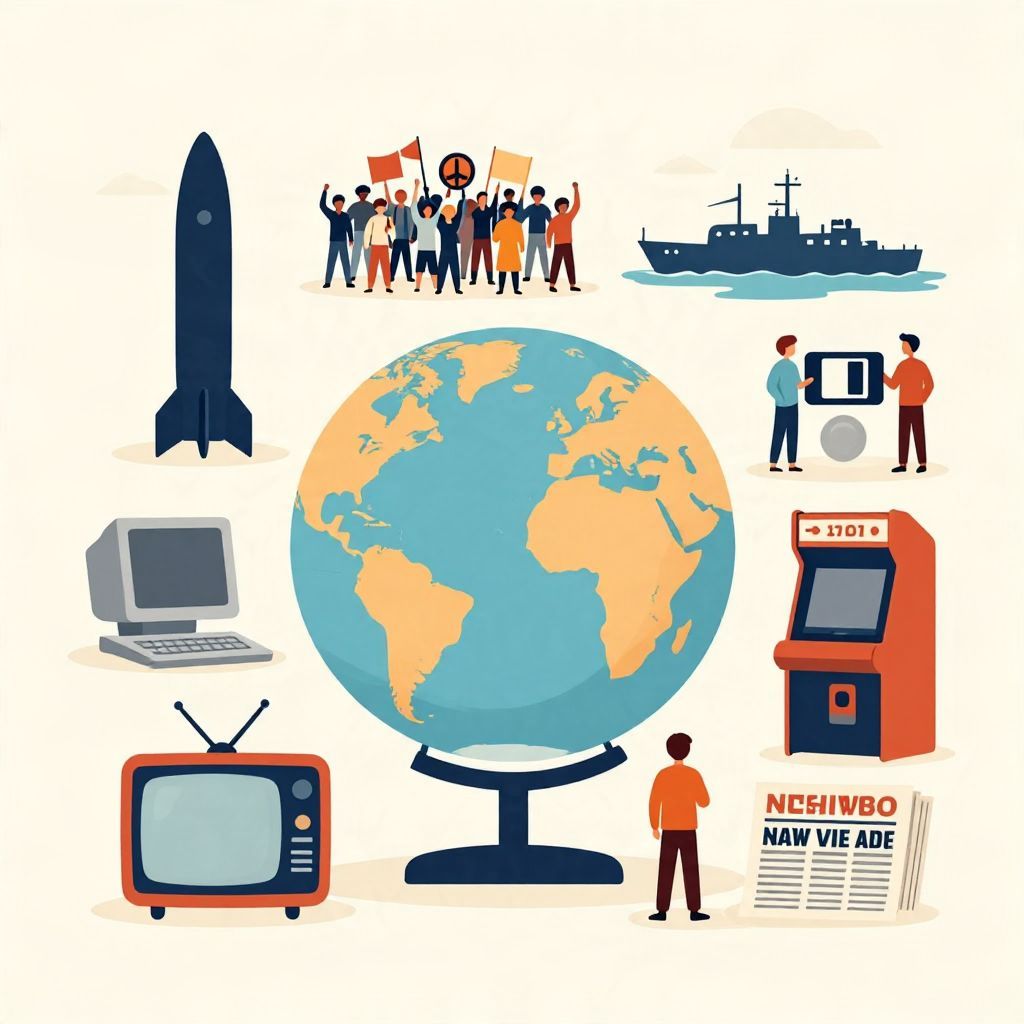
What happened in 1982? It was a year of sharp Cold War tensions, economic strain, major cultural shifts, and a few events that still shape politics and society today. Across the world, 1982 brought war, recession, technological change, and memorable breakthroughs in music, film, and sport.
To understand 1982, it helps to see it as a turning point rather than a single story. In the span of twelve months, governments changed course, conflicts escalated, and new technologies and cultural trends began to define the late 20th century.
What happened in 1982?
In 1982, the world saw the Falklands War, the deepening of the global debt crisis, the launch of the first CD player, the emergence of the AIDS crisis as a major public health concern, and major political changes in several countries. It was a year shaped by Cold War rivalry, economic uncertainty, and rapid cultural transformation.
The major events of 1982
1. The Falklands War
One of the defining events of 1982 was the Falklands War, fought between Argentina and the United Kingdom from April to June. Argentina invaded the Falkland Islands on 2 April 1982, claiming sovereignty over the British-controlled territory. Britain responded by sending a naval task force, and after weeks of fighting, British forces retook the islands.
The war mattered far beyond the South Atlantic. It boosted the political standing of British Prime Minister Margaret Thatcher, contributed to the fall of Argentina’s military junta, and showed that limited wars could still have major diplomatic consequences during the Cold War era.
2. Cold War tension remained high
1982 was also a tense year in the broader Cold War. Relations between the United States and the Soviet Union remained strained over nuclear weapons, Afghanistan, and competing global influence. The early 1980s were marked by renewed fear of nuclear conflict, and public protests against arms buildup were common in many countries.
Although the Cold War did not suddenly end in 1982, the year reflected how unstable the international order had become. Leaders on both sides were still testing one another, and the language of confrontation remained strong.
3. The global economy was under pressure
Many countries struggled with recession, inflation, and high unemployment in 1982. The world economy was still dealing with the aftershocks of the oil shocks of the 1970s, and developing nations faced a severe debt crisis. Mexico’s announcement in August 1982 that it could no longer meet its debt obligations became a key moment in that crisis.
This financial shock affected banks, governments, and ordinary people across Latin America and beyond. It helped shape a decade of austerity, loan restructuring, and economic reform in many countries.
4. The AIDS crisis became more visible
By 1982, doctors were recognizing that a new and serious illness was spreading, later identified as AIDS. The disease had first been noticed in the United States in 1981, but 1982 was an important year in which the medical and public health community began to understand that this was not an isolated set of cases.
At the time, knowledge of transmission was limited, and stigma was widespread. The year marked the beginning of a long public health struggle that would reshape medicine, activism, and social attitudes around the world.
5. Technology and consumer culture changed quickly
1982 was an important year for consumer technology. The compact disc, developed by Philips and Sony, entered the market and signaled a major shift in how people would listen to music. The first commercial CD player was introduced in Japan in 1982, beginning the transition from analog sound to digital audio.
Other technologies were also advancing. Personal computers were becoming more visible in homes and offices, and the digital age was beginning to take shape in everyday life, even if most people did not yet realize how transformative it would become.
Key events in 1982 by month
January to March
- January: The year opened amid recession, Cold War tension, and continuing debate over nuclear weapons.
- March: Pope John Paul II made a historic visit to Britain, the first by a reigning pope to the country since the Reformation.
April to June
- 2 April: Argentina invaded the Falkland Islands.
- April–June: Fighting continued in the Falklands War.
- 14 June: Argentine forces surrendered, ending the war.
July to September
- August: Mexico announced it could not service its foreign debt, intensifying the Latin American debt crisis.
- September: The first reported cases of a disease later known as AIDS were increasingly discussed in medical circles, though understanding remained incomplete.
October to December
- October: The first commercial compact disc player went on sale in Japan.
- November: The United States held midterm elections during a period of economic concern and political change.
- December: The year ended with continuing recession, Cold War anxiety, and a growing sense that the world was entering a new technological era.
Why 1982 mattered historically
It showed the limits of military power
The Falklands War demonstrated that even a short conflict could have lasting political consequences. For Britain, victory reinforced a more assertive foreign policy. For Argentina, defeat weakened the military government and helped pave the way for a return to democracy in 1983.
The war also reminded the world that colonial-era disputes had not disappeared. Territorial claims, national pride, and strategic calculation still mattered in the late 20th century.
It exposed the fragility of the world economy
The debt crisis of 1982 was one of the clearest signs that the postwar economic order was under strain. Many developing countries had borrowed heavily during the 1970s, expecting continued growth. When interest rates rose and export earnings weakened, repayment became difficult or impossible.
This helped usher in a period of structural adjustment, tighter financial oversight, and long-term debate about inequality between wealthy and poorer nations.
It marked the beginning of a major health crisis
Although AIDS would become far more widely understood later, 1982 was one of the first years when the scale of the crisis started to become visible. The early confusion and stigma surrounding the disease had profound consequences, delaying public understanding and effective response.
In historical terms, 1982 sits at the start of one of the most important public health crises of the modern era.
It accelerated the digital transition
The arrival of the compact disc symbolized more than a new format for music. It represented the broader shift toward digital technology that would eventually transform entertainment, communication, and work. What seemed like a consumer novelty in 1982 became part of a much larger technological revolution.
Culture, sport, and everyday life in 1982
Music and film
1982 was a memorable year in popular culture. Michael Jackson’s Thriller was released late in the year and would soon become one of the most influential albums in music history. In film, audiences saw a mix of science fiction, fantasy, and blockbuster entertainment, reflecting the growing power of global mass media.
Popular culture in 1982 also showed how television, music videos, and international marketing were becoming more important. The entertainment industry was entering a new phase of scale and visibility.
Sport
In sport, 1982 included the FIFA World Cup in Spain, where Italy won the tournament. The event drew global attention and is remembered as one of the major sporting moments of the decade. Sports events in 1982 often carried political and cultural significance well beyond the field of play.
Daily life
For many people, 1982 meant economic caution. Inflation, unemployment, and interest rates affected family budgets in much of the world. At the same time, new consumer goods, home electronics, and global media made the decade feel increasingly modern. It was a year when older postwar assumptions were giving way to a more uncertain but more connected world.
How historians view 1982
Historians often see 1982 as part of the early 1980s transition from the crisis-ridden 1970s to the more globally integrated and technologically driven world that followed. It was not a single watershed in every region, but it was a year when several important changes became impossible to ignore.
Some events, like the Falklands War, had immediate political effects. Others, like the debt crisis, AIDS, and digital media, unfolded over many years. Together, they make 1982 a useful lens for understanding the late 20th century.
Takeaway
What happened in 1982 was more than a collection of headlines: it was a year when war, economics, health, and technology all pointed toward a changing world. If you want to place it in context, you may also find it useful to read about what happened in 1983 and what happened in 1986, both of which help show how the events of 1982 fit into the wider decade.