
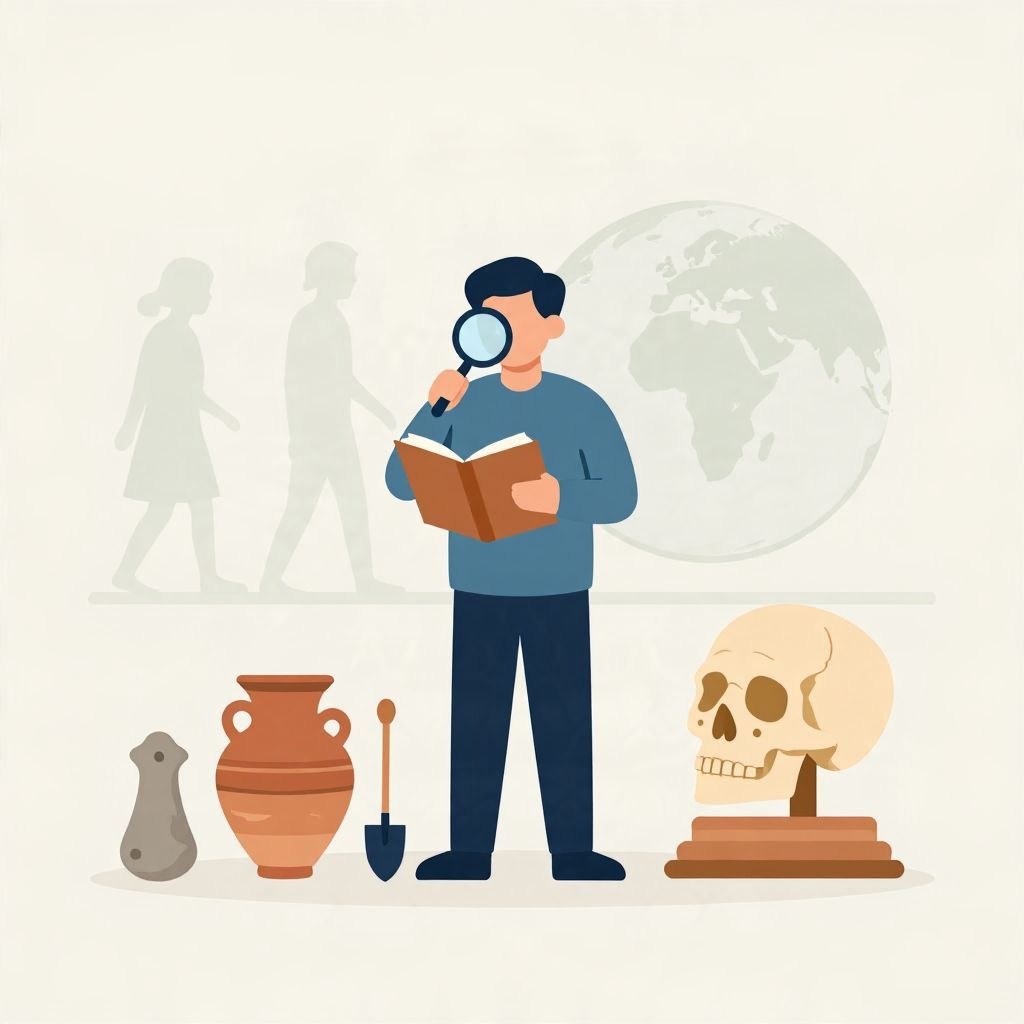
What does anthropology mean? At its simplest, anthropology is the study of humans: their origins, cultures, languages, societies, and biological development. The word comes from Greek roots meaning “human” and “study,” but the discipline itself took shape over centuries as scholars tried to understand human difference and human commonality.
Its history reflects changing ideas about race, empire, evolution, culture, and fieldwork. Anthropology is now a broad academic field, but its meaning has shifted over time as researchers moved from speculation about “other peoples” to careful, evidence-based study of human lives in context.
What Does Anthropology Mean?
Anthropology means the systematic study of humans in all their diversity. It examines how people live, think, communicate, adapt, and change over time. Modern anthropology usually includes cultural anthropology, archaeology, biological anthropology, and linguistic anthropology, each focused on a different part of the human story.
The word’s origins
The term comes from the Greek anthrōpos (“human being”) and -logia (“study” or “account of”). In European scholarship, “anthropology” began as a broad term for knowledge about humanity. It did not always mean what it means today; early uses could include philosophy, anatomy, or moral reflection as well as social observation.
Why the meaning matters
Understanding what anthropology means is important because the field has never been only about describing customs. It has also been about how scholars interpret human variation, how they compare societies, and how they avoid turning cultural difference into hierarchy. That tension shaped the discipline’s history from the beginning.
How Anthropology Developed Over Time
Anthropology emerged gradually rather than appearing at a single date. Long before it became a formal discipline, travelers, missionaries, administrators, philosophers, and natural historians wrote about peoples they encountered. These accounts were often biased, but they laid part of the groundwork for later anthropological questions about culture, kinship, belief, and social organization.
Ancient and early modern roots
Classical writers such as Herodotus and Tacitus described customs of foreign peoples, though their works mixed observation with rumor and moral judgment. In the early modern period, European expansion brought more sustained contact with Africa, the Americas, Asia, and the Pacific. These encounters produced a flood of descriptions, but they were usually framed through colonial assumptions rather than neutral inquiry.
By the 18th century, Enlightenment thinkers increasingly tried to classify human societies and explain social development. Some of these schemes were highly speculative and ranked societies in “stages” of progress, reflecting the prejudices of the age. Still, they helped create the idea that human life could be studied comparatively and systematically.
The 19th century and the birth of academic anthropology
Anthropology became a recognizable academic discipline in the 19th century, especially in Europe and North America. This was the era of empire, museum collecting, evolutionary theory, and growing interest in human origins. Scholars gathered artifacts, skulls, language data, and travel reports, often without the consent of the people involved. The discipline’s early history is therefore tied to colonial power as well as scholarship.
One major influence was evolutionary thought after Charles Darwin’s work on natural selection. Some anthropologists applied evolutionary ideas to culture in ways that are now rejected, imagining all societies moving along a single path from “primitive” to “civilized.” This approach, often called unilineal evolutionism, is now understood as simplistic and ethnocentric. Yet it helped define anthropology as a field concerned with human development over time.
From armchair theory to fieldwork
A major turning point came in the early 20th century, when anthropologists increasingly relied on long-term fieldwork rather than secondhand reports. Researchers such as Franz Boas in the United States argued that cultures must be studied on their own terms and that sweeping racial hierarchies were scientifically unsound. Boas and his students helped shift anthropology toward cultural relativism, historical particularism, and close observation.
In Britain, fieldworkers such as Bronisław Malinowski emphasized participant observation: living among the people being studied, learning the language, and observing everyday life directly. This method became one of anthropology’s defining practices. It changed the discipline from a largely comparative and speculative enterprise into one grounded in detailed ethnographic research.
The Main Branches of Anthropology
Today, anthropology usually refers to four major subfields. Together they show how broad the discipline has become, and they explain why the word can mean different things in different contexts.
- Cultural anthropology: studies living societies, social practices, beliefs, kinship, economy, politics, and everyday life.
- Archaeology: studies past human societies through material remains such as tools, buildings, pottery, and burial sites.
- Biological anthropology: studies human evolution, genetics, primates, and biological variation.
- Linguistic anthropology: studies language in social life, including how speech shapes identity, power, and community.
How these branches connect
These branches overlap more than they once did. A study of ancient migration, for example, may use archaeology, genetics, and language evidence together. A study of colonial contact may combine historical documents with oral traditions and material culture. Anthropology’s strength lies in this ability to connect human biology, culture, and history.
Anthropology’s Historical Significance
Anthropology matters because it changed how scholars think about human difference. It challenged older assumptions that one society could be the universal standard for all others. Over time, it helped establish the idea that customs, beliefs, and social institutions should be understood in context rather than judged only by outside standards.
Contributions to understanding culture
One of anthropology’s most important contributions was the concept of culture as learned, shared, and variable. This idea seems obvious today, but it was historically significant. It shifted attention away from fixed notions of race or destiny and toward the ways people learn behavior, create meaning, and organize social life.
Anthropology also expanded knowledge of societies that had been ignored or misrepresented in written histories. Oral traditions, kinship systems, ritual life, and local ecological knowledge became legitimate subjects of study. In many cases, anthropologists preserved information that might otherwise have been lost, though the field has also had to confront the unequal power relations under which that information was collected.
Complicated ties to colonialism
The discipline’s history cannot be separated from empire. Early anthropological research often depended on colonial access, and some data collection served administrative or political goals. Museums accumulated human remains and cultural objects in ways that are now widely criticized. Modern anthropology has spent decades examining this legacy, repatriating remains and objects in some cases, and rethinking who gets to produce knowledge about whom.
This self-critique is part of anthropology’s historical significance. Few disciplines have so openly questioned their own foundations. That process has led to greater attention to ethics, collaboration, and the voices of the people being studied.
Key Shifts in the Discipline
Anthropology has changed repeatedly as historical circumstances changed. Its meaning today is the result of several major shifts in method and interpretation.
- From speculation to observation — scholars moved from broad theories about “human nature” to detailed study of specific communities.
- From ranking to context — cultures came to be understood as different, not arranged on a simple ladder of progress.
- From outsiders to collaboration — more recent anthropology increasingly involves local scholars, community consultation, and ethical review.
- From isolated categories to connections — researchers now often study how migration, trade, ecology, and power shape human life together.
Postwar anthropology and new debates
After World War II, anthropology expanded globally and became more self-aware. Scholars debated whether the field should focus on small-scale communities, modern states, colonialism, or global systems. Feminist anthropology, postcolonial critique, and interpretive approaches all challenged older assumptions. By the late 20th century, anthropology was no longer defined by a single method or theory, but by a commitment to studying humans in context.
What Anthropology Means Today
In the modern world, anthropology means more than the study of distant societies. It examines migration, cities, medicine, religion, technology, inequality, climate change, and digital life. Anthropologists may work in universities, museums, public health, heritage preservation, or policy research. The field remains rooted in comparison, but it now pays closer attention to ethics, voice, and the complexity of lived experience.
Why the definition is still debated
Anthropology’s meaning is still debated because the field spans so many topics. Some people use the term mainly for cultural anthropology; others think first of archaeology or human evolution. In practice, anthropology is best understood as a family of approaches united by one question: what does it mean to be human, and how do humans live in relation to one another and to their environments?
A Brief Timeline of Anthropology
The history of anthropology can be summarized in a few major stages:
- Classical antiquity — writers describe foreign peoples, often through moral comparison.
- 15th–18th centuries — European exploration produces large bodies of travel writing and classification schemes.
- 19th century — anthropology becomes a formal academic field, shaped by empire and evolutionary theory.
- Early 20th century — fieldwork, participant observation, and cultural relativism transform the discipline.
- Post-1945 era — anthropology broadens, becomes more critical of colonialism, and diversifies its methods.
- 21st century — the field studies globalization, digital culture, environment, health, and heritage alongside traditional topics.
Conclusion
So, what does anthropology mean? Historically, it means the study of humans, but that simple definition hides a long and contested past. The discipline grew from travel writing, empire, and evolutionary theory into a more careful, self-critical study of culture, biology, language, and the past. Its lasting value lies in showing that human life is both shared and diverse, shaped by history, and best understood in context. For related reading, see what cultural preservation architecture means and how cultural diffusion works.