
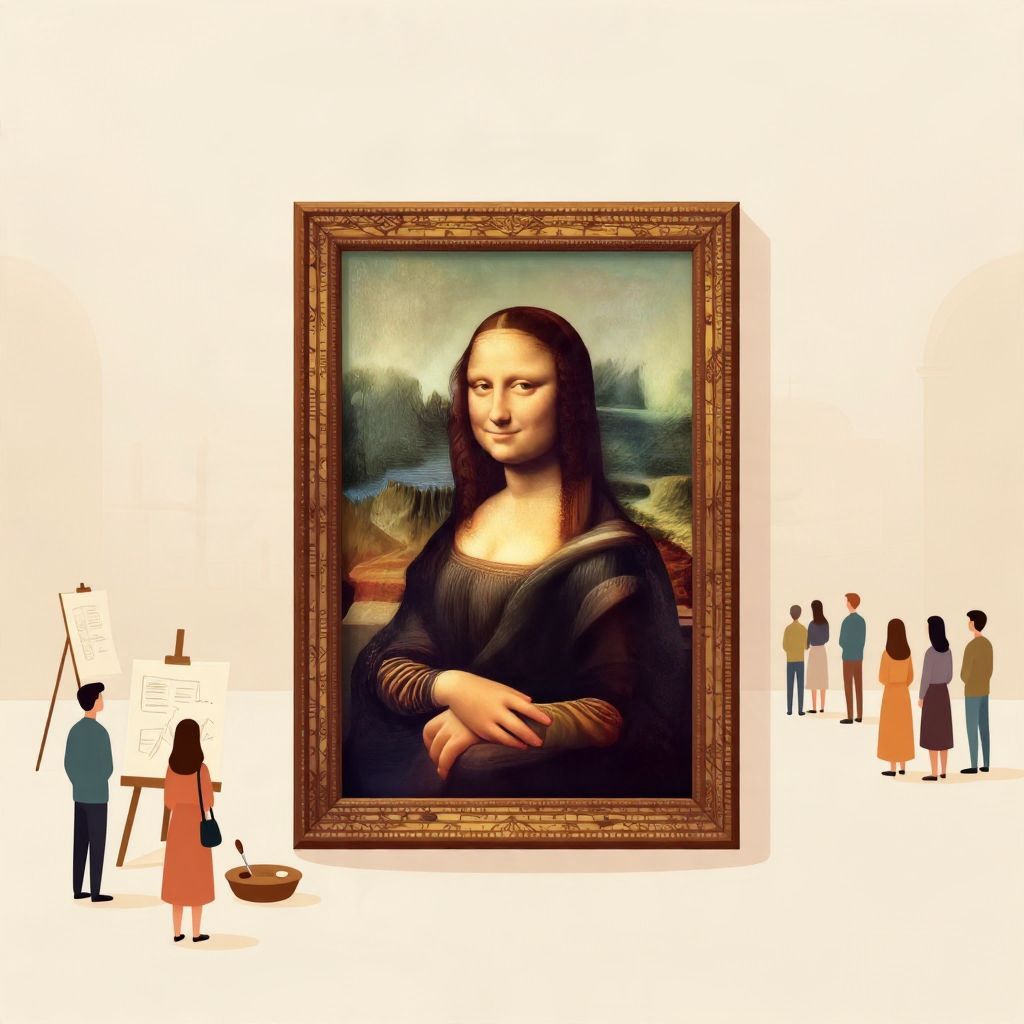
The Mona Lisa is famous because it combines artistic brilliance, a mysterious subject, a dramatic history, and centuries of cultural attention. Painted by Leonardo da Vinci in the early 1500s, it became one of the best-known images in the world not only for how it looks, but also for how it was displayed, stolen, discussed, copied, and mythologized over time.
Its fame did not happen all at once. The painting’s reputation grew through Renaissance admiration, royal ownership, a sensational theft in 1911, and its later status as a global symbol of art itself. Today, people know it even if they know little about Renaissance painting.
Why Is the Mona Lisa Famous?
The Mona Lisa is famous because it is a masterpiece by Leonardo da Vinci, shows an unusually lifelike and ambiguous portrait style, and has a history that made it widely discussed far beyond art circles. Its fame was amplified by royal collecting, museum display, mass reproduction, and the 1911 theft that turned it into an international sensation.
The Painting Itself: Why It Stands Out
At the center of the Mona Lisa’s fame is the painting’s artistic quality. Leonardo used techniques that made the face and hands appear soft, natural, and subtly animated. The famous smile seems to shift depending on how it is viewed, which gives the portrait an air of mystery that has fascinated viewers for centuries.
Leonardo’s technique
Leonardo da Vinci was not only a painter but also a scientist and observer of anatomy, light, and expression. In the Mona Lisa, he used sfumato, a blending technique that softens edges and creates gradual transitions between light and shadow. This helped produce a realistic face without harsh outlines.
That realism mattered in the early 1500s. Portraits were common among elites, but Leonardo’s treatment of expression, atmosphere, and pose made this work feel unusually alive. The sitter is seated in a calm, balanced composition against a distant landscape, which adds to the painting’s quiet intensity.
The mystery of the expression
One reason the Mona Lisa became so memorable is that her expression is hard to pin down. She does not smile broadly, yet she is not stern. That ambiguity has encouraged endless interpretation. Some viewers see warmth, others reserve, and others uncertainty. This uncertainty is part of the painting’s lasting appeal.
Scholars generally identify the sitter as Lisa Gherardini, the wife of Florentine merchant Francesco del Giocondo, which is why the work is also called La Gioconda in Italian and La Joconde in French. The identification is widely accepted, though the painting’s exact original purpose and completion date are still discussed in scholarship.
How the Mona Lisa Became a Historical Celebrity
The Mona Lisa did not become world-famous simply because it was beautiful. Many great paintings remained known mainly to specialists. The Mona Lisa’s rise came from a series of historical events that gave it exceptional visibility and symbolic power over time.
Leonardo’s reputation
Leonardo da Vinci was already admired in his own lifetime as a remarkable artist and thinker. Because he was associated with genius, any work linked to him carried special prestige. The Mona Lisa benefited from that reputation, especially as later generations came to view Leonardo as the model of Renaissance creativity.
Royal ownership and prestige
After Leonardo’s death in 1519, the painting entered royal collections in France. It was eventually associated with French kings and displayed in prestigious settings. Royal ownership mattered because it signaled value and rarity. A painting kept by a monarch was not just an artwork; it was a treasure of state.
Over time, the Mona Lisa moved through important French residences and later into the national collection. Its placement in elite spaces helped preserve it and gave it an aura of exclusivity long before it became a museum icon.
The Louvre and public fame
When the painting became part of the Louvre’s collection, it shifted from a private royal treasure to a public cultural object. The museum setting made it available to a much wider audience. As travel, printing, and journalism expanded in the 19th and 20th centuries, the painting’s image spread far beyond Paris.
The 1911 Theft Made It a Global Sensation
One of the biggest reasons the Mona Lisa is famous today is the theft of 1911. On 21 August 1911, the painting disappeared from the Louvre. The theft was widely reported, and the search for the missing masterpiece became an international story. For two years, the Mona Lisa was absent from the museum and present everywhere in the news.
Why the theft mattered
The theft transformed the painting from a respected artwork into a cultural legend. Newspapers covered the case extensively, and the mystery increased public curiosity. People who had never cared about Renaissance art suddenly knew the Mona Lisa’s name. The absence of the painting made its image more powerful than ever.
The painting was recovered in 1913 after the thief, Vincenzo Peruggia, was caught in Italy. He had taken the painting from the Louvre and claimed, in essence, that it should be returned to Italy. His motive is often simplified in popular retellings, but the historical record shows a mix of nationalism, opportunity, and personal action rather than a grand political plot.
After the theft
Once recovered, the Mona Lisa returned to the Louvre with even greater fame. The theft had turned it into a headline object, and its celebrity only grew in the age of mass media. From that point on, it was not merely admired; it was recognized as the world’s most famous painting.
Why the Mona Lisa Is So Often Reproduced
The Mona Lisa is famous because it is endlessly reproduced. Its face appears in books, posters, advertisements, cartoons, and digital media. Repetition has made the image instantly recognizable, even to people who have never visited a museum. In modern culture, visibility often creates fame, and the Mona Lisa has had more visibility than almost any other artwork.
A universal image
Because the composition is simple and the face is centered, the painting is easy to copy and adapt. Artists, advertisers, and satirists have used it as a visual shorthand for “art” itself. This has given the painting a second life outside the museum, where it functions as a symbol of culture, prestige, and even artistic seriousness.
Tourism and the museum experience
Millions of visitors go to the Louvre partly to see the Mona Lisa. Ironically, its fame can make the viewing experience difficult: the painting is relatively small, protected behind glass, and often surrounded by crowds. This contrast between enormous fame and modest physical size has become part of the story.
For many visitors, seeing the Mona Lisa is less about close study than about participating in a shared cultural ritual. That experience reinforces the painting’s fame, because people leave with the sense that they have encountered a world landmark.
What the Mona Lisa Represents in History
The Mona Lisa matters historically because it sits at the intersection of Renaissance art, royal collecting, modern museums, and mass culture. It is not just a painting; it is a case study in how objects become famous. Its reputation grew through artistic excellence, but also through institutions, media, and public imagination.
Renaissance art and humanism
The painting reflects Renaissance interest in the individual person. Instead of showing a saint, mythological figure, or grand historical scene, Leonardo presented a real woman in a composed, intimate portrait. That focus on individuality helped define the cultural values of the period.
The power of mystery
Historians and art scholars often note that the Mona Lisa’s fame is partly due to what it does not reveal. We do not know every detail of its original display, and the sitter’s expression resists simple explanation. The painting invites interpretation without ever fully yielding its secrets, which keeps attention alive.
A symbol larger than the artwork
Over time, the Mona Lisa became more than a portrait. It became a symbol of artistic genius, museum culture, and even global heritage. That symbolic status explains why people who know little about Renaissance Italy still recognize the image immediately.
Common Myths and Misunderstandings
Because the Mona Lisa is so famous, it has accumulated myths. Some are harmless, but others distort the historical record. It helps to separate established facts from popular legend.
- Myth: The painting was always the most famous artwork in the world.
Reality: Its fame grew gradually, especially after the 1911 theft and the rise of mass media. - Myth: The smile has a single hidden meaning.
Reality: The expression is open to interpretation, and scholars do not agree on one definitive reading. - Myth: The painting’s fame comes only from the theft.
Reality: The theft was crucial, but Leonardo’s artistry and the painting’s later museum status were equally important.
Why People Still Care About It Today
The Mona Lisa remains famous because it continues to satisfy several human interests at once: beauty, mystery, celebrity, and history. It is one of the rare artworks that is both highly regarded by specialists and instantly recognized by the general public. Few objects bridge those worlds so successfully.
Its fame also says something about modern culture. We often remember works that are discussed, reproduced, and surrounded by stories. The Mona Lisa has all of those qualities. It is a portrait, but it has become a global icon.
In historical terms, the Mona Lisa is famous not for one single reason but for the way art, biography, theft, and media combined over centuries. If you want to explore related topics, you may also be interested in how big the Mona Lisa is and where King Francis kept the Mona Lisa.