
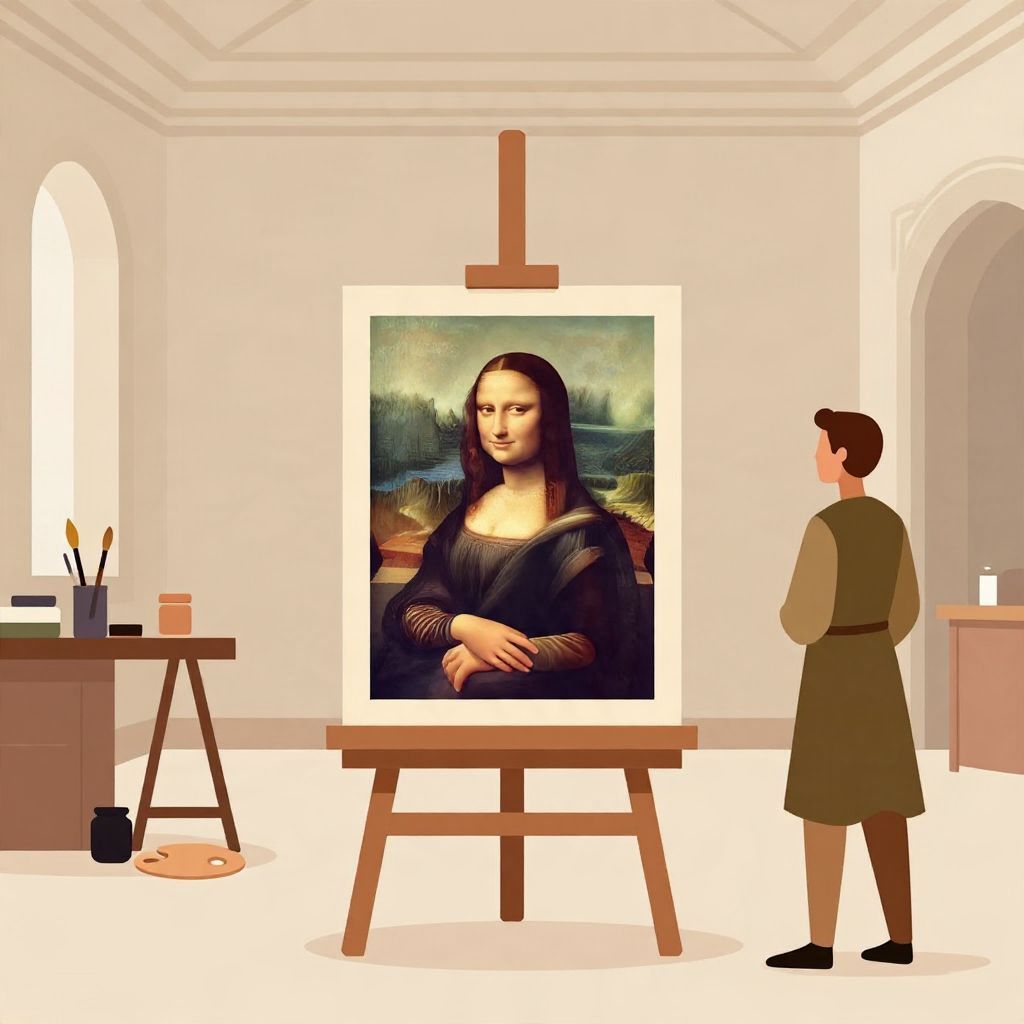
The Mona Lisa is not a large painting. Leonardo da Vinci’s portrait measures about 77 cm by 53 cm, or roughly 30 in by 21 in, making it smaller than many people expect when they first see it in a museum or in photographs. Its fame comes less from size than from its artistic innovation, mystery, and long history.
Understanding how big the Mona Lisa is also helps explain why it feels so different in person: it is intimate, carefully composed, and meant for close viewing rather than monumental display.
How big is the Mona Lisa?
The Mona Lisa is about 77 cm high and 53 cm wide (approximately 30 x 21 inches). It is painted on a poplar wood panel, not canvas, and it is relatively small compared with many famous museum masterpieces. Its modest size reflects Renaissance portrait traditions, which often favored a private, human-scale format.
What are the Mona Lisa’s exact dimensions?
The standard dimensions given by the Louvre and most art historians are 77 cm × 53 cm. Because the work is painted on wood, the panel itself and its framing history can affect how it is measured and presented, but the painted image is generally described in those terms. In practical terms, it is about the size of a medium poster or a large framed photograph.
Why do people think it is bigger?
Many visitors are surprised because the painting’s reputation makes it seem monumental. In reality, the Mona Lisa is displayed behind protective glass and often viewed from a distance, which can make it feel even smaller. Reproductions in books, online images, and advertisements also distort scale, since the portrait is often enlarged far beyond its actual size.
Why did Leonardo paint the Mona Lisa at this size?
Leonardo da Vinci likely chose a size suited to a private portrait rather than a public statement piece. In early 16th-century Italy, portrait panels were commonly made for domestic settings, where a smaller format encouraged close attention to facial expression, gesture, and atmosphere. The size supports the painting’s quiet immediacy.
Renaissance portrait conventions
Portraits in Leonardo’s time were often designed to show status, identity, and refinement. A smaller panel could still signal wealth and taste, especially when the artist was as celebrated as Leonardo. The Mona Lisa’s scale fits this tradition while also allowing Leonardo to experiment with soft transitions, subtle expression, and spatial depth.
Origins of the Mona Lisa
The Mona Lisa is usually identified as a portrait of Lisa Gherardini, the wife of Florentine merchant Francesco del Giocondo. That identification is widely accepted, though art history has long included debate about alternative sitters and interpretations. Most scholars place the beginning of the painting around 1503, with work continuing intermittently in the following years.
Florence and the early 1500s
The painting emerged in Renaissance Florence, a city shaped by commerce, patronage, and artistic competition. Leonardo was already known for technical brilliance and intellectual curiosity. The Mona Lisa belongs to a moment when artists were increasingly interested in naturalism, psychology, and the individual sitter rather than strictly formal likeness.
A brief timeline of the Mona Lisa
- c. 1503 – Leonardo likely begins the portrait in Florence.
- Early 1500s – The painting is worked on over time, with Leonardo known for revising rather than finishing quickly.
- 1516 – Leonardo moves to France under the patronage of King Francis I, likely bringing the painting with him.
- 1519 – Leonardo dies in France; the painting remains in royal collections.
- 18th–19th centuries – The work gains growing fame among artists, writers, and collectors.
- 1911 – The painting is stolen from the Louvre, dramatically increasing its public notoriety.
- Today – It is one of the most visited and recognized artworks in the world.
How size affects the painting’s historical meaning
The Mona Lisa’s modest dimensions are part of what makes it historically important. It is not a grand altarpiece or a monumental public image. Instead, it invites intimate looking. That intimacy helped make Leonardo’s subtle techniques—especially his soft modeling and atmospheric background—central to the work’s impact.
Small size, large influence
Although the painting is physically small, its cultural reach has become enormous. Its scale contrasts sharply with its fame, which is one reason it attracts so much attention. The mismatch between size and reputation has become part of the Mona Lisa’s modern identity: a relatively small object that carries an outsized place in global visual culture.
What makes the Mona Lisa so famous?
The painting’s fame comes from several overlapping factors: Leonardo’s reputation, the sitter’s enigmatic expression, the technical mastery of the painting, and its later history in royal and museum collections. The 1911 theft also transformed it from a respected masterpiece into a worldwide sensation. Its fame is therefore historical, not accidental.
The role of the smile and gaze
Viewers have long been drawn to the expression of the sitter, especially the ambiguous smile and direct gaze. These features are enhanced by the painting’s size, which requires close viewing. The small format encourages the viewer to study details, making the experience more personal and psychologically intense than with a large-scale work.
Historical significance of the Mona Lisa
The Mona Lisa matters not only because it is famous, but because it represents a turning point in portrait painting. Leonardo combined careful observation with idealization, creating an image that feels alive rather than static. The painting also reflects Renaissance ideas about individuality, nature, and the relationship between art and human character.
From Renaissance portrait to global icon
Over time, the Mona Lisa moved beyond its original context. It became a symbol of artistic genius, then a mass-culture icon reproduced on posters, postcards, books, and digital screens. That transformation shows how a work of art can acquire new meanings across centuries, far beyond the intentions of its maker or first owner.
Why the Mona Lisa’s size still matters today
Knowing the Mona Lisa’s actual size changes how people understand it. The painting is not meant to overwhelm by scale; it works by intimacy, precision, and restraint. Its small dimensions help explain why it rewards close looking and why it has remained so compelling for more than five centuries.
In the end, the Mona Lisa is about the size of a modest framed portrait, but its historical importance is far greater. For readers interested in the painting’s broader story, see also where King Francis kept the Mona Lisa and, for a different perspective on scale in history, how big the Roman Empire was.