
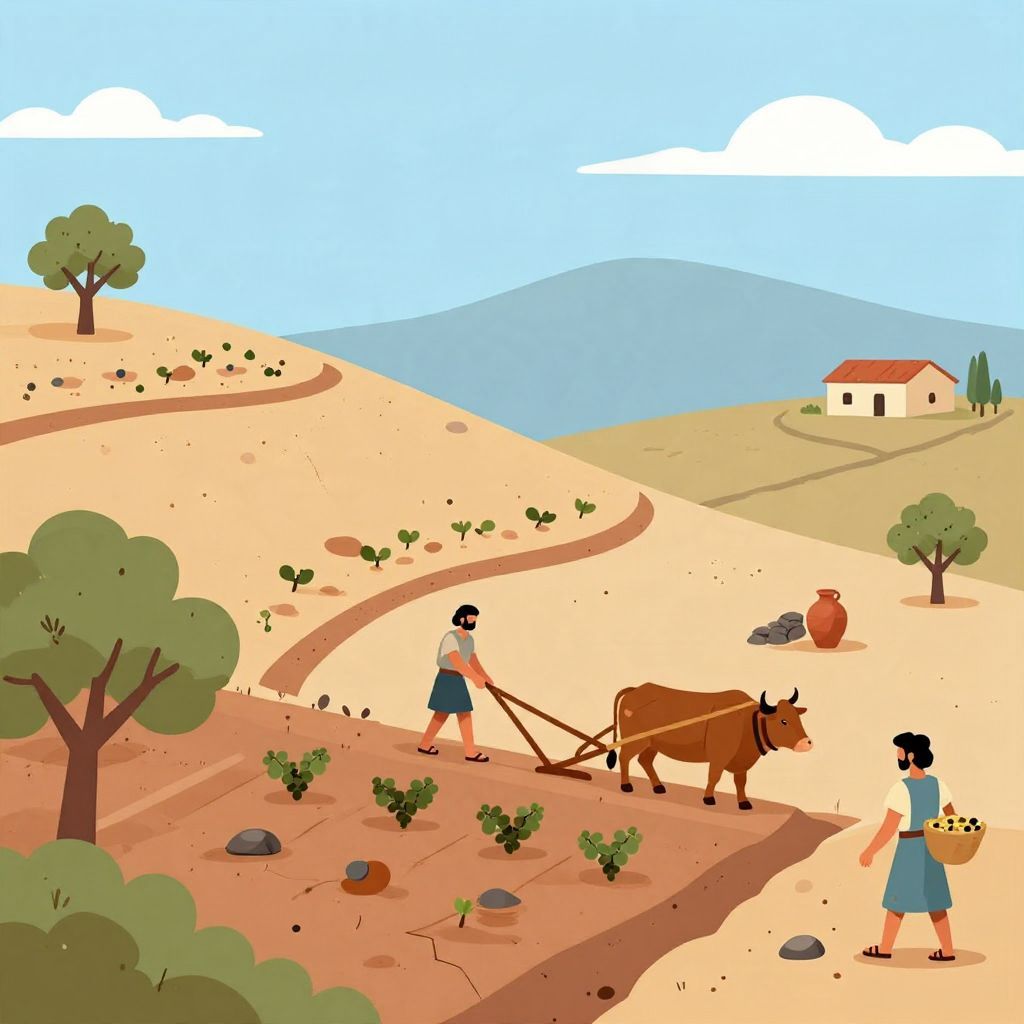
Why was farming difficult in ancient Greece? The short answer is that geography made large-scale agriculture hard. Much of Greece was mountainous, rocky, and thin-soiled, with limited flat land, uneven rainfall, and few big rivers or broad plains. Ancient Greek farmers had to work small plots, depend on seasonal weather, and constantly adapt to poor growing conditions.
That did not mean agriculture was impossible. Greeks grew cereals, olives, grapes, figs, and vegetables, and many communities survived through careful farming, herding, trade, and colonization. But compared with river-valley civilizations such as Egypt or Mesopotamia, ancient Greece offered fewer natural advantages for farming and much less margin for error.
Why was farming difficult in ancient Greece?
Farming in ancient Greece was difficult mainly because the land was rugged, the soil was often poor, and rainfall was irregular. Most communities had to farm small, scattered plots rather than large fertile fields. Drought, erosion, and limited water supplies made harvests uncertain, so Greek farmers lived with constant risk and low yields.
The geography of Greece worked against large-scale farming
Mountains divided the land
Ancient Greece was not one broad agricultural plain but a landscape broken up by mountain ranges, hills, and narrow valleys. These natural barriers limited the amount of arable land and made transport between regions difficult. Villages and city-states often developed in isolated pockets, each with its own local farming base.
This fragmentation mattered because farming thrives where land can be cultivated in large, connected areas. In Greece, flat land was scarce, and many communities had to make do with terraced slopes or small valley floors. That reduced the amount of grain that could be grown and made food supplies vulnerable to local failure.
Soil quality was often poor
Much of Greece had thin, rocky, and nutrient-poor soil. In some places, centuries of erosion had stripped away the richer topsoil, leaving ground that could support hardy crops but not heavy grain production. Farmers often had to conserve every usable patch of land and improve it with labor-intensive methods such as terracing and careful manuring.
The result was a farming system that could produce olives and vines relatively well, but struggled with cereals. Wheat and barley were staples, yet yields were often modest. Since grain was essential for daily bread and porridge, this made food security a constant concern.
Rainfall was unreliable and water was limited
Ancient Greek farming depended on seasonal rain
Unlike civilizations built around major rivers, ancient Greece lacked a dependable network of large, irrigated river plains. Rain fell mostly in the cooler months, while summers were hot and dry. That pattern suited some crops, especially olives and grapes, but it made grain farming risky and limited the growing season.
In years of low rainfall, harvests could fail or shrink sharply. Because ancient farmers had no modern irrigation systems, they had little ability to buffer drought. A bad season could mean hunger, debt, or the need to import grain from elsewhere.
Few natural irrigation systems existed
Greece did have streams, springs, and some river valleys, but these were usually too small or too seasonal to support the kind of irrigation agriculture found in Egypt or Mesopotamia. Without wide floodplains and predictable river cycles, Greek farmers could not rely on annual silt deposits to renew the soil.
Some communities built cisterns, wells, and simple water-management systems, but these solutions were local and limited. Water scarcity remained one of the central reasons farming was difficult in ancient Greece.
Greek farmers faced low yields and constant labor
Small farms dominated the landscape
Most Greek farmers worked small family holdings rather than large estates. Because plots were modest and scattered, families had to use their labor efficiently and diversify what they grew. A household might combine grain, vines, olives, vegetables, herbs, and livestock to reduce risk.
This system was practical, but it also shows how difficult agriculture was. Instead of specializing in one abundant crop, farmers had to spread effort across several modest sources of food and income. One poor harvest could not easily be offset by a huge surplus from another field.
Tools and methods were simple
Ancient Greek agriculture relied on basic tools such as wooden plows, hoes, sickles, and animal traction where available. These methods were effective enough for small-scale farming, but they did not transform difficult land into highly productive farmland. Labor was intensive, and much depended on family work, seasonal rhythms, and local knowledge.
Because the technology was limited, farmers could not easily overcome bad soil or drought. The challenge was not only natural conditions but also the absence of powerful agricultural machinery or advanced irrigation networks.
Why cereals were especially hard to grow
Grain needed better land than Greece often offered
Cereals such as wheat and barley were the basis of the ancient diet, but they needed more reliable moisture and better soil than many Greek regions could provide. On poor land, grain yields could be low and inconsistent. That made it difficult for local production to meet the needs of a growing population.
As a result, many Greek communities became dependent on imported grain, especially in later periods. This dependence was not a sign of agricultural failure alone; it was also a response to the limits imposed by the landscape.
Olives and grapes suited the terrain better
Greek farmers often shifted toward crops that matched the environment. Olive trees tolerate rocky ground and dry summers, and grapevines also do well in Mediterranean conditions. These crops became economically and culturally important because they were more reliable than grain in many parts of Greece.
Even so, olives and grapes required patience. They take years to mature, and they do not provide the same immediate calories as grain. So while they helped Greek farmers survive and trade, they did not solve the basic problem of feeding everyone.
Population growth and political life increased the pressure on land
More people meant more demand for food
During the archaic and classical periods, many Greek communities grew in population and political complexity. More people meant more mouths to feed, but the amount of fertile land did not increase. In some regions, land pressure intensified competition among families and social classes.
This pressure could lead to debt, migration, colonization, or political conflict. Farming difficulty was therefore not just an economic issue; it shaped Greek society, settlement patterns, and even the development of the polis, or city-state.
Land ownership could be uneven
In many city-states, especially where elite families controlled the best land, poorer farmers were more vulnerable to bad harvests. A failed crop could mean borrowing seed or food, falling into debt, or losing land. Ancient Greek sources show that land and food security were deeply connected to social stability.
These tensions help explain why agricultural hardship mattered so much in Greek history. Farming difficulty could influence law, politics, and migration, not just household life.
Ancient Greeks adapted in practical ways
Terracing and mixed farming helped
Greek farmers did not simply accept poor land; they adapted to it. On hillsides, they built terraces to slow erosion and create usable fields. They also practiced mixed farming, combining crops with sheep, goats, and sometimes cattle, which allowed them to use land that was unsuitable for grain.
Goats and sheep were especially useful on rough terrain because they could graze where crops could not grow well. Their milk, meat, wool, and manure made them valuable parts of the rural economy.
Trade and colonization reduced local shortages
Because local farming often could not produce enough grain, many Greek communities turned to trade. Ports and maritime networks allowed cities to import food from more fertile regions around the Mediterranean and Black Sea. In some cases, Greeks founded colonies partly to secure resources and relieve pressure on land at home.
This does not mean colonization was caused only by farming problems, but agricultural limits were one important factor among several. The sea became a solution to the land’s shortcomings.
How farming difficulties shaped Greek history
The difficulty of farming in ancient Greece had lasting consequences. It encouraged small-scale landholding, local independence, and reliance on maritime trade. It also helped shape the politics of city-states, since access to land and food was a major source of power and conflict. In this sense, Greek civilization grew not in spite of its difficult landscape, but in response to it.
So, why was farming difficult in ancient Greece? Because the environment was demanding: mountains reduced farmland, soil was often poor, rainfall was seasonal, and water resources were limited. Greek farmers responded with skill and resilience, but they worked within narrow natural limits. If you want to explore more about the wider setting of Greek life, see what Greece was known for and what ancient Greeks looked like.