
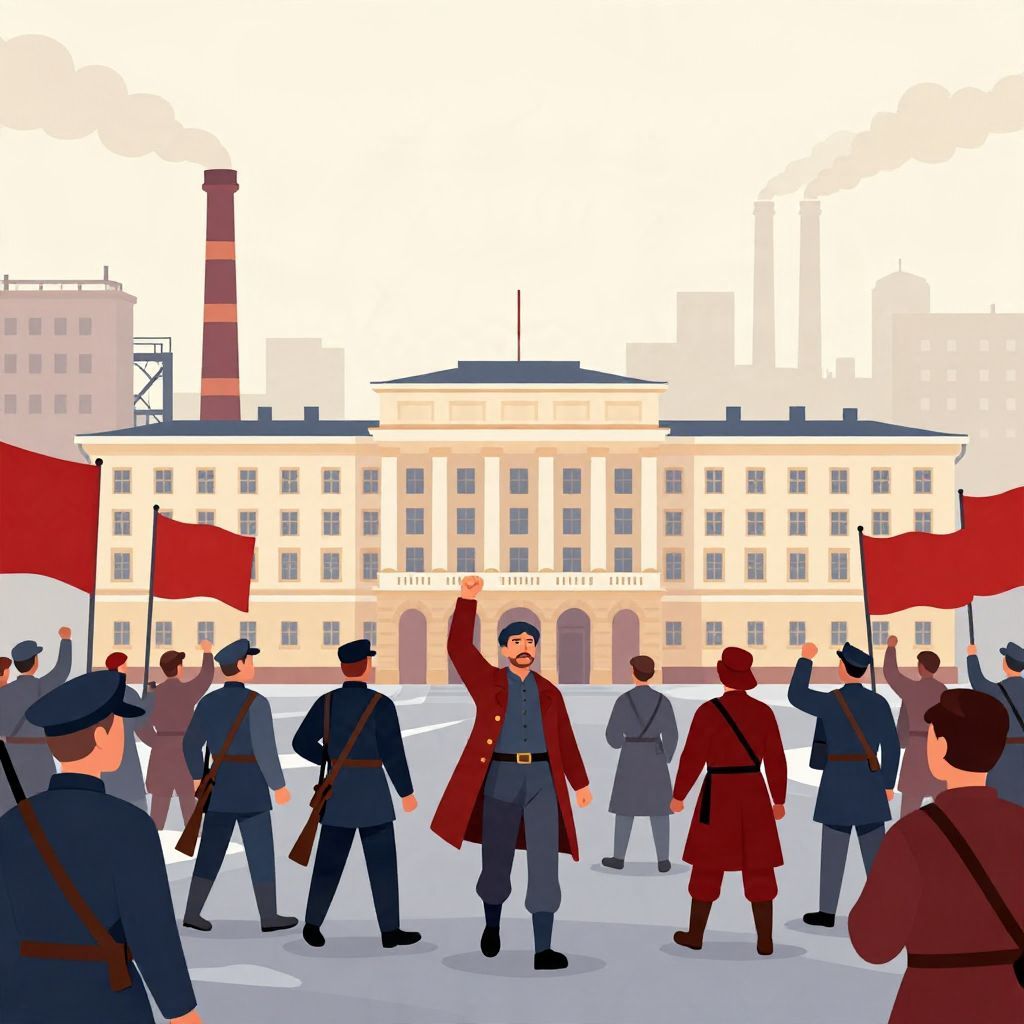
What was one consequence of the October Revolution? One major consequence was the Bolsheviks’ seizure of power in Russia, which led to the creation of the world’s first communist government. That change transformed Russian politics, triggered civil war, and eventually produced the Soviet Union. It also had global effects, influencing revolutionary movements and shaping twentieth-century history.
The October Revolution of 1917 was not a single isolated event but the turning point in a wider collapse of imperial Russia during World War I. Its consequences were immediate, dramatic, and long-lasting, affecting government, society, war, and ideology far beyond Russia’s borders.
What Was One Consequence Of The October Revolution?
One clear consequence of the October Revolution was that the Bolsheviks took control of the Russian state and began building a communist regime. They overthrew the Provisional Government in Petrograd, claimed authority in the name of soviets, and soon pursued policies that ended Russia’s role in World War I and reshaped the country’s political future.
How the Bolsheviks Came to Power
The October Revolution took place in November 1917 by the modern calendar, though Russia was still using the Julian calendar at the time, so it is usually called the October Revolution. It followed the February Revolution earlier that year, which had forced Tsar Nicholas II to abdicate and ended centuries of Romanov rule. The Provisional Government that replaced the tsar struggled to solve war, land, and food crises.
A government weakened by war
Russia was exhausted by World War I. Military defeats, shortages in the cities, inflation, and growing unrest made it difficult for any government to maintain authority. The Provisional Government chose to continue fighting the war, which damaged its popularity. The Bolsheviks, led by Vladimir Lenin, gained support by promising “peace, land, and bread,” a simple slogan that appealed to soldiers, workers, and peasants.
The seizure of key institutions
In Petrograd, Bolshevik forces and allied Red Guards seized strategic sites and overthrew the Provisional Government. The takeover was relatively swift compared with later civil war fighting, but it was politically decisive. The Bolsheviks then announced that power had passed to the soviets, or councils of workers’ and soldiers’ deputies, though in practice the party increasingly controlled those institutions.
Immediate Political Consequences
The most immediate consequence was the collapse of Russia’s short-lived liberal-democratic experiment. The Bolsheviks dissolved the old political order and moved quickly to eliminate rivals. They restricted opposition newspapers, arrested political opponents, and established new organs of power that concentrated authority in Bolshevik hands. This was the beginning of one-party rule in Russia.
The Constituent Assembly and Bolshevik authority
Russia did hold elections for a Constituent Assembly in late 1917, and the Bolsheviks did not win a majority of the vote. When the Assembly met in January 1918, it was dissolved after one session. This was a crucial sign that the new regime would not develop into a parliamentary democracy. Instead, the Bolsheviks justified their rule as the dictatorship of the proletariat, a Marxist concept that they interpreted as rule by the revolutionary party on behalf of the working class.
Russia’s Exit from World War I
Another major consequence of the October Revolution was Russia’s withdrawal from World War I. The Bolsheviks wanted peace immediately, and in March 1918 they signed the Treaty of Brest-Litovsk with Germany and its allies. The treaty cost Russia vast territories and resources, but it ended the country’s participation in the war.
Why peace mattered so much
For many Russians, especially soldiers and peasants, ending the war was one of the revolution’s most important promises. The treaty was deeply controversial because it surrendered land in Eastern Europe and the Baltic region. Yet the Bolsheviks believed that survival of the revolution mattered more than preserving imperial borders. This decision also changed the wider war by allowing Germany to shift troops westward, even though the broader conflict ended later in 1918.
The Russian Civil War and Revolutionary Violence
The October Revolution did not bring stability. Instead, it helped spark the Russian Civil War, which lasted roughly from 1918 to 1921, though violence continued in some areas beyond that. The Bolsheviks, now called the Reds, fought a range of opponents known collectively as the Whites, along with nationalist movements, foreign intervention forces, and local anti-Bolshevik groups.
Why civil war followed
The revolution divided the country because many Russians rejected Bolshevik rule, feared radical social change, or opposed the loss of territory and property. The new regime also faced resistance from former officers, landowners, liberals, and non-Russian national groups. Civil war intensified political repression and contributed to famine, displacement, and widespread suffering.
War communism and state control
During the civil war, the Bolsheviks introduced emergency measures often called War Communism. The state took control of industry, requisitioned grain from peasants, and centralized economic life to support the Red Army. These policies were not simply ideological experiments; they were wartime responses to crisis. Still, they deepened resentment and showed how revolutionary power could become highly coercive.
The Birth of the Soviet Union
One of the long-term consequences of the October Revolution was the creation of a new state system. After the civil war, the Bolsheviks consolidated their rule and in 1922 formed the Union of Soviet Socialist Republics (USSR). This was not an immediate result of October 1917, but it grew directly from the revolution and the political order it created.
From revolution to state-building
The Bolsheviks did more than overthrow a government; they built a new political model based on party leadership, state ownership of major industry, and official commitment to socialism. Over time, this system became highly centralized. Under Joseph Stalin, who rose to dominance after Lenin’s death, the Soviet state became even more authoritarian, though that later development should not be confused with the revolution’s original moment.
Social and Economic Change in Revolutionary Russia
The October Revolution also transformed everyday life. The Bolsheviks promised to remake society by redistributing land, expanding literacy, promoting women’s rights in law, and weakening the power of the old elite. Some of these changes were real and significant, though they were often unevenly implemented and came with heavy state control.
Land, labor, and class
Peasants expected land reform, and the new regime legalized the seizure of large estates, though the state later sought to control agriculture more tightly. Workers gained symbolic importance in Bolshevik ideology, but industrial labor under the Soviet system could be harsh and disciplined. The revolution therefore did not simply “liberate” society; it replaced one hierarchy with another, even as it abolished aristocratic privilege and private ownership in key sectors.
Cultural and religious change
The Bolsheviks also challenged the influence of the Russian Orthodox Church and promoted secular, revolutionary culture. Religious institutions lost status and property, while the state encouraged atheism and political education. These changes mattered because they marked a break with imperial traditions and helped define Soviet identity as modern, socialist, and anti-monarchical.
Global Consequences of the October Revolution
The revolution’s consequences extended well beyond Russia. It inspired communist parties, labor movements, and anti-colonial activists around the world. At the same time, it alarmed conservative governments and helped shape the global struggle between communism and anti-communism that defined much of the twentieth century.
A model for revolution
For supporters, the Bolshevik victory showed that a revolutionary party could seize state power and attempt to build socialism. For critics, it demonstrated the dangers of political extremism, civil conflict, and one-party rule. In many countries, the October Revolution became both a symbol of hope and a warning sign. Its legacy influenced revolutions, state policies, and ideological debates from Europe to Asia and beyond.
Fear, reform, and repression abroad
Governments outside Russia often reacted to the revolution by tightening surveillance of radicals and labor organizers. Some states introduced reforms to reduce social unrest, while others intensified repression. In this way, the October Revolution helped reshape politics internationally even where no communist revolution occurred.
Why the October Revolution Still Matters
The October Revolution matters because it changed not only Russia’s government but also the structure of twentieth-century world politics. It ended the old imperial order in Russia, helped bring the country out of World War I, and launched a new state that would become a superpower. Its consequences were revolutionary in the fullest sense: political, social, military, and global.
If you want to understand the revolution’s wider impact, it helps to look at the chain of events around 1917 and the question of why Russia left the war. Related reading on what happened in 1917 and why Russia left World War I can place the October Revolution in its broader historical context.