
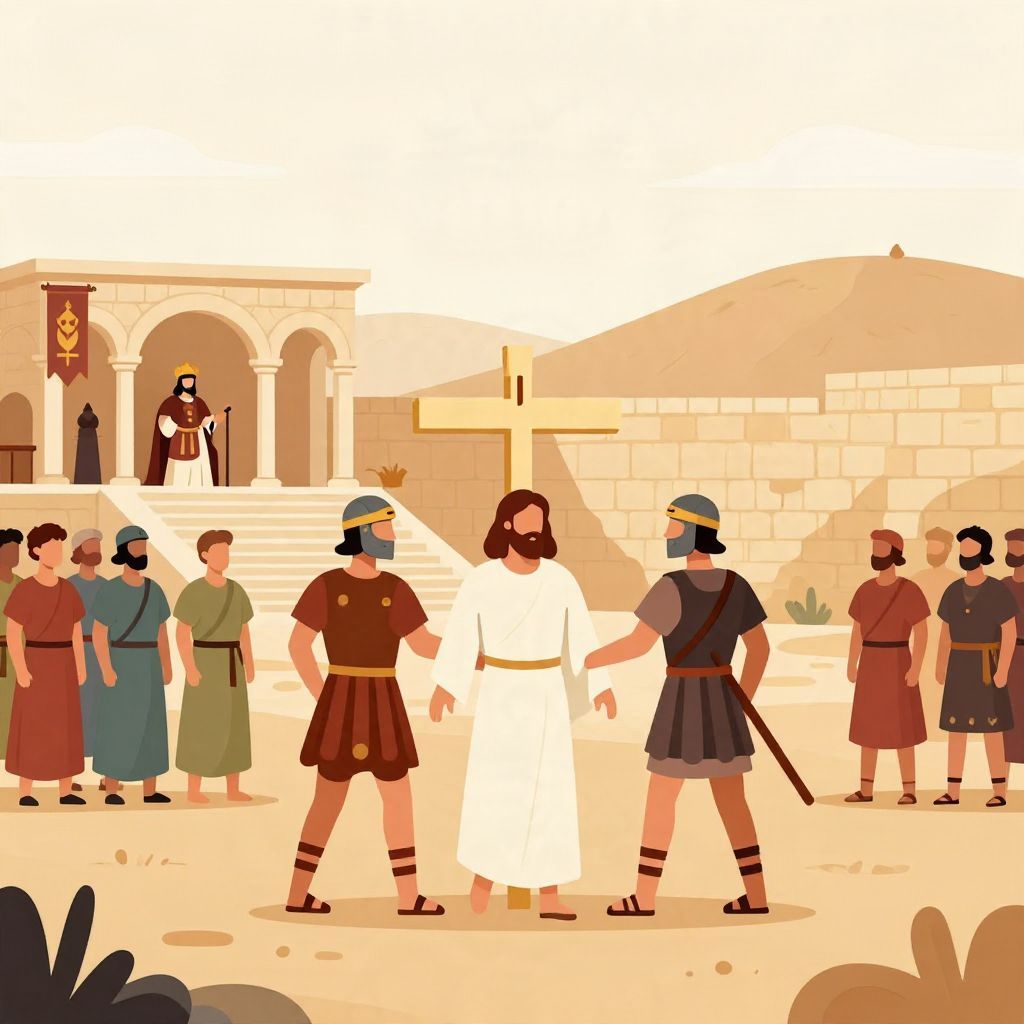
The question “Why did the Romans kill Jesus?” sits at the intersection of history, religion, and politics. The short answer is that Roman authorities executed Jesus by crucifixion because they viewed him, or at least allowed him to be treated as, a political threat in a tense province where public order mattered above all else.
The execution took place in Roman-ruled Judea, probably around 30 or 33 CE, during the governorship of Pontius Pilate. The historical evidence suggests that Jesus was not killed simply for preaching religion, but because his movement and the events around his arrest could be interpreted as dangerous in a volatile region under imperial control.
Why did the Romans kill Jesus?
Roman authorities likely executed Jesus because they saw him as a potential source of unrest, especially after his public activity in Jerusalem during Passover. In Roman law, crucifixion was a punishment for rebels, slaves, and serious threats to order. The charge most closely associated with his death was political: claiming kingship or challenging Roman authority.
The Roman setting: Judea under occupation
To understand the execution, it helps to understand the province. Judea was not an independent kingdom at the time of Jesus’ death. It was under Roman rule, and Roman governors were responsible for keeping peace, collecting taxes, and suppressing disorder. Local religious leaders had influence, but final authority in capital cases rested with Rome.
Jerusalem was especially sensitive during major festivals such as Passover, when crowds gathered to remember liberation from foreign rule. That made any public disturbance potentially explosive. Roman officials were trained to prevent unrest quickly and decisively, even if that meant harsh punishment for one person as a warning to many.
Pilate’s role
Pontius Pilate was the Roman prefect of Judea, usually dated to 26–36 CE. The sources portray him as the official who authorized crucifixion. In Roman practice, governors had broad discretion in dealing with perceived threats. Even if local leaders brought accusations, the final decision to execute would have been Roman.
What was Jesus accused of?
The historical record is not perfectly clear, because the surviving accounts come from texts written by Jesus’ followers. Still, the broad outline is consistent: Jesus was arrested, brought before authorities, and condemned to death by crucifixion. The most likely accusation was not simply blasphemy in a narrow religious sense, but a political one framed in religious language.
One key issue was the title “king of the Jews.” In the Roman world, kingship implied power, loyalty, and the possibility of revolt. If Jesus was presented as a messianic figure or kingly claimant, Roman officials could interpret that as sedition, even if his own message was more spiritual than military.
Religious and political tensions
Jesus’ public actions may have increased suspicion. He preached about the kingdom of God, gathered followers, and entered Jerusalem in a way that could be read as symbolic and provocative. The cleansing of the Temple, whether understood as protest or prophetic action, would have alarmed both religious elites and Roman authorities because the Temple was central to public order.
- Public crowds made authorities nervous.
- Messianic language could sound like political rebellion.
- Temple disruption threatened stability in a sacred and crowded space.
- Passover timing heightened fears of unrest.
Did the Romans act alone?
Probably not. The execution required Roman authority, but local collaboration likely helped bring it about. The Jerusalem priestly leadership had reasons to fear disorder, especially if Jesus’ movement attracted crowds or challenged established authority. In that sense, the death of Jesus was the result of a convergence of interests, not one simple cause.
It is important to distinguish historical responsibility from later religious blame. The Romans performed the execution. Some local leaders may have supported or encouraged it. But the event unfolded within a colonial political system where Rome held ultimate power and routinely used crucifixion to deter resistance.
Why local leaders may have cooperated
Some scholars think temple authorities feared that Jesus’ popularity could provoke Roman intervention against the wider population. If a public teacher stirred messianic hopes, the authorities might have viewed removing him as a way to protect the community from a crackdown. That does not erase Roman responsibility; it explains why the arrest could have been politically useful to multiple parties.
Why crucifixion?
Crucifixion was one of the harshest punishments in the Roman world. It was public, humiliating, and intended to terrorize onlookers. Rome used it especially for people seen as rebellious or socially expendable. By crucifying Jesus, the authorities were sending a message: challenges to imperial order would be crushed.
The method itself tells us a great deal. Crucifixion was not a random execution style. It was a political instrument. For a man accused of kingship, it was especially fitting from the Roman point of view, because it mocked the idea of royal power while displaying Roman dominance.
What the historical sources actually show
The earliest Christian writings say that Jesus was crucified under Pontius Pilate. Non-Christian references from the first and early second centuries also support the basic fact that he was executed by Roman authority. The details of the trial are harder to reconstruct because the surviving narratives were written by believers who interpreted the event through theology as well as history.
That means historians are careful. They generally agree on the core facts: Jesus was arrested in Jerusalem, handed over in some fashion to Roman authority, and crucified under Pilate. They are less certain about every exact exchange in the trial or the precise balance of responsibility between Roman and local authorities.
What is historically secure?
- Jesus was a real historical figure active in early first-century Judea.
- He was executed by crucifixion.
- The execution happened under Roman rule, during Pilate’s governorship.
- The likely reason was a perceived threat to public order or political stability.
Why the “king” issue mattered so much
Rome did not tolerate rival claims to sovereignty. Even a symbolic or religiously charged claim could become dangerous if crowds gave it political meaning. In a province already sensitive to unrest, a preacher associated with the coming of God’s kingdom could be misunderstood—or deliberately portrayed—as a claimant to earthly rule.
This is one reason the inscription over the cross, preserved in the Gospel tradition as a form of accusation, matters historically. Whether exact wording can be verified or not, it reflects the Roman tendency to frame executions as warnings against rebellion. The message was less about theology than about power.
How modern historians explain the execution
Most historians today do not reduce the death of Jesus to a single cause. Instead, they see a combination of factors:
- Roman imperial control over a politically sensitive province
- Fear of unrest during a major festival
- Jesus’ public activity and growing following
- Possible local cooperation from authorities who wanted to prevent trouble
- Roman use of crucifixion as a deterrent punishment
In this view, Jesus was not executed because Rome judged a theological argument. He was executed because his movement could be interpreted as socially disruptive and politically risky. That interpretation fits what is known about Roman rule elsewhere in the empire.
What happened after the execution?
The death of Jesus did not end the movement associated with him. In fact, it became the central event around which Christianity developed. His followers reinterpreted the crucifixion as part of a divine plan and later proclaimed his resurrection. Historically, that transformation explains why a Roman execution in a provincial city became one of the most influential events in world history.
The Romans probably intended to eliminate a problem. Instead, the execution helped create a durable religious movement that spread far beyond Judea. That outcome is one reason the question remains so important: the event was both a local act of imperial control and a turning point with global consequences.
Conclusion
The Romans killed Jesus because they saw him as a political danger in a tense province, not because they were settling a purely religious dispute. Crucifixion under Pontius Pilate was a Roman response to perceived instability, likely shaped by local collaboration and the volatile atmosphere of Passover in Jerusalem. For a related historical angle, see how old Jesus was when he was crucified and what happened to Judas after betraying Jesus.