
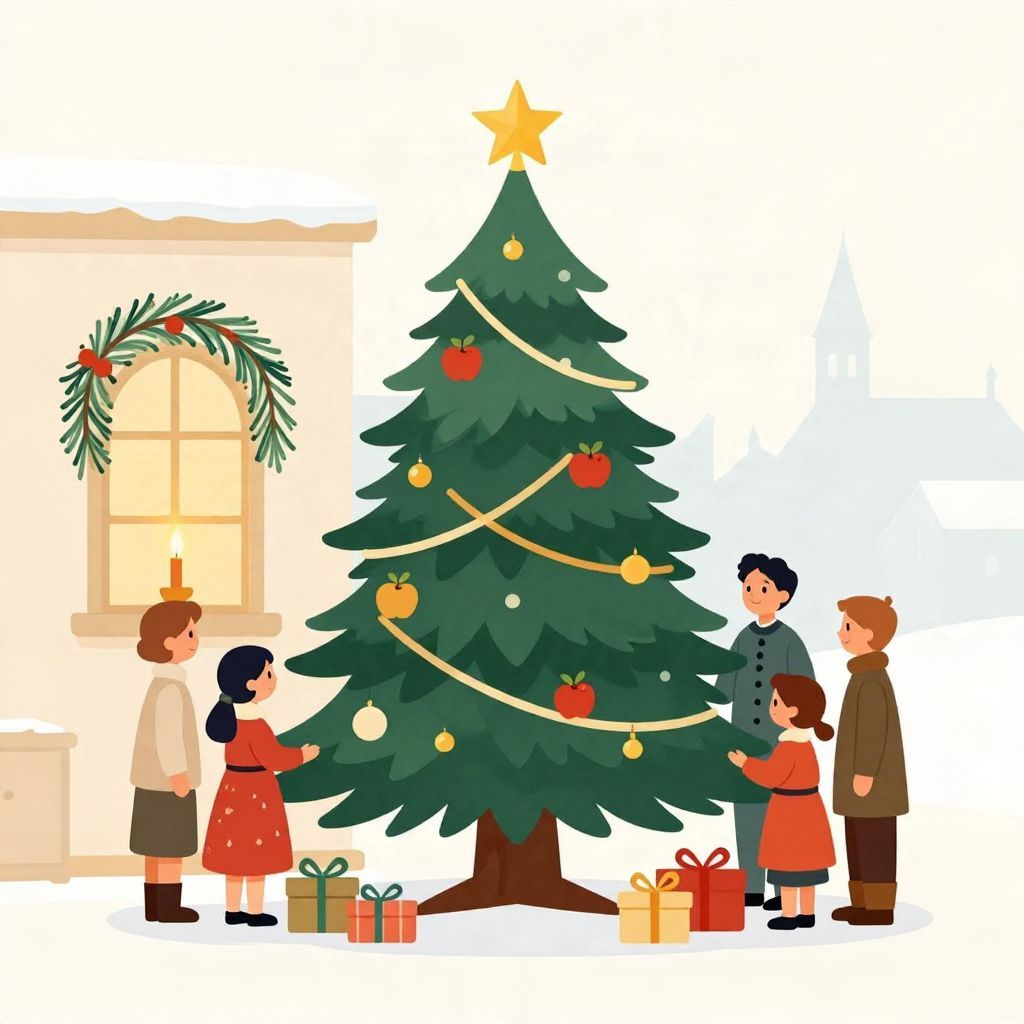
What is the meaning of the Christmas tree? At its simplest, the Christmas tree is a symbol of winter celebration, life, and hope. Today it is strongly associated with Christian Christmas, but its history is older and more layered than a single origin story.
Its meaning has changed over time: from evergreen symbolism in pre-Christian Europe, to a Christian domestic tradition in early modern Germany, to a global holiday emblem shaped by migration, commerce, and popular culture.
What Is The Meaning Of The Christmas Tree?
The Christmas tree usually means life, renewal, and celebration in the middle of winter. In Christian contexts, it can also represent eternal life through Christ. Historically, however, the tree’s meaning developed over centuries and was influenced by older evergreen customs, Protestant household devotion, and later Victorian and modern holiday traditions.
Where Did the Christmas Tree Tradition Come From?
The Christmas tree did not begin as a single, neatly documented invention. Its roots lie in a mix of European winter customs that used evergreen plants to symbolize endurance during the darkest season. Long before the modern tree appeared indoors, people in parts of Europe decorated homes with holly, ivy, fir branches, and other evergreens during midwinter festivals.
Evergreens before Christianity
In ancient Europe, evergreens were associated with survival, protection, and the return of light after winter. Roman celebrations such as Saturnalia included greenery, and many northern European peoples treated evergreen plants as signs that life continued even when the landscape seemed dead. These customs did not create the Christmas tree directly, but they helped establish the symbolic language that later made the tree meaningful.
Medieval and early modern Christian customs
By the Middle Ages, Christians in Europe had absorbed and reshaped many seasonal traditions. In some places, church plays used a “paradise tree” decorated with apples to represent the Garden of Eden and the story of Adam and Eve. This was not yet the modern Christmas tree, but it shows how a tree could carry religious meaning in Christian storytelling long before it became a household decoration.
When Did the Modern Christmas Tree Appear?
The modern Christmas tree is most closely associated with early modern Germany, probably in the 16th century. Historical evidence suggests that decorated indoor trees or tree-like structures were used in German-speaking regions by Protestant families, though the exact first tree is impossible to identify. By the 17th and 18th centuries, the custom was more clearly established in parts of Germany and nearby regions.
Martin Luther and the popular legend
A common story says that the reformer Martin Luther began the custom after seeing stars through evergreen branches and bringing a tree indoors for his family. This is a popular legend, not solidly documented history. Luther may have helped shape Protestant domestic religious culture, but historians do not treat him as the proven “inventor” of the Christmas tree.
Why the tree fit Protestant домашний life
In Protestant households, religious practice often moved from church-centered ritual toward family devotion at home. A decorated tree could serve as a focus for prayer, scripture, and celebration. In this setting, the tree’s meaning shifted from a general evergreen symbol to a specifically Christian domestic emblem of the Nativity season.
What Did the Christmas Tree Mean in Christian Tradition?
For many Christians, the Christmas tree came to symbolize everlasting life, hope, and the joy of Christ’s birth. Its evergreen branches suggested life that does not fade in winter, making it an especially powerful image for a feast celebrating divine light entering the world. Different Christian communities have interpreted that symbolism in slightly different ways.
Symbols attached to the tree
As the custom spread, people added ornaments that gave the tree additional layers of meaning:
- Lights or candles symbolized Christ as light in darkness.
- Stars evoked the Star of Bethlehem.
- Apples could recall the Garden of Eden and redemption.
- Garlands and ribbons emphasized beauty, abundance, and celebration.
These meanings were not fixed everywhere. Families, churches, and regions adapted the tree to their own beliefs and customs.
How Did the Christmas Tree Spread Across Europe and Beyond?
The Christmas tree spread gradually through Europe in the 18th and 19th centuries. It was embraced by aristocratic households, then by middle-class families, and eventually by broader society. This spread was helped by royal influence, print culture, migration, and the growing popularity of Christmas as a family-centered holiday.
Britain and royal influence
The tree became especially popular in Britain in the 19th century. A major turning point came when Queen Victoria and Prince Albert were depicted with a decorated Christmas tree in the 1840s. The image was widely circulated and helped make the tree fashionable among British and American families. The royal family did not invent the custom, but they strongly influenced its popularity.
The United States and immigrant traditions
German immigrants brought Christmas tree traditions to North America, where they gradually became more common in the 19th century. At first, the custom was viewed by some as foreign or even suspicious. Over time, however, it became widely accepted, especially as newspapers, magazines, and store displays promoted it as part of the modern Christmas season.
How the Meaning Changed in the 19th and 20th Centuries
By the late 19th century, the Christmas tree had become less of a narrowly religious symbol and more of a broad cultural one. It still carried Christian meaning for many people, but it also came to represent family togetherness, generosity, childhood wonder, and festive domestic life. In the modern era, the tree became a shared holiday emblem used by both religious and secular households.
Victorian Christmas and family life
The Victorian period helped transform Christmas into a sentimental family holiday. The tree fit that new atmosphere perfectly. It was placed in the home, decorated by the family, and often surrounded by gifts. In this setting, the tree symbolized warmth, domestic affection, and the idea of Christmas as a special time for children.
Commercialization and mass culture
As Christmas became more commercial in the 19th and 20th centuries, the tree also became a centerpiece for shopping displays, public celebrations, and advertising. Electric lights replaced candles in many homes and public spaces, making trees safer and more dazzling. This commercial expansion did not erase the tree’s older meanings, but it added new ones tied to consumer culture and public spectacle.
Is the Christmas Tree a Pagan Symbol?
This is one of the most common questions about the Christmas tree, and the answer is nuanced. The tree is not simply a pagan symbol, nor is it purely a Christian invention. Its history includes pre-Christian evergreen customs, but the modern Christmas tree took shape within Christian Europe, especially in Protestant households. The best historical answer is that it is a layered tradition with multiple cultural ancestors.
Why the pagan claim persists
Because evergreens were used in pre-Christian winter festivals, some people conclude that the Christmas tree is directly pagan. That oversimplifies the evidence. Similar symbols can reappear in different eras for different reasons. The modern Christmas tree developed in a Christian setting even though it drew on older seasonal symbolism.
A blended tradition
Historians usually describe the Christmas tree as a blended tradition: ancient evergreen symbolism, medieval Christian imagery, early modern household devotion, and later Victorian and commercial customs all contributed to the form we know today. Its meaning changed as societies changed.
What Does the Christmas Tree Mean Today?
Today, the Christmas tree can mean different things to different people. For Christians, it may still point to the Nativity, eternal life, and divine light. For others, it represents winter celebration, family gathering, nostalgia, or simply the festive season. Its power lies in that flexibility: one object can carry religious, cultural, and emotional meaning at the same time.
Public and private meanings
In homes, the tree often marks a season of giving and shared ritual. In public spaces, it can symbolize community celebration and winter festivity. In churches, it may be explicitly tied to Christian worship. The same tree can therefore function as both a sacred and a secular symbol, depending on context.
Conclusion: The Historical Meaning of the Christmas Tree
The Christmas tree means more than decoration. Historically, it grew from evergreen winter symbolism into a Christian household tradition and then into a global emblem of Christmas itself. Its enduring meaning is rooted in hope, life, and light during the dark season, which helps explain why the tradition has lasted so long and spread so widely. For more on related holiday customs, see what a Christmas stocking means and how Mexico celebrates Christmas.