
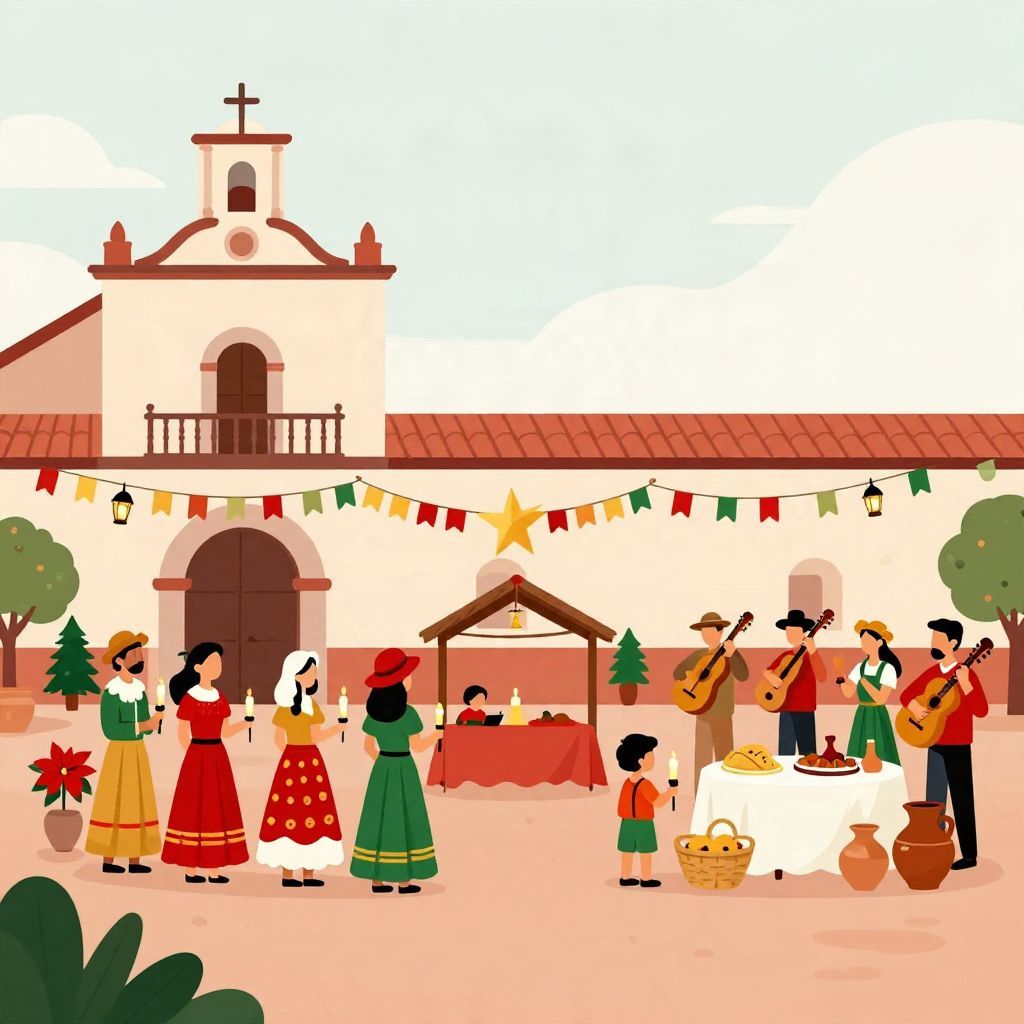
How does Mexico celebrate Christmas? The short answer is that Christmas in Mexico is a deeply religious, family-centered season shaped by Catholic tradition, Spanish colonial history, and older local customs. It is not just a single day on December 25, but a festive period that unfolds through processions, prayers, food, music, and gatherings.
Its most distinctive features include the Posadas, nativity scenes, midnight Mass, and regional foods such as tamales and ponche. Over time, Mexican Christmas has blended European Christian rituals with local expressions of community, making it one of the most historically rich holiday traditions in the Americas.
How does Mexico celebrate Christmas?
Mexico celebrates Christmas through a season of religious observance, family gatherings, and public festivity that begins in mid-December and continues into early January. The most important traditions are the Posadas, Christmas Eve dinner and Mass, nativity displays, and Epiphany on January 6, when gifts are often exchanged and Rosca de Reyes is shared.
The historical origins of Christmas in Mexico
The roots of Mexican Christmas go back to the Spanish conquest and the spread of Catholicism in the 16th century. Missionaries used feast days, processions, and dramatic rituals to teach Christian stories to Indigenous communities. Over time, these practices mixed with local forms of communal celebration, creating traditions that were both Catholic and distinctly Mexican.
Spanish colonization and Catholic ritual
After the fall of the Mexica capital in 1521, Spanish friars worked to convert Indigenous peoples across New Spain. Christmas became part of a larger religious calendar that emphasized the birth of Christ, the Virgin Mary, and saints’ feast days. Churches, convents, and town plazas became central spaces for holiday worship and celebration.
One of the most important colonial-era developments was the use of staged religious teaching. Missionaries adapted Christian stories into plays, songs, and public ceremonies. This approach helped establish the structure of Christmas observance in Mexico: prayer, performance, food, and neighborhood participation.
The rise of the Posadas
The Posadas are among the most recognizable Mexican Christmas traditions. They are usually held from December 16 to December 24 and reenact Mary and Joseph’s search for shelter before the birth of Jesus. The exact origin is complex. Colonial religious festivals in New Spain helped shape them, and later popular practice standardized them into a nine-night devotion.
Each night often includes a procession, candlelight, hymns, and a request for lodging, followed by a gathering with food, drinks, and a piñata. The Posadas reflect a long historical pattern in Mexico: religious devotion expressed through communal celebration rather than private observance alone.
A timeline of Christmas in Mexico
Mexican Christmas traditions developed gradually rather than appearing all at once. The holiday’s history can be understood as a sequence of colonial introduction, local adaptation, and modern expansion into a national cultural celebration.
- 16th century: Spanish missionaries introduce Christmas liturgy, processions, and religious teaching in New Spain.
- Colonial period: Nativity scenes, church services, and devotional festivities become part of urban and rural religious life.
- Late colonial and 19th centuries: The Posadas become more widely practiced as a seasonal community tradition.
- 20th century: Christmas becomes increasingly visible in schools, neighborhoods, and public spaces, while family-centered customs spread more broadly.
- Today: Christmas in Mexico combines religious observance, regional foodways, commercial decorations, and strong family traditions.
The most important Christmas traditions in Mexico
Although customs vary by region, class, and family, several traditions appear across much of Mexico. These practices show how Christmas is both a religious holiday and a social event that connects households, neighborhoods, and parishes.
Las Posadas
During the Posadas, participants often carry candles and sing verses asking for shelter, while others inside a home or church respond before welcoming them in. The ritual usually ends with food, drink, and celebration. In many communities, the final night on December 24 is especially important.
Nativity scenes, or nacimientos
Mexican homes, churches, and public spaces frequently display nacimientos, or nativity scenes. These can be simple or elaborate, sometimes including mountains, rivers, animals, and local figures. The baby Jesus is often placed in the manger only at Christmas, symbolizing the moment of birth rather than merely decorating for the season.
Midnight Mass and Christmas Eve
For many Catholic families, Christmas Eve is more important than Christmas Day itself. The evening often includes a large meal, family time, and attendance at Misa de Gallo, or Midnight Mass. This reflects the traditional Christian emphasis on the vigil before Christ’s birth.
Food and drink
Christmas food is central to the holiday experience. Common dishes include tamales, bacalao a la vizcaína, romeritos, pozole in some regions, and sweet breads. Warm drinks such as ponche, a fruit punch often made with guava, tejocote, cinnamon, and sugar cane, are especially associated with the season.
Piñatas and children’s celebrations
Piñatas are a beloved part of Posadas and children’s parties. In Christmas contexts, they are often star-shaped, traditionally with seven points, which are sometimes interpreted as representing the seven deadly sins. Although this symbolism comes from Christian teaching, the piñata also reflects broader festive traditions of play, reward, and communal joy.
Religious meaning and cultural blending
Mexican Christmas is historically significant because it shows how a European religious holiday was transformed in the Americas. The result was not a simple copy of Spanish custom. Instead, local communities shaped the celebration in ways that fit their own social life, language, and regional traditions.
Christian devotion and community life
The holiday centers on the Nativity story, but in Mexico it has long been lived through collective action. Processions, songs, and neighborhood gatherings make Christmas a public event as well as a private one. This communal style reflects the importance of local religious brotherhoods, parish life, and family networks in Mexican history.
Indigenous and regional influences
It is important not to oversimplify Christmas as purely “Spanish” or purely “Indigenous.” The evidence supports a blended history. Indigenous communities adopted, adapted, and sometimes reshaped Christian festivals according to local practice. Regional differences remain visible today in food, music, and the timing of celebrations.
Christmas in Mexico today
Modern Mexican Christmas includes both long-standing traditions and newer influences. Cities may feature lights, commercial displays, and imported holiday imagery, while homes and churches continue older practices. Television, migration, and global consumer culture have changed the season, but they have not replaced its religious and family-centered core.
In many homes, the season begins with the first Posada and continues through Christmas Eve, Christmas Day, New Year’s celebrations, and Epiphany on January 6. Children may receive gifts on Christmas Day, on January 6, or on both dates, depending on family custom. The holiday season therefore extends well beyond a single calendar day.
Epiphany and Rosca de Reyes
January 6, the Feast of the Epiphany, remains an important part of the Christmas cycle in Mexico. Families share Rosca de Reyes, a ring-shaped sweet bread with a hidden figurine of the baby Jesus inside. Whoever finds the figurine is traditionally expected to host or provide tamales on Candlemas, February 2.
This custom shows how Mexican Christmas is part of a longer devotional calendar, not an isolated event. The season links the Nativity, the visit of the Magi, and later feast days into one extended cycle of celebration.
Why Mexican Christmas matters historically
Mexican Christmas matters because it reveals how religion, empire, and local culture interact over centuries. The holiday is a living example of colonial transformation: Spanish Catholic forms were introduced, but they were not preserved unchanged. They were reworked by local communities into something durable, meaningful, and distinctly Mexican.
It also shows how holidays can carry historical memory. The Posadas preserve a ritualized story of seeking shelter; nativity scenes reinforce Christian teaching; family meals and neighborhood gatherings express social bonds that have endured through political change, modernization, and urban growth. In that sense, Christmas in Mexico is both a religious observance and a historical record of cultural continuity.
Conclusion
Mexico celebrates Christmas as a season of faith, family, and community, shaped by centuries of Catholic tradition and local adaptation. From the Posadas to Midnight Mass, from tamales to Rosca de Reyes, the holiday reflects a long historical blend of devotion and celebration. If you’re interested in related traditions, you may also enjoy reading about the history of the Christmas stocking and the history of Carnival.