
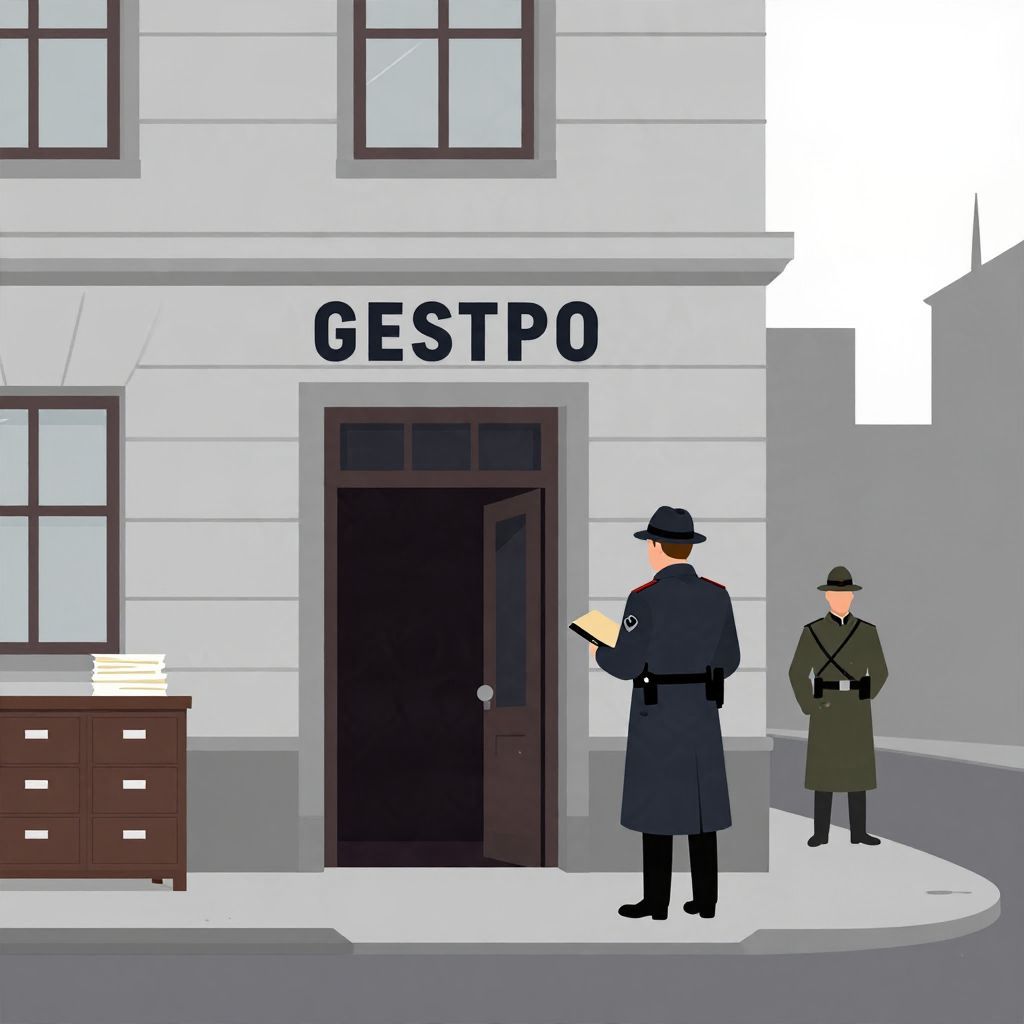
What does Gestapo mean? The word refers to the Nazi regime’s secret police force, officially known as the Geheime Staatspolizei in German, which translates to “Secret State Police.” It became one of the most feared institutions in Nazi Germany because it helped identify, arrest, interrogate, and terrorize real and imagined opponents of the regime.
Understanding the term matters because “Gestapo” is not just a name; it stands for a system of political repression that helped the Nazis maintain power from the 1930s until the end of World War II.
What Does Gestapo Mean?
Gestapo is a shortened form of Geheime Staatspolizei, meaning “Secret State Police.” It was the Nazi regime’s political police force, created to hunt down enemies of the state, suppress dissent, and enforce conformity through surveillance, intimidation, imprisonment, and torture. Over time, the word “Gestapo” became a symbol of Nazi terror itself.
The Origin of the Word Gestapo
The term was formed from the first letters of the German words Geheime (secret), Staat (state), and Polizei (police). This abbreviation was practical, but it also reflected the organization’s purpose: a police body operating in secrecy on behalf of the state. The Gestapo was not simply a normal criminal police force. Its role was political, ideological, and coercive.
Language and meaning in context
In everyday English, “Gestapo” is often used loosely to describe any harsh or abusive police behavior. Historically, however, the term refers to a specific institution in Nazi Germany. That distinction matters. The Gestapo was part of a broader dictatorship that used law, bureaucracy, propaganda, and violence together to control society.
How the Gestapo Was Created
The Gestapo emerged in the early years of Nazi rule. It was first established in Prussia in 1933, shortly after Adolf Hitler became chancellor of Germany. Hermann Göring played an important role in its early development as Prussian interior minister. The force was later expanded and centralized under Nazi control, especially after Heinrich Himmler gained influence over Germany’s police apparatus.
By 1934, the Gestapo had become more closely tied to the Nazi state. In 1936, Himmler was appointed chief of the German police, and the Gestapo was folded into a wider system of policing and security. Eventually, it became part of the Reich Main Security Office (RSHA), created in 1939, which coordinated Nazi security and repression across occupied Europe.
Key stages in its development
- 1933: Created in Prussia as a political police force.
- 1934–1936: Expanded and brought more firmly under Nazi leadership.
- 1939: Incorporated into the Reich Main Security Office.
- 1939–1945: Operated across Germany and Nazi-occupied territories during the war.
What Did the Gestapo Do?
The Gestapo investigated and suppressed opposition to the Nazi regime. Its targets included communists, social democrats, trade unionists, clergy who resisted Nazi policies, Jews, resistance members, and ordinary people accused of making critical remarks. It relied on denunciations from the public, informants, surveillance, files, raids, arrests, and brutal interrogation methods.
Methods of control
- Surveillance: monitoring mail, phone calls, and political activity
- Informants: using neighbors, coworkers, and officials to report suspected dissent
- Arrests and detention: imprisoning people without normal legal protections
- Interrogation and torture: extracting information through fear and violence
- Coordination with other Nazi agencies: working with the SS, police, and camp system
The Gestapo’s power did not rest only on its own officers. It benefited from a society in which many people feared speaking openly, and some actively cooperated with the regime. Historians often emphasize that Nazi repression was both centralized and dependent on local participation.
How Powerful Was the Gestapo?
Popular memory sometimes imagines the Gestapo as an all-seeing, omnipresent force. In reality, it was powerful but not limitless. It had relatively few officers compared with the size of the population it controlled, especially in Germany itself. Its effectiveness came from a combination of fear, bureaucracy, public cooperation, and the wider Nazi police state, not from sheer numbers alone.
That said, the Gestapo’s reputation for omnipotence was itself useful to the Nazis. If people believed they were always being watched, they were less likely to resist. The regime deliberately cultivated this fear, and the Gestapo’s name became shorthand for arbitrary arrest and state terror.
Myth and reality
It is a myth that the Gestapo controlled every aspect of daily life through constant direct surveillance. Instead, much of its work depended on reports from ordinary citizens and on the willingness of the Nazi system to punish suspicion aggressively. The terror was real, but it was also amplified by rumor, uncertainty, and the knowledge that even small acts of dissent could be dangerous.
The Gestapo and the Nazi Dictatorship
The Gestapo was central to the Nazi dictatorship because it helped destroy political opposition and enforce racial policy. After the Nazis came to power in 1933, they moved quickly to eliminate democratic institutions and silence opponents. The Gestapo provided a mechanism for turning political disagreement into a criminal matter.
It also played a role in the persecution of Jews and other groups targeted by Nazi ideology. While the Gestapo was not the only agency involved in the Holocaust, it contributed to the machinery of persecution, deportation, and coercion that made mass murder possible. Its work intersected with the SS, the concentration camp system, and occupation authorities across Europe.
Why the Gestapo mattered historically
- It helped dismantle civil liberties in Nazi Germany.
- It enforced ideological conformity through fear.
- It supported the persecution of Jews and other targeted groups.
- It became a model of secret-police power in the modern age.
Gestapo in World War II
During World War II, the Gestapo’s reach expanded beyond Germany into occupied territories. It worked to detect resistance movements, track down fugitives, and support Nazi occupation policies. In some places it cooperated with local collaborators; in others it operated through German administrative and police structures already in place.
The war intensified the Gestapo’s violence. Resistance networks, escaped prisoners, forced laborers, and people hiding from deportation all came under threat. In this period, the Gestapo became even more closely associated with arbitrary arrest, deportation to concentration camps, and the destruction of opposition under wartime conditions.
Who Led the Gestapo?
The Gestapo’s leadership changed over time, but it was always tied to the Nazi power structure. Early on, Hermann Göring helped establish it in Prussia. Heinrich Himmler later became the dominant figure over German police and security organizations. Reinhard Heydrich was also highly influential in shaping the broader security apparatus that included the Gestapo.
It is important to note that the Gestapo was not an independent rogue force. It functioned inside the Nazi state and answered to its political leadership. That connection made its actions part of official policy, not merely the result of individual cruelty.
What Happened to the Gestapo After 1945?
The Gestapo ceased to exist with the defeat of Nazi Germany in 1945. Its leaders and members were investigated in the postwar period, especially during the Nuremberg trials and related prosecutions. Some were convicted for crimes against humanity, war crimes, and membership in criminal organizations. Others escaped punishment or reintegrated into postwar life, which remains a subject of historical debate and memory.
After the war, the Gestapo became one of the clearest symbols of Nazi tyranny. Its name survived as a warning about what can happen when police power is detached from law, rights, and accountability.
Why the Word Still Matters Today
“Gestapo” remains a powerful word because it captures more than a police force. It evokes state terror, political repression, and the abuse of authority. Historians use the term carefully because it refers to a specific historical institution, but the word has also entered public language as a warning against authoritarianism.
Studying what Gestapo means helps explain how the Nazi regime ruled: not only through speeches and armies, but through paperwork, fear, and the deliberate destruction of freedom. The Gestapo was one of the regime’s key instruments for turning dictatorship into daily reality.
In short, Gestapo means “Secret State Police,” but historically it signifies much more: the Nazi system of surveillance, coercion, and terror. If you want to explore the wider context, see what the Gestapo was and why France fell so quickly to the Nazis.