
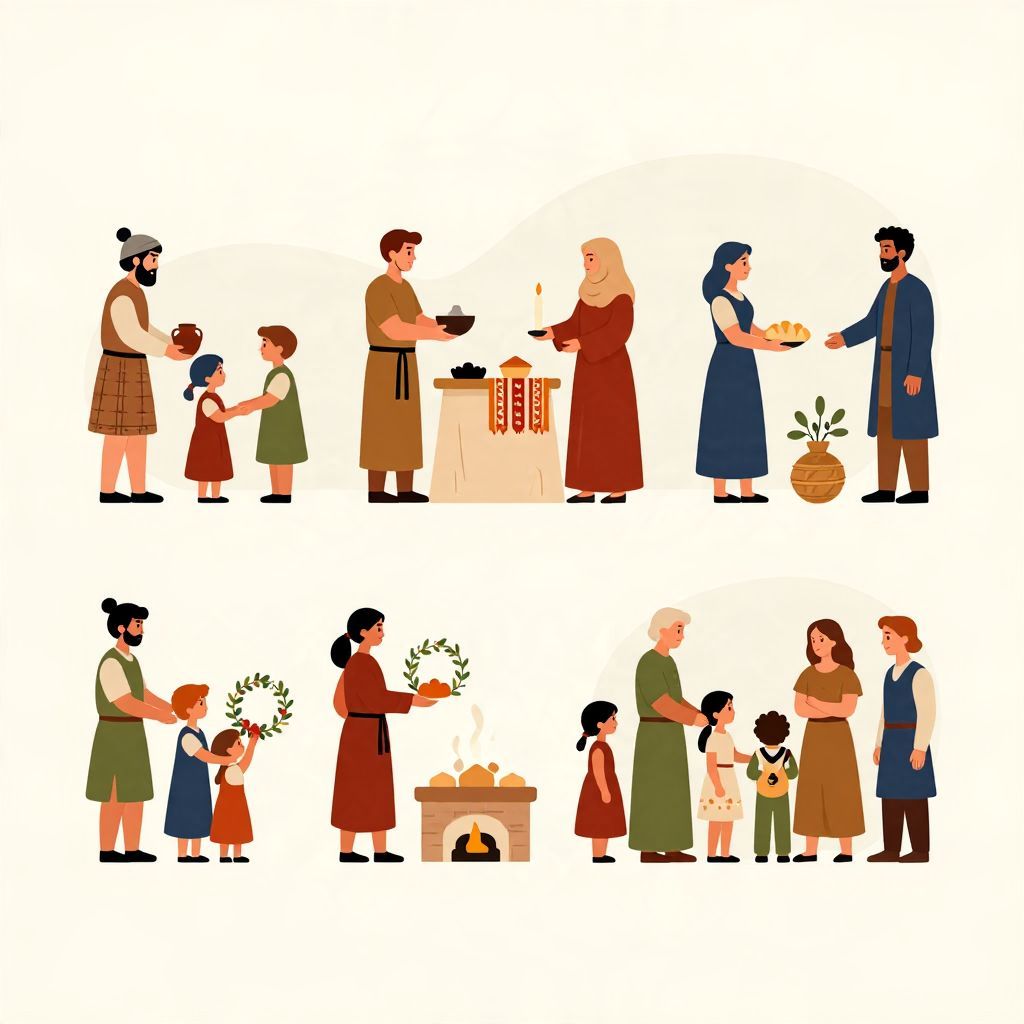
Traditions are the inherited customs, beliefs, and repeated practices that connect people to their past. They can be as formal as religious rituals or as everyday as holiday meals, greetings, or family celebrations. Because traditions are passed from one generation to the next, they help communities remember who they are and what they value.
Historically, traditions have shaped societies for thousands of years. They preserve memory, teach behavior, reinforce identity, and give meaning to life events. But traditions are not frozen in time: they change, adapt, and sometimes disappear as societies evolve.
What Are Traditions?
Traditions are long-established customs or beliefs handed down within families, communities, religions, or nations. They may be written or unwritten, sacred or secular, and they usually gain authority because people repeat them over time. In history, traditions have helped societies organize daily life, mark important moments, and transmit values across generations.
Where Did Traditions Come From?
Traditions did not begin at a single moment. They emerged gradually as early human groups repeated useful or meaningful actions—such as burial rites, seasonal ceremonies, storytelling, and communal feasts. Over time, repetition turned habit into custom, and custom into tradition. Many historians see traditions as one of the oldest ways humans created social continuity before writing existed.
Early Human Societies
In prehistoric societies, traditions likely developed through oral memory and repeated practice. Archaeology suggests that early humans performed rituals around death, food, and group identity long before recorded history. Because these societies left no written explanations, scholars infer traditions from burial sites, cave art, figurines, tools, and settlement patterns. These traces suggest that shared practices helped early communities cooperate and make sense of the world.
Ancient Civilizations
As states and cities emerged in Mesopotamia, Egypt, China, India, and the Mediterranean, traditions became more formalized. Kings, priests, and scribes recorded laws, ceremonies, festivals, and genealogies. Religious calendars and royal rituals gave traditions public authority. In many ancient societies, tradition was closely tied to legitimacy: rulers claimed to preserve ancestral ways, while temples and courts used ceremony to display continuity and order.
Why Do Traditions Matter in History?
Traditions matter because they help societies remember the past, define belonging, and pass on values. They can stabilize communities by creating shared expectations, but they can also exclude outsiders or resist change. Historically, traditions have been both a source of social unity and a tool of power, used to justify authority, inheritance, class, religion, and national identity.
Traditions as Social Memory
Before widespread literacy, traditions were one of the main ways people preserved knowledge. Stories, songs, ceremonies, and repeated customs carried information about ancestors, moral rules, and communal history. Even after writing spread, tradition remained important because many people learned history not from books but from family practice, religious observance, and public ritual.
Traditions and Identity
Traditions often tell people who they are. A wedding custom, a national holiday, or a religious fast can signal membership in a larger group. In empires, kingdoms, and modern nation-states alike, leaders have used tradition to create unity. At the same time, communities under pressure have often defended traditions as a way to preserve distinct identity against conquest, migration, colonization, or assimilation.
How Traditions Changed Over Time
Traditions have never been static. They change when societies migrate, trade, conquer, convert, industrialize, or modernize. Some traditions survive for centuries with only small adjustments; others are invented or reshaped to meet new needs. Historians often stress that “ancient” traditions may be far more recent than people assume, and that even long-standing customs have histories of adaptation.
Religious Traditions
Religious traditions are among the most durable in history. They include rituals, sacred texts, feast days, pilgrimages, dietary rules, and forms of worship. Judaism, Christianity, Islam, Hinduism, Buddhism, and other faiths developed rich traditions that spread across regions and changed as they encountered new languages and cultures. Religious tradition often gave communities a sense of continuity across generations and across vast distances.
Family and Community Traditions
Family traditions tend to be smaller in scale but deeply personal. They include naming patterns, inheritance customs, holiday meals, and rites of passage such as births, coming-of-age ceremonies, marriages, and funerals. In many historical societies, these customs helped families manage property, kinship, and social roles. They also gave ordinary life a rhythm that connected the household to the wider community.
National Traditions
Many national traditions are older than modern nations, but they became especially important in the 18th, 19th, and 20th centuries. As states sought loyalty from diverse populations, they promoted flags, anthems, parades, monuments, and civic holidays. Some of these traditions grew from older local customs; others were deliberately created or standardized to strengthen national feeling.
Traditions in the Medieval and Early Modern Worlds
During the medieval period, traditions were central to religion, law, and social hierarchy. Feudal obligations, coronation ceremonies, guild customs, and church festivals structured life in Europe, while similar patterns of inherited practice shaped societies across Asia, Africa, and the Islamic world. In the early modern era, exploration, empire, and print culture spread traditions across continents and transformed them in the process.
Law, Ceremony, and Authority
Medieval rulers often relied on tradition to legitimize power. Coronations, oaths, and inherited titles signaled lawful succession. Courts and parliaments also developed procedural traditions that made government seem stable and predictable. In many places, customary law remained as important as written law, especially in local communities where precedent mattered more than formal codes.
Trade, Migration, and Cultural Exchange
Trade routes such as the Silk Roads, Indian Ocean networks, and trans-Saharan routes carried more than goods. They also carried festivals, foods, music, clothing styles, and religious practices. Migration and conquest could preserve traditions, blend them, or replace them. As a result, many traditions that seem “local” today are actually products of long historical exchange.
How Scholars Study Traditions
Historians study traditions by combining written sources, oral histories, archaeology, art, and comparative cultural evidence. They ask when a tradition first appears, how it changed, who promoted it, and what purpose it served. This matters because traditions are often treated as timeless even when they were shaped by specific historical circumstances.
Oral Tradition and Written History
Oral tradition is especially important for societies that preserved memory through storytelling rather than writing. Historians use oral accounts carefully, recognizing that they can contain both historical memory and later reinterpretation. Oral tradition may preserve real events, but it can also merge facts with symbolism, moral lessons, and myth. The challenge is not to dismiss oral tradition, but to read it critically.
Invented Traditions
Some traditions are relatively recent creations presented as ancient. Historians call these “invented traditions” when customs are deliberately formalized to create continuity with the past. This does not mean they are fake or meaningless. It means they were often assembled, adapted, or standardized for modern purposes such as nationalism, monarchy, school culture, or public ceremony. Their power comes from the belief that they connect people to something older than themselves.
Examples of Traditions Across History
Traditions appear in nearly every area of life. Some are sacred, some civic, and some practical. A few broad examples show how diverse they can be:
- Religious rituals such as prayer cycles, pilgrimages, fasting, and holy days
- Life-cycle ceremonies such as baptisms, bar mitzvahs, weddings, and funerals
- Seasonal festivals tied to harvests, solstices, or religious calendars
- Family customs such as naming patterns, heirlooms, and holiday gatherings
- National ceremonies such as parades, memorial days, and anthem performances
- Professional traditions such as guild rules, academic regalia, or military customs
Do Traditions Always Stay the Same?
No. Traditions survive because they adapt. A custom may change language, clothing, music, or timing while keeping its symbolic meaning. In some cases, old traditions fade when societies urbanize or secularize. In others, people revive traditions to strengthen identity during crisis or change. Continuity, in historical terms, often comes through adaptation rather than exact repetition.
Tradition and Modern Change
Industrialization, mass schooling, print media, migration, and digital communication all changed the way traditions spread. In the modern world, people can preserve traditions more consciously than ever before, but they can also remix them quickly. A holiday, for example, may combine ancient symbols, commercial practices, and family habits that developed only recently. This layered quality is typical of many traditions.
The Historical Meaning of Tradition Today
Today, the word tradition often suggests something old, respected, and meaningful. Historically, however, traditions are not simply relics of the past. They are living practices created and recreated by people over time. They can preserve memory, express identity, and support community, but they can also be debated, revised, or rejected when they no longer fit changing realities.
So, what are traditions? They are the inherited customs and beliefs that link generations, shape social life, and give continuity to human communities. From ancient rituals to modern national holidays, traditions show how people remember the past while adapting to the present. To explore related ideas, see what is a tradition and what is folk culture.