
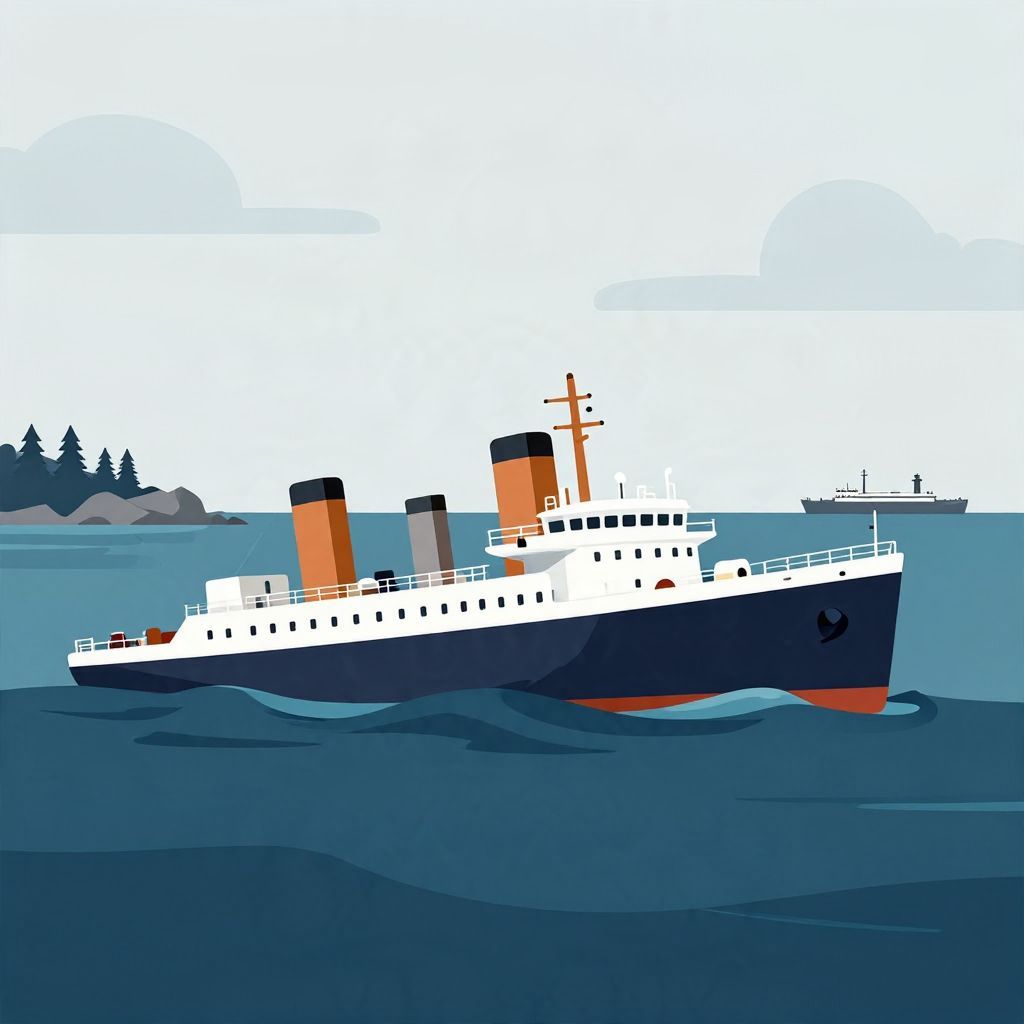
People still ask, “Where did the Edmund Fitzgerald sink?” because the ship’s loss became one of the most famous maritime disasters in North American history. The answer is precise: the SS Edmund Fitzgerald sank in Lake Superior, near the boundary between the United States and Canada, on November 10, 1975.
The wreck lies in deep water off the coast of Michigan’s Upper Peninsula, roughly north of Whitefish Bay and east of the Keweenaw Peninsula. The ship went down during a fierce storm, and the exact circumstances of its final moments remain partly uncertain, which has only deepened public fascination with the event.
Where did the Edmund Fitzgerald sink?
The Edmund Fitzgerald sank in Lake Superior, in the eastern part of the lake near the Michigan-Ontario border, about 17 miles northwest of Whitefish Point. Its wreck rests on the lakebed in very deep water, far below the surface and difficult to inspect directly. The ship went down during a violent November storm in 1975, and all 29 crew members were lost.
The location in plain terms
If you are looking for the place on a map, the sinking occurred in the open waters of Lake Superior, not in a harbor or river mouth. The ship was traveling toward Whitefish Bay when it disappeared from radar and radio contact. Divers and later underwater surveys located the wreck on the bottom of the lake, split into major sections, which confirmed that the ship had broken apart before settling.
Why the exact spot matters
The exact location matters because it helps historians, marine investigators, and the public understand the final phase of the disaster. The wreck’s position shows that the ship was close to shelter but still exposed to the worst of the storm. It also highlights how dangerous the Great Lakes can be, especially in late autumn when weather changes rapidly and waves can become enormous.
What happened to the Edmund Fitzgerald in 1975?
The Edmund Fitzgerald was a 729-foot Great Lakes freighter carrying iron ore from Superior, Wisconsin, to Zug Island near Detroit. On November 9, 1975, it entered a powerful storm on Lake Superior. By the evening of November 10, the ship had vanished. No distress signal was sent that clearly explained what happened, and the wreck was later found in two large pieces on the lake floor.
A ship built for heavy cargo
Launched in 1958, the Edmund Fitzgerald was one of the largest ore carriers on the Great Lakes. It was designed to haul taconite pellets, a processed iron ore used in steelmaking. For years, the ship represented the efficiency and scale of mid-20th-century industrial shipping. Its size made it famous, but size alone did not make it invulnerable to weather, waves, or structural stress.
The storm on Lake Superior
The storm that struck Lake Superior in November 1975 was severe, with high winds, freezing spray, and waves that made navigation extremely difficult. Other ships in the area also struggled. The Fitzgerald was not alone in facing dangerous conditions, but it became the most tragic case. The combination of rough seas, possible damage, and the lake’s notorious cold and depth meant that survival after a major failure was unlikely.
How the sinking unfolded
Because the ship went down in a storm and no crew survived, the final minutes are not fully known. Investigators later pieced together the sequence from radar, radio reports, wreck surveys, and weather data. The most widely accepted view is that the ship suffered catastrophic structural failure, though the precise trigger remains debated.
Timeline of the final voyage
- November 9, 1975: The Edmund Fitzgerald departs Superior, Wisconsin, loaded with iron ore.
- November 10, afternoon: The storm intensifies over Lake Superior.
- Evening: The ship is near the eastern end of the lake, approaching Whitefish Bay.
- About 7:10 p.m.: The Fitzgerald disappears from radar and contact is lost.
- Afterward: Search efforts begin, but no survivors are found.
Why the wreck broke apart
One of the central questions in the disaster is whether the ship broke apart on the surface, partially submerged, or after striking the bottom. The wreck’s condition suggests a violent breakup. Some historians and maritime experts emphasize the role of massive waves and flooding; others point to structural weakness, cargo shift, or damage from grounding. The evidence supports a disaster caused by multiple stresses rather than a single simple failure.
Where is the wreck today?
The wreck of the Edmund Fitzgerald remains on the floor of Lake Superior, in deep, cold water that has helped preserve it. Exact coordinates are known to researchers and authorities, but the site is treated with respect because it is also a gravesite. The ship’s remains are not a tourist attraction in the ordinary sense; they are part of a maritime memorial and a protected historic loss.
Depth and preservation
Lake Superior’s cold freshwater environment slows decay compared with many saltwater wreck sites. That has helped preserve the ship’s structure, though time and pressure have still taken a toll. Underwater surveys have shown that the wreck is broken and scattered in places, reflecting the force of the sinking and the years since 1975.
Memorial significance
For many people around the Great Lakes, the Fitzgerald is more than a shipwreck. It symbolizes the risks faced by sailors who moved the raw materials of American industry. Annual remembrance events, songs, and museum exhibits have kept the story alive. The wreck site itself stands as a reminder that the Great Lakes are inland waters, but they can be as unforgiving as any ocean.
Why the Edmund Fitzgerald became so famous
The sinking of the Edmund Fitzgerald became famous because it combined several powerful elements: a huge modern freighter, a violent storm, the loss of all hands, and a mystery that has never been fully resolved. The disaster also occurred in an era when many people assumed industrial shipping was highly controlled and technologically secure. The Fitzgerald exposed the limits of that confidence.
The role of Gordon Lightfoot’s song
Much of the ship’s lasting fame comes from Gordon Lightfoot’s 1976 song “The Wreck of the Edmund Fitzgerald.” The song is not a historical record in the strict sense, but it brought the disaster to a wide audience and helped turn the event into a cultural memory. Popular memory and historical evidence are not the same thing, yet in this case the song ensured that many people learned the basic facts of the tragedy.
What historians can say with confidence
Historians and maritime researchers can say with confidence that the ship sank in Lake Superior on November 10, 1975, near Whitefish Bay, and that all 29 crew members died. They can also say the storm was severe and that the wreck was later found on the lake bottom. What remains less certain is the exact sequence of mechanical failure, flooding, and breakup that caused the ship to go down.
Historical background: Great Lakes shipping in the 20th century
The Edmund Fitzgerald disaster belongs to a broader history of Great Lakes commerce. For generations, iron ore, coal, grain, and other bulk goods moved through the lakes on large freighters. These ships were essential to the industrial economy of the Midwest. Their crews worked in a demanding environment where weather, ice, and navigation hazards could quickly turn routine transport into an emergency.
Industrial growth and maritime risk
By the mid-20th century, Great Lakes shipping had become highly organized and technologically advanced. Yet the lakes still produced dangerous storms, especially in late fall. The Fitzgerald’s sinking showed that modern design did not eliminate risk. It also led to renewed attention to safety procedures, weather forecasting, emergency communication, and ship construction standards.
Aftermath and lessons
The disaster prompted investigation and debate about lake shipping safety. Questions about hatch covers, structural strength, loading practices, and weather warnings became part of the public discussion. While no single reform can be credited with preventing every future tragedy, the sinking contributed to a stronger awareness of the hazards of Great Lakes navigation. It also left a lasting human legacy through the memory of the 29 men who died.
So, where did the Edmund Fitzgerald sink?
The Edmund Fitzgerald sank in Lake Superior, near the Michigan-Ontario border, close to Whitefish Bay and Whitefish Point, on November 10, 1975. The wreck lies on the lakebed in deep water, and the disaster remains one of the most famous shipwrecks in North American history because of its scale, mystery, and enduring cultural memory.
If you want to place the disaster in a wider historical context, it is useful to compare it with other major events of the 20th century and the year it occurred. You may also find related background in what happened in 1979 and what happened in 1945, which help show how the Fitzgerald fits into the broader modern era of war, industry, and change.