
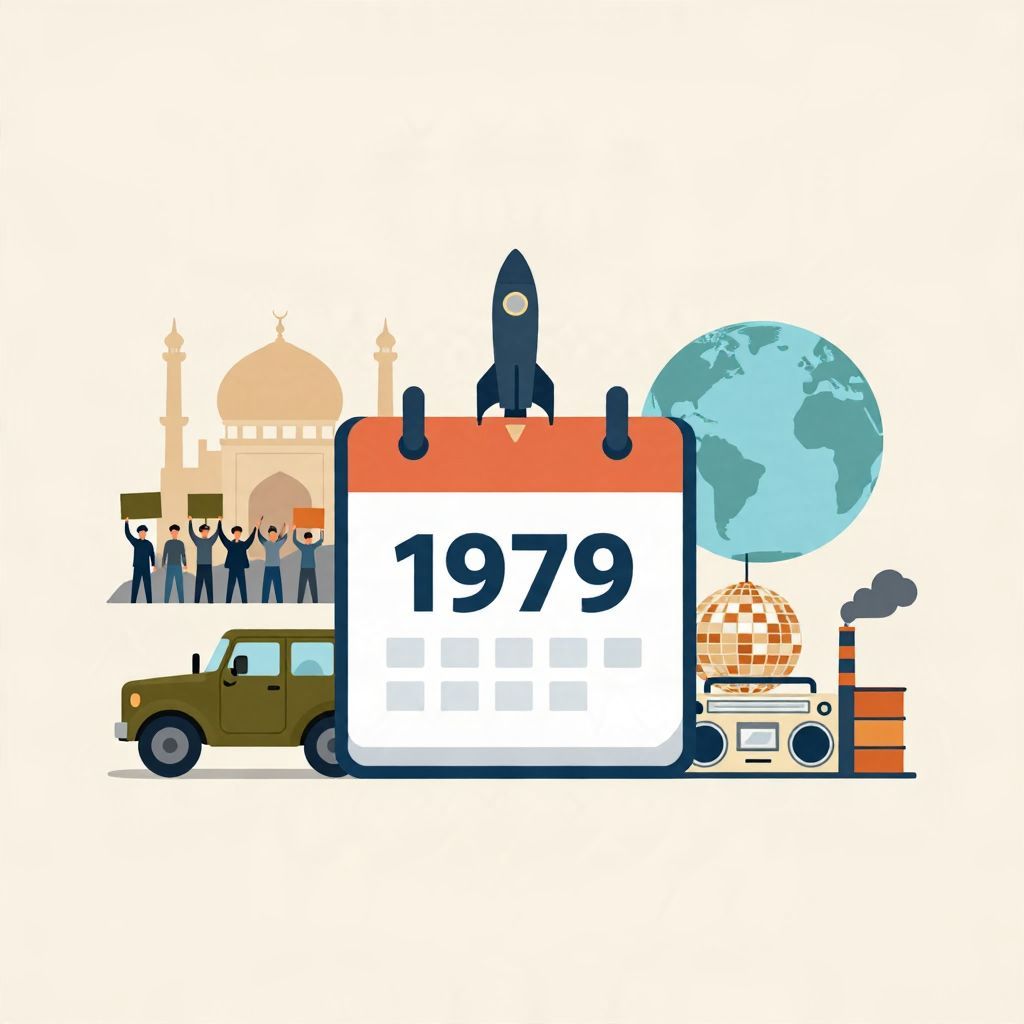
What happened in 1979? In a single year, the world saw revolutions, war, economic upheaval, and major cultural change. It was the year the Cold War sharpened in some places, while new political forces emerged in others, reshaping global politics for decades.
From the Iranian Revolution and the Soviet invasion of Afghanistan to the election of Margaret Thatcher and the Three Mile Island accident, 1979 was a turning point. It also brought the first major AIDS cases to public attention, the launch of the first personal computer era into wider life, and important shifts in music, media, and everyday culture.
What Happened in 1979?
1979 was a watershed year in modern history. The Iranian Revolution overthrew the Shah and created an اسلامی republic, the Soviet Union invaded Afghanistan, and Margaret Thatcher became Britain’s first female prime minister. At the same time, the year exposed new anxieties about nuclear power, global energy, and political instability.
The Major Events of 1979: A Timeline
January to March: Revolution in Iran and a changing world order
One of the defining developments of 1979 was the collapse of the Pahlavi monarchy in Iran. After months of mass protests, strikes, and unrest, Shah Mohammad Reza Pahlavi left the country in January. Ayatollah Ruhollah Khomeini returned from exile in February and became the central figure in the revolution. By April, Iran had formally become an Islamic Republic after a referendum.
This was not just a change of ruler. It transformed Iran’s political system, altered the balance of power in the Middle East, and deeply affected relations between Iran and the United States. The revolution also showed that anti-authoritarian movements could take very different ideological forms, including religious ones.
March to April: Nuclear fear and environmental anxiety
On 28 March 1979, the Three Mile Island nuclear accident in Pennsylvania became the most serious accident in U.S. commercial nuclear power history. Although the release of radiation was limited and no immediate deaths were caused, the event damaged public confidence in nuclear energy and led to stricter regulation.
The accident mattered because it came at a time when many governments were debating energy security after the oil shocks of the 1970s. It helped turn nuclear power into a long-term political issue rather than only a technological one.
May: A new political era in Britain
On 4 May 1979, Margaret Thatcher became prime minister of the United Kingdom after the Conservative Party won the general election. She was the first woman to hold the office. Her victory marked the beginning of a major shift in British politics toward market-oriented economic policies, trade union confrontation, and a more assertive style of government.
Thatcher’s rise was not an isolated event. It reflected wider frustration with inflation, labor unrest, and economic stagnation in Britain and across much of the Western world. Her premiership would become one of the most influential in late 20th-century politics.
November to December: The Iranian hostage crisis and Afghanistan
On 4 November 1979, Iranian militants seized the U.S. Embassy in Tehran and took American diplomats hostage. The crisis lasted 444 days and became a defining moment in U.S.-Iran relations. It also weakened President Jimmy Carter politically and symbolized the collapse of American influence in post-revolutionary Iran.
Then, on 24 December 1979, the Soviet Union invaded Afghanistan. Soviet leaders said they were responding to instability and requests from a friendly government, but many historians see the invasion as an attempt to preserve Soviet influence in a strategically important country. The invasion triggered a long war that drew in Afghan resistance fighters, the United States, Pakistan, Saudi Arabia, and others. It became one of the most consequential Cold War interventions of the era.
Why 1979 Mattered So Much
The year marked a turning point in the Cold War
1979 is often remembered as the year the Cold War entered a more dangerous phase. The Soviet invasion of Afghanistan intensified superpower rivalry in Asia and helped deepen U.S.-Soviet tensions. Meanwhile, the Iranian Revolution removed a key American ally in the Middle East and contributed to a broader sense of instability in global politics.
These events did not end the Cold War, but they changed its geography and tone. The focus shifted increasingly to proxy conflicts, regional crises, and ideological competition in the developing world.
It accelerated political change in the West
The election of Margaret Thatcher in Britain reflected a wider reaction against postwar economic management. Across Europe and North America, many voters and leaders were questioning high inflation, state intervention, and union power. 1979 did not create these debates, but it helped bring them to the center of politics.
In the years that followed, similar arguments shaped policy in the United States and beyond. The late 1970s and early 1980s became associated with deregulation, privatization, and a new emphasis on free-market economics.
It exposed the fragility of modern systems
Three Mile Island reminded the public that advanced technology could fail in ways that were difficult to contain or explain. The accident influenced public opinion far beyond the United States, feeding debates about safety, transparency, and environmental risk.
At the same time, energy insecurity, inflation, and political unrest made many people feel that the postwar order was under strain. 1979 was a year when confidence in institutions weakened in several parts of the world.
Key Events Around the World in 1979
- January: Shah Mohammad Reza Pahlavi leaves Iran amid revolution.
- February: Ayatollah Khomeini returns to Iran from exile.
- March 28: Three Mile Island nuclear accident in Pennsylvania.
- April: Iran becomes an Islamic Republic after a referendum.
- May 4: Margaret Thatcher becomes prime minister of the United Kingdom.
- November 4: U.S. Embassy in Tehran is seized; hostage crisis begins.
- December 24: Soviet Union invades Afghanistan.
Culture, Technology, and Everyday Life in 1979
Popular culture reflected a changing mood
1979 was also a notable year in music, film, and television. Popular culture often mirrored the uncertainty of the time: disco was near its peak, punk and new wave were reshaping music, and audiences were increasingly drawn to sharper, more experimental styles. The cultural landscape of the late 1970s was less optimistic than the early postwar decades, but also more creative and diverse.
In film and television, audiences saw a mix of escapism and anxiety. Science fiction, disaster stories, and gritty urban dramas remained popular, reflecting public fascination with both technology and instability.
Technology was entering a new phase
While 1979 is not remembered for one single invention, it belonged to the early personal computing era. Companies were beginning to bring computers closer to homes and small businesses, setting the stage for the digital transformation of the 1980s. Portable music players and consumer electronics were also changing how people listened, watched, and worked.
These developments were still early, but they mattered. The late 1970s were a bridge between the industrial age and the digital age.
Health and social history also changed
In 1979, doctors and public health officials began noticing unusual patterns of illness that would later be recognized as the early AIDS epidemic. At the time, the disease was not yet understood, but the first medical observations would eventually lead to one of the most significant public health crises of the late 20th century.
This is a reminder that not all historical turning points are immediately obvious. Some are only fully understood in hindsight.
The Deeper Causes Behind 1979’s Turbulence
The legacy of the 1970s
Many of 1979’s events were rooted in earlier developments. The oil shocks of 1973 and 1979-era energy concerns had weakened economic confidence. The Vietnam War and Watergate had reduced trust in government, especially in the United States. In Iran, rapid modernization under the Shah had created social tensions, political repression, and resentment among different groups.
The Soviet invasion of Afghanistan also reflected long-standing Cold War competition and the fragility of communist-aligned regimes in the region. In other words, 1979 was not a random crisis year. It was the moment when several unresolved problems came to a head.
Revolution, reaction, and uncertainty
What unites many of the year’s major events is instability. Revolutionary movements challenged old regimes, governments responded with force or reform, and ordinary people faced economic pressure and political uncertainty. Some outcomes were transformative, like the Iranian Revolution. Others were destabilizing, like the hostage crisis and the Afghan war.
That combination made 1979 feel like a hinge year: the end of one political mood and the beginning of another.
Historical Impact of 1979
The impact of 1979 lasted far beyond the calendar year. The Iranian Revolution reshaped Middle Eastern politics and remains central to regional tensions today. The Soviet invasion of Afghanistan helped set the stage for a decade-long war and contributed to the eventual weakening of Soviet power. Thatcher’s election influenced economic policy far beyond Britain.
Three Mile Island changed how the public viewed nuclear energy, while the early recognition of AIDS foreshadowed a global health emergency. Together, these developments made 1979 one of the most consequential years of the late 20th century.
So, What Should We Remember About 1979?
1979 was a year when the modern world changed direction. Revolutions, elections, accidents, and invasions all revealed how fragile the existing order had become. It was not a year of one event, but of several turning points happening at once. For that reason, historians often treat 1979 as a threshold between the unstable 1970s and the more ideologically defined world of the 1980s.
If you want to see how the consequences of 1979 continued into later decades, you may also find it useful to read about what happened in 1986 and what happened in 1991.