
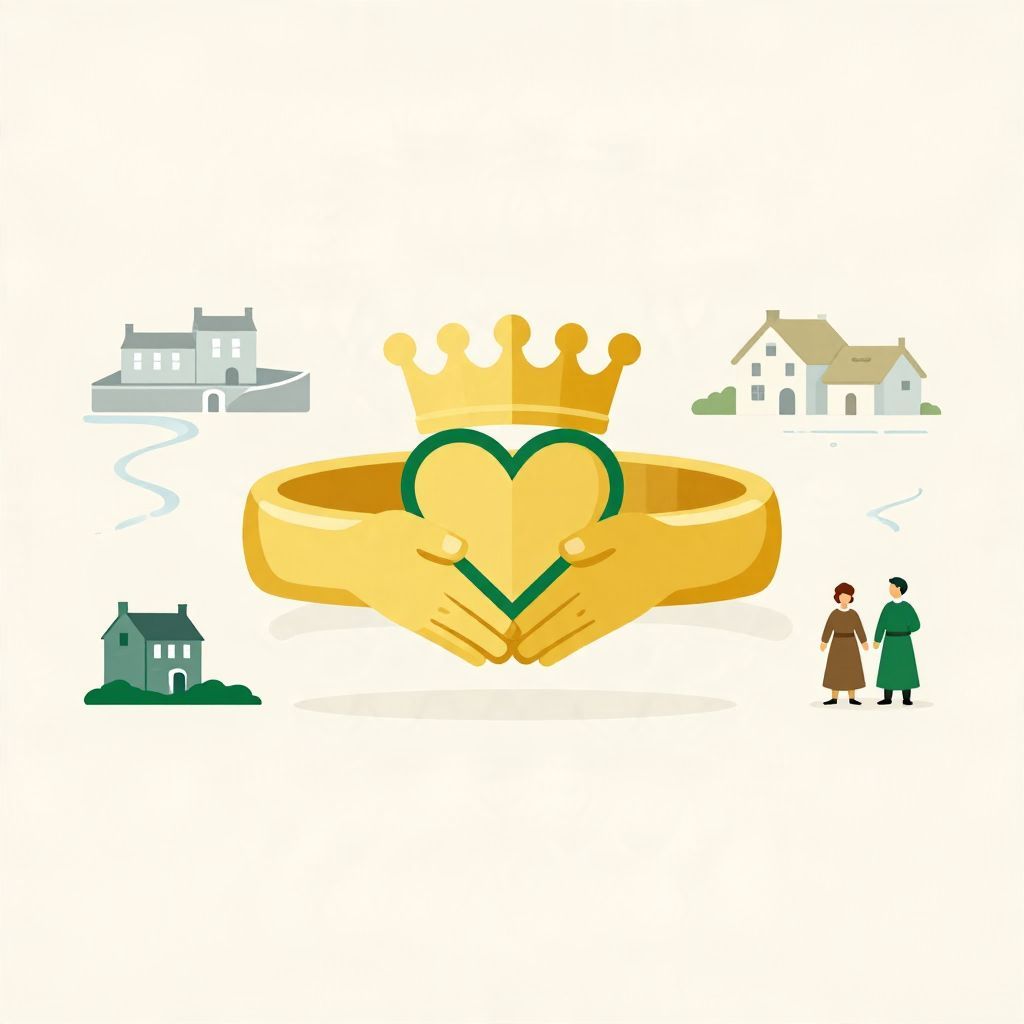
A Claddagh ring is a traditional Irish ring design showing two hands holding a heart topped by a crown. It is usually worn to signal friendship, love, or loyalty, and over time it has become one of the best-known symbols of Irish identity.
Its exact beginnings are partly wrapped in legend, but the ring is strongly associated with the fishing village of Claddagh near Galway and with Irish craftsmanship from the early modern period. Its meaning is simple, yet its history reflects changing ideas about courtship, marriage, status, and heritage.
What Is a Claddagh Ring?
A Claddagh ring is a finger ring with a distinctive motif: two hands clasping a heart, usually crowned. In Irish tradition, the hands represent friendship, the heart love, and the crown loyalty. The design is not ancient in the archaeological sense, but it has deep cultural roots in Ireland and became a lasting emblem of Irishness.
The basic design and symbolism
- Hands = friendship
- Heart = love
- Crown = loyalty
That symbolism is widely repeated today, though it likely became standardized after the ring was already in circulation. Like many folk symbols, the meaning grew stronger as the object itself became more famous.
Where Did the Claddagh Ring Come From?
The Claddagh ring is associated with the Claddagh, a historic fishing community just outside Galway city in western Ireland. Most historians place the ring’s emergence in the 17th or 18th century, though the precise origin is uncertain. The most common historical explanation is that it developed in or around Galway among local goldsmiths and jewelers.
The ring’s name comes from the place, not from a family title or royal decree. “Claddagh” refers to the community where the design became famous, and that local connection is central to its identity. The design may have drawn on broader European ring traditions, but it became distinctly Irish through local use and memory.
Why the origin is hard to pin down
There is no single universally accepted documentary “birth certificate” for the Claddagh ring. Surviving evidence is limited, and much of the early story comes from oral tradition and later retellings. That means historians usually speak cautiously: the ring likely emerged in early modern Ireland, and Galway was its main center of association.
The Legend of Richard Joyce
The best-known story links the Claddagh ring to Richard Joyce, a Galway man said to have been captured by pirates and sold into slavery in North Africa. According to the legend, he learned goldsmithing there, returned to Galway after his release, and created the ring for the woman he loved.
This is a powerful and enduring tale, but it belongs partly to legend. It is often dated to the late 17th century, yet the details cannot be verified with complete certainty. The story matters historically because it helped make the ring meaningful, but it should not be treated as proven fact in every detail.
History and folklore together
Folklore often preserves cultural truth even when it cannot be documented line by line. In the case of the Claddagh ring, the Richard Joyce story gave the ring a romantic origin and tied it to themes of endurance, return, and devotion. Whether or not Joyce was the original maker, the legend helped popularize the design.
How Was the Claddagh Ring Used Historically?
The ring was not simply decorative. In Irish social life, it became a wearable sign of relationship status and personal intention. It could indicate courtship, engagement, marriage, or emotional attachment, depending on how it was worn. That flexibility helped the ring endure across generations.
Traditional ways of wearing it
- Right hand, heart outward: often read as single or open to love
- Right hand, heart inward: often read as in a relationship
- Left hand, heart inward: commonly associated with marriage
These customs are widely known today, though they were not always fixed in exactly the same way in every place or period. The important point is that the ring became a social signal, not just an ornament.
Why Did the Claddagh Ring Become So Popular?
The ring’s popularity grew because it combined several powerful ideas in one small object: affection, fidelity, and local identity. It was easy to recognize, easy to gift, and meaningful in both romantic and familial settings. For emigrants and their descendants, it also became a portable reminder of Irish heritage.
Irish identity and diaspora
As Irish migration expanded in the 18th, 19th, and 20th centuries, the Claddagh ring traveled with it. In places such as Britain, North America, Australia, and beyond, it became a visible marker of Irishness. For some wearers it expressed ancestry; for others it simply represented a cherished relationship or connection to Ireland.
That wider popularity did not erase its local roots. Instead, the ring moved from a regional tradition to a global symbol, much as other cultural objects do when they are carried by migration and memory.
What Does the Claddagh Ring Mean in Historical Context?
Historically, the Claddagh ring reflects the importance of symbolic jewelry in everyday life. In societies where public declarations of affection and social status were often governed by custom, a ring could communicate meaning without words. The Claddagh design made those meanings explicit through its imagery.
More than a love token
Although modern explanations focus heavily on romance, the ring’s symbolism is broader than courtship alone. Friendship and loyalty were equally important in Irish social culture, especially in communities where kinship, neighborhood ties, and trust mattered greatly. The ring’s three-part symbolism helped it speak to all of those values at once.
Its crown also gave the design a sense of dignity and order. In some interpretations, the crown lifts the heart’s emotion into a realm of constancy and honor. That may be a later reading, but it fits the ring’s long-standing emphasis on faithful attachment rather than fleeting passion.
Is the Claddagh Ring Ancient?
No, not in the sense of being medieval or pre-Christian. The Claddagh ring is generally understood as an early modern Irish design, probably appearing in the 17th or 18th century. Its style may echo older European motifs, but the ring itself belongs to a much later historical setting than Ireland’s ancient past.
This distinction matters. Popular culture sometimes treats the ring as if it were an age-old Celtic relic. In reality, its power comes less from extreme antiquity than from the way it gathered meaning over time. It is a historical object with a living tradition, not a prehistoric artifact.
How Did the Claddagh Ring Spread Beyond Galway?
The ring spread through trade, gifting, migration, and the growth of interest in Irish cultural symbols. By the 19th century, it was increasingly recognized outside Galway. Later, as Irish identity became more visible in transnational communities, the ring gained even wider appeal.
From local craft to national emblem
Several factors helped the transition:
- Jewelry makers reproduced the design for a broader market.
- Irish emigrants carried the ring abroad as a keepsake and symbol.
- Writers, collectors, and antiquarians helped frame it as a distinctively Irish tradition.
- Modern tourism and heritage culture reinforced its fame.
By the 20th century, the Claddagh ring had become one of the most recognizable pieces of Irish-themed jewelry in the world.
What Should We Make of the Claddagh Ring Today?
Today, the Claddagh ring sits at the intersection of history, heritage, and personal meaning. Some people wear it because of family tradition, some because of Irish ancestry, and others because they simply appreciate its design and symbolism. Its endurance shows how a local object can become globally meaningful without losing its historical character.
For historians, the ring is a useful example of how material culture works: objects can carry stories, identities, and social rules across generations. The Claddagh ring is not just jewelry. It is a small artifact of Irish history that links craftsmanship, folklore, migration, and love.
In short, a Claddagh ring is a traditional Irish symbol of friendship, love, and loyalty, most closely tied to Galway and early modern Ireland. Its exact origin remains partly uncertain, but its cultural importance is clear. If you are interested in related forms of historical jewelry and status symbols, you may also enjoy reading about what a signet ring is and what a torc is.