
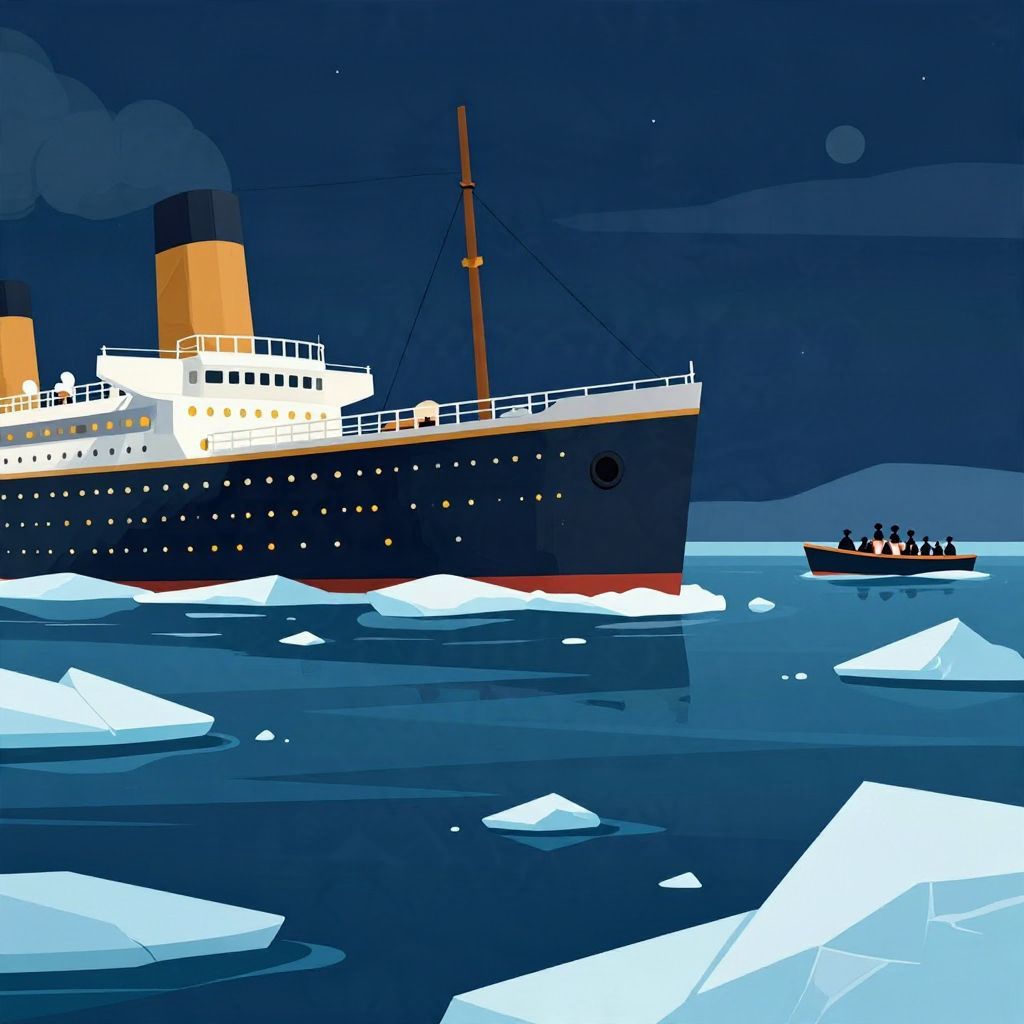
The question “How cold was the water in the Titanic?” usually refers to the North Atlantic water into which the ship’s passengers and crew fell after the liner struck an iceberg on 14 April 1912. The answer matters because the temperature of the sea was a major factor in the disaster’s death toll: even strong swimmers could lose consciousness quickly in near-freezing water.
In practical terms, the water around the Titanic was extremely cold, generally estimated at about 28 to 31°F (-2 to -1°C), close to the freezing point of seawater. That temperature helped turn a shipwreck into a mass-casualty event, making hypothermia a far deadlier threat than the sinking itself for many people in the water.
How cold was the water in the Titanic?
The water was likely around 28 to 31°F (-2 to -1°C), cold enough to cause rapid cold shock, severe loss of muscle control, and hypothermia within minutes. Because seawater freezes below 32°F, the North Atlantic near the Titanic was not ice, but it was close enough to freezing to be lethal very quickly.
Why the exact temperature is approximate
No one measured the sea temperature at the exact moment and spot where the Titanic sank. Historians and marine researchers rely on nearby weather records, ocean conditions, and survivor testimony to estimate it. The commonly cited range reflects the cold Labrador Current and the presence of icebergs in the area, both signs of exceptionally frigid water.
Even a difference of a few degrees mattered. In water near freezing, the body loses heat far faster than in air, and the initial gasp and panic of cold shock can make swimming or holding onto debris extremely difficult. For many people, the sea itself became the immediate killer.
The Titanic disaster and the cold North Atlantic
The Titanic sank in the early hours of 15 April 1912 after colliding with an iceberg late on the night of 14 April. The ship was traveling through the North Atlantic south of Newfoundland, an area known for ice hazards in spring. The sea was calm, but the water temperature was brutally low.
Geographic and seasonal conditions
The sinking occurred in a region influenced by the cold Labrador Current, which carries icy water southward from the Arctic. In April, this current helped create a dangerous mix of icebergs, cold surface water, and poor visibility. The Titanic’s route crossed a zone where ice warnings were common, though the ship still maintained speed for much of the night.
The season also mattered. Early spring in the North Atlantic is not a time of warming seas. The ocean around the wreck site remained cold enough to produce life-threatening exposure within minutes, especially for anyone without protective clothing or immediate rescue.
What cold water did to people in the sea
Near-freezing water does not just make a person feel uncomfortable; it attacks the body in stages. First comes cold shock, then rapid loss of coordination, then hypothermia. In the Titanic disaster, these effects overwhelmed most people in the water long before rescue could reach them.
The stages of exposure
- Cold shock: an involuntary gasp and rapid breathing that can cause panic or inhalation of water.
- Loss of muscle control: hands and legs weaken, making it hard to swim or hold onto floating objects.
- Hypothermia: the body’s core temperature drops, leading to confusion, collapse, and death.
Survivor accounts from the Titanic disaster describe the water as shockingly cold, and the historical record supports that impression. People who entered the sea were often incapacitated within a very short time. Lifeboats that remained nearby could sometimes hear cries for help, but the conditions made rescue slow and difficult.
How long could someone survive in Titanic’s water?
Survival time depended on clothing, body size, movement, and whether a person found flotation support, but in water around freezing, many people would lose effective use of their limbs within minutes. Death could follow shortly after, especially without rescue. The cold was so severe that even strong adults faced a very narrow survival window.
Why some people lasted longer than others
Not everyone experienced the same outcome. Some factors improved survival slightly: heavy clothing could trap a little insulating air, and a person clinging to wreckage or a lifeboat might conserve energy better than someone actively swimming. But the difference was limited. In water this cold, time was measured in minutes, not hours.
This is one reason the Titanic disaster was so deadly despite the presence of lifeboats. The ship did not simply sink; it left hundreds of people exposed to an environment that was almost immediately fatal. The temperature of the sea magnified every delay in rescue.
Why the water temperature mattered historically
The cold water is central to understanding the Titanic not just as a maritime tragedy, but as a historical event that exposed weaknesses in early 20th-century safety practices. The disaster showed that lifeboats, wireless distress calls, and nearby ships were all essential, because survival in the water itself was unlikely.
Impact on maritime safety
After the sinking, investigators and the public focused on the mismatch between the ship’s luxury and the realities of emergency survival. The Titanic carried too few lifeboats for everyone aboard, and the water temperature made that shortage catastrophic. The disaster helped drive reforms in maritime safety, including stronger lifeboat requirements and improved radio watchkeeping.
In that sense, the cold water was not just a detail of the wreck site. It was part of the reason the disaster became one of the most studied shipwrecks in history. The sea conditions turned evacuation failure into mass mortality.
What the historical evidence tells us
Historians are careful about exact numbers, but there is broad agreement on the basic picture. The water was near freezing, the conditions were severe, and exposure in the sea was rapidly fatal. The precise temperature is best treated as an informed estimate rather than a measured fact.
Evidence and uncertainty
We know the Titanic sank in an area affected by cold Arctic water and icebergs. We also know from survivor testimony and later analysis that the sea was extremely cold. What we do not have is a direct thermometer reading from the sinking point at the exact time of the disaster. That is why reputable accounts usually give a range rather than a single exact figure.
This kind of historical uncertainty is normal. For many past events, especially those at sea, scholars must reconstruct conditions from indirect evidence. In the Titanic’s case, the evidence is strong enough to support a clear conclusion: the water was dangerously cold, and that cold was a major cause of death.
Why the Titanic’s water temperature still captures attention
People continue to ask about the water temperature because it helps explain the human scale of the tragedy. The Titanic is often remembered for its size, luxury, and dramatic sinking, but the final moments were shaped by something more basic: the body’s inability to endure the North Atlantic for long.
The cold water also gives the disaster a physical reality that is easy to understand. A ship can be imagined, a collision can be described, but the sea temperature reveals why so many lives were lost even after the evacuation began. It reminds us that history is often decided by environment as much as by engineering or human error.
So, how cold was the water in the Titanic? Very close to freezing—roughly 28 to 31°F (-2 to -1°C)—cold enough to make the North Atlantic itself a lethal part of the disaster. If you want to explore the event further, see also how cold the water was when the Titanic sank and how long it took the Titanic to sink.