
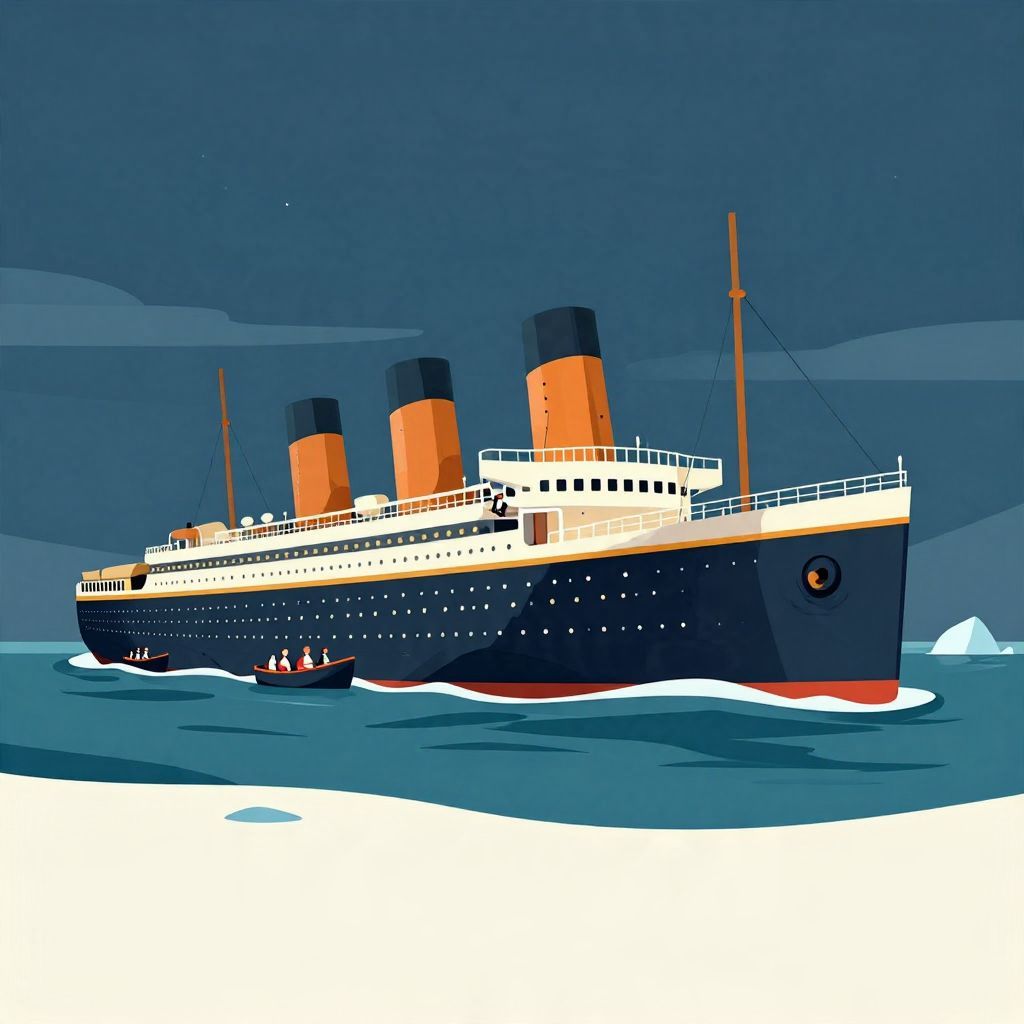
The question “How long did it take the Titanic to sink?” points to one of the most famous maritime disasters in history. The answer is usually given as about two hours and forty minutes, counting from the ship’s collision with an iceberg at 11:40 p.m. on April 14, 1912, to its final plunge beneath the North Atlantic at about 2:20 a.m. on April 15.
That short span mattered enormously. In less than three hours, a modern “unsinkable” liner was lost, and more than 1,500 people died. The timeline of the sinking reveals not just the speed of the disaster, but also the limits of early 20th-century ship design, safety procedures, and emergency response.
How long did it take the Titanic to sink?
The Titanic took about 2 hours and 40 minutes to sink after striking an iceberg on the night of April 14, 1912. The ship hit the iceberg at 11:40 p.m. and disappeared beneath the surface around 2:20 a.m. on April 15. The exact minute is based on survivor testimony and later historical reconstruction, so the figure is an informed estimate rather than a stopwatch-perfect measurement.
The sinking timeline: from iceberg strike to final plunge
The disaster unfolded in stages, not all at once. The collision opened multiple compartments in the bow, and the ship slowly filled with water. At first, many passengers and crew did not realize how serious the damage was. As the night went on, the bow settled lower, the stern rose higher, and the ship’s fate became unavoidable.
Key moments in the disaster
- 11:40 p.m. — Titanic strikes the iceberg.
- Shortly after midnight — Flooding is confirmed in several forward compartments.
- 12:15–12:30 a.m. — Distress calls begin; lifeboats are prepared.
- After 1:00 a.m. — The bow is visibly lower, and evacuation becomes urgent.
- 2:00 a.m. — The ship is near its breaking point; the stern rises sharply.
- About 2:20 a.m. — Titanic breaks apart and sinks completely.
Why did the Titanic sink so fast?
Titanic did not sink instantly because it was a large ship with watertight compartments designed to slow flooding. But the iceberg damage extended along a long section of the starboard side, opening several compartments at once. The ship could survive flooding in only a limited number of compartments; once that limit was exceeded, water gradually overwhelmed the vessel.
Watertight compartments were not enough
Titanic was built with watertight bulkheads, a major safety feature for the time. However, the bulkheads did not extend high enough to keep water from spilling over from one compartment to the next once the bow sank deeper into the sea. In other words, the ship was safer than many earlier liners, but not truly “unsinkable.”
The iceberg damage was extensive
Historians generally agree that the iceberg did not tear a single giant hole in the hull. Instead, it likely caused a series of openings and buckled seams along the side. This kind of damage was especially dangerous because it allowed water to enter multiple compartments simultaneously, making the flooding much harder to contain.
What happened during the sinking?
After the collision, the crew and officers worked to assess the damage and launch lifeboats. Many passengers initially remained calm, not yet understanding the scale of the emergency. As the ship’s angle increased, the evacuation grew more chaotic, especially because there were not enough lifeboats for everyone aboard.
Evacuation and distress signals
Titanic sent distress messages by wireless telegraph, asking nearby ships for assistance. Lifeboats were launched during the night, but many went away only partly filled. This reflected a mix of factors: confusion, disbelief that the ship would actually sink, and the pressure of lowering boats from a tilting deck in darkness.
The final moments
By the last hour, the ship’s stern was lifted dramatically out of the water. The strain on the hull became extreme. At about 2:20 a.m., Titanic broke apart and sank. Survivors in lifeboats described hearing a powerful roar and seeing the ship vanish into the sea. These accounts are among the most haunting in maritime history, though details vary because witnesses observed the event from different distances and angles.
How accurate is the 2 hours and 40 minutes figure?
The commonly cited duration is broadly accepted by historians, but it should be understood as an approximation. The collision time is well documented, and the final sinking time is reconstructed from survivor testimony and later analysis. Small differences in reported minutes do not change the larger historical fact: Titanic remained afloat for less than three hours after impact.
Why the exact minute is debated
Nighttime conditions, the confusion on board, and the fact that many witnesses were in lifeboats or in the water make precise timing difficult. Some accounts suggest slight variations in when the ship finally disappeared, but the standard timeline of 11:40 p.m. to 2:20 a.m. remains the most widely used historical estimate.
The historical significance of Titanic’s sinking
The sinking of the Titanic became a global turning point because it exposed weaknesses in maritime safety and public assumptions about technology. The disaster led to major reforms in ship design, lifeboat requirements, wireless communication, and ice patrols. It also became a lasting symbol of human confidence, class division, and the limits of engineering.
Maritime safety reforms
In the aftermath, governments and shipping authorities pushed for stronger safety standards. The most important changes included more lifeboats, better emergency drills, continuous radio watch, and improved international coordination in icy waters. The tragedy helped inspire the first International Convention for the Safety of Life at Sea, commonly known as SOLAS, in 1914.
Why the disaster still matters
Titanic’s sinking remains important not only because of the loss of life, but because it showed how a modern system can fail when design, procedure, and human judgment all fall short at once. The ship’s rapid sinking also shaped public memory: it was not simply a shipwreck, but a highly visible disaster involving wealth, ambition, class, and the fragility of technological certainty.
Common misconceptions about how Titanic sank
Because the story has been retold so often, several myths have become attached to it. Separating fact from legend helps explain the disaster more clearly.
- Myth: Titanic sank immediately after the iceberg strike.
Fact: It stayed afloat for about 2 hours and 40 minutes. - Myth: The iceberg made one huge gash in the hull.
Fact: The damage was likely a series of openings and buckled seams along the starboard side. - Myth: The ship was truly unsinkable.
Fact: That was a popular claim, but it was never an absolute guarantee. - Myth: Everyone on board knew the ship would sink right away.
Fact: Many passengers did not grasp the danger until much later in the night.
What the timeline tells us
The question “How long did it take the Titanic to sink?” has a simple answer, but the history behind it is more revealing. The ship did not go down in minutes; it sank over a tense, tragic span of nearly three hours, giving crew and passengers time to react, but not enough time to save everyone. That gap between collision and final loss is what makes Titanic’s story so enduring.
If you want to explore the disaster further, you may also be interested in how cold the water was when the Titanic sank and how far down the Titanic rests today.