
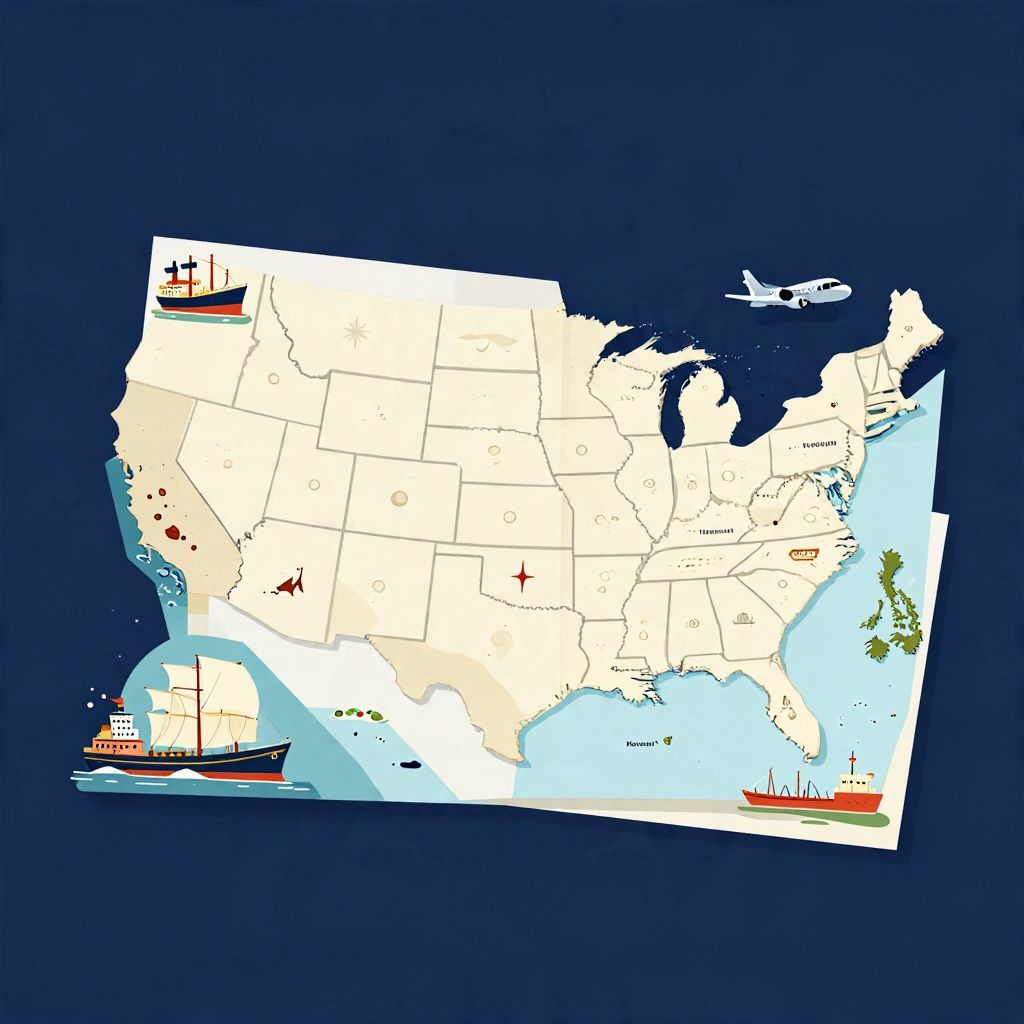
How To Hide An Empire is a history book by Daniel Immerwahr that explains a central but often overlooked fact about the United States: it was, and in some ways still is, an empire. The book argues that U.S. power cannot be understood only through the 50 states, because overseas territories, military bases, and colonial rule shaped American history from the late 19th century onward.
Its story is not just about conquest. It is also about law, citizenship, race, war, economics, and the way Americans chose to remember—or ignore—their imperial past.
What is How to Hide an Empire about?
How to Hide an Empire is a 2019 history of American expansion by Daniel Immerwahr. Its main argument is that the United States built an empire across islands, ports, and strategic territories, but later obscured that fact by folding some places into the nation, excluding others, and treating overseas rule as exceptional rather than central to U.S. history.
Immerwahr’s book covers the Philippines, Puerto Rico, Guam, Hawaiʻi, Alaska, and other territories, showing how American power expanded beyond the continental mainland. He also explains how the U.S. used military force, economic control, and legal distinctions to govern people who were often not granted full citizenship or equal rights.
The origins of the book’s central idea
The title points to a historical puzzle: how could a country that often described itself as anti-colonial become an empire? The answer lies in the period after the Spanish-American War of 1898, when the United States acquired overseas possessions and entered a new era of global power. The book traces how Americans managed this contradiction by hiding empire in plain sight.
Why 1898 matters
Before 1898, the United States had already expanded across North America through settlement, war, and dispossession of Indigenous peoples. But 1898 marked a major shift. After defeating Spain, the U.S. took control of the Philippines, Guam, and Puerto Rico, while also annexing Hawaiʻi. This was the moment when American expansion became unmistakably overseas and imperial in the modern sense.
That change mattered because it forced Americans to confront a difficult question: if the republic was founded on liberty, how could it rule millions of people without granting them the same political rights as citizens in the states?
How did the United States become an empire?
The United States became an empire through a mix of war, annexation, strategic occupation, and legal exception. It did not always call itself an empire, and many Americans preferred words like “territory,” “protectorate,” or “possession.” But the historical reality was imperial rule over lands and peoples outside the mainland.
Key stages of expansion
- Continental expansion in the 18th and 19th centuries, including the Louisiana Purchase and the Mexican-American War.
- Indigenous dispossession, which cleared land for settlement and state-building.
- Overseas acquisition after 1898, especially in the Caribbean and Pacific.
- Military basing and global reach in the 20th century, which extended U.S. influence far beyond formal colonies.
Immerwahr emphasizes that empire was not a side story. It was part of how the United States rose to world power. Industrial growth, naval strategy, and access to markets all encouraged expansion. The book links American empire to broader patterns of modern imperialism rather than treating it as an anomaly.
Timeline of the history behind How to Hide an Empire
The book spans more than a century, but several turning points are especially important. These events show how the United States moved from continental republic to overseas power and then to a state that often preferred invisible forms of control.
Major dates and developments
- 1840s–1860s: Continental expansion accelerates, including Texas annexation, the Mexican Cession, and increasing pressure on Indigenous lands.
- 1898: The Spanish-American War leads to U.S. control of Puerto Rico, Guam, and the Philippines; Hawaiʻi is annexed the same year.
- 1899–1902: The Philippine-American War follows, as Filipino forces resist U.S. rule.
- 1900s–1910s: The U.S. develops a larger imperial system of territorial administration, tariffs, and military presence.
- 1941–1945: World War II intensifies the importance of Pacific territories and military bases.
- 1946: The Philippines becomes independent, though U.S. influence remains strong.
- 1959: Alaska and Hawaiʻi become states, changing how Americans imagine the nation’s geography.
- Late 20th century to present: The U.S. retains territories and a vast global base network, even as many Americans overlook their imperial origins.
Why the book calls empire “hidden”
Immerwahr’s phrase “hide an empire” captures a historical habit: the United States often made imperial rule less visible by separating the mainland from the territories and by treating colonial possession as something temporary, technical, or outside normal national life. Maps, school lessons, and political language all helped reinforce that separation.
Maps and public memory
One of the book’s most memorable themes is cartography. Standard maps of the United States usually center the mainland and minimize or omit Alaska, Hawaiʻi, and overseas territories. That visual habit is not neutral. It teaches viewers to think of the nation as geographically compact, even though American power has long been spread across oceans.
This matters historically because empire often depends on distance. If colonial subjects are far away, and if their lands are not pictured as part of the nation, it becomes easier for the public to ignore their political status.
Territories, citizenship, and unequal rights
A major theme in How to Hide an Empire is the legal inequality built into U.S. territorial rule. People living in colonies and territories were often governed by American law but did not receive the same constitutional protections or political representation as residents of the states.
The “insular cases” and legal ambiguity
In the early 20th century, a series of Supreme Court decisions known as the Insular Cases helped define the constitutional status of the territories. These rulings are controversial because they created a framework in which full constitutional rights did not automatically extend to all U.S.-controlled lands. Historians and legal scholars continue to debate their meaning and legacy, but their effect was to institutionalize unequal status.
That legal structure helped the empire function quietly. It allowed the United States to govern overseas lands without fully incorporating them, making imperial control easier to justify at home.
How war shaped American empire
War is central to the book’s narrative because the United States repeatedly used military force to gain and maintain power. The Spanish-American War opened the door to overseas empire, but later conflicts also reinforced it. Military bases, naval routes, and wartime occupation became tools of long-term influence.
The Philippines as a case study
The Philippines is one of the clearest examples in the book. After Spain ceded the islands to the United States in 1898, many Filipinos expected independence. Instead, they faced a new colonial ruler. The resulting Philippine-American War was brutal and costly, and it revealed that American expansion was not simply benevolent modernization.
Immerwahr uses this case to show that the United States often presented itself as liberating people while simultaneously denying them self-rule. That contradiction is one of the book’s strongest historical insights.
Industrialization, markets, and strategic power
The book also connects empire to industrial growth. By the late 19th century, the United States was becoming a major industrial economy, and industrial power encouraged overseas expansion. Factories needed raw materials, markets, shipping routes, and naval protection. Empire offered access to all of these.
This does not mean industrialization automatically caused imperialism, but the two developments reinforced each other. As the U.S. became richer and more technologically capable, it also became more able to project force abroad. That broader relationship is one reason the book fits well alongside studies of industrialization and imperialism in world history.
What happened after the peak of formal empire?
Formal colonial rule declined in some places, especially after World War II, but the imperial system did not disappear. Instead, it changed shape. The United States increasingly relied on military bases, alliances, economic pressure, and strategic influence rather than direct colonial administration alone.
From colonies to base network
Immerwahr argues that the postwar United States became less visibly colonial but not less imperial. The country maintained a global military footprint that gave it enormous reach. In that sense, the empire became harder to see, not smaller in significance.
This shift helps explain the book’s title. The empire was not destroyed; it was reorganized and obscured.
Why the book matters to history today
How to Hide an Empire matters because it changes how readers understand the United States. Instead of seeing American history as a simple story of liberty, democracy, and continental growth, the book asks readers to reckon with conquest, colonial rule, and unequal citizenship. That broader view makes U.S. history more accurate and more global.
The book has also shaped public discussion about territories such as Puerto Rico and Guam, where questions of political status, disaster response, and representation remain unresolved. By placing these places at the center rather than the margins, Immerwahr challenges a long habit of forgetting.
Legacy of the book and its historical argument
The legacy of How to Hide an Empire lies in its ability to reframe familiar history. It does not claim that the United States was identical to older European empires, but it does argue that American exceptionalism has often hidden imperial realities. That is a significant historical correction.
For students and general readers, the book offers two important lessons. First, empires are not always announced as such; they are often normalized through law, maps, and language. Second, the history of the United States is incomplete if it ends at the shoreline of the mainland.
In the end, How to Hide an Empire is both a history book and a warning: nations can conceal power by making it look ordinary. To understand the American past fully, readers need to look beyond the 50 states and into the territories, wars, and legal structures that made empire possible. For related context, see how industrialization led to imperialism and what the largest empire in history was.